This article appeared in The American Baptist magazine in May 1973 to report a seminar on “Homosexuality and the ABC.”
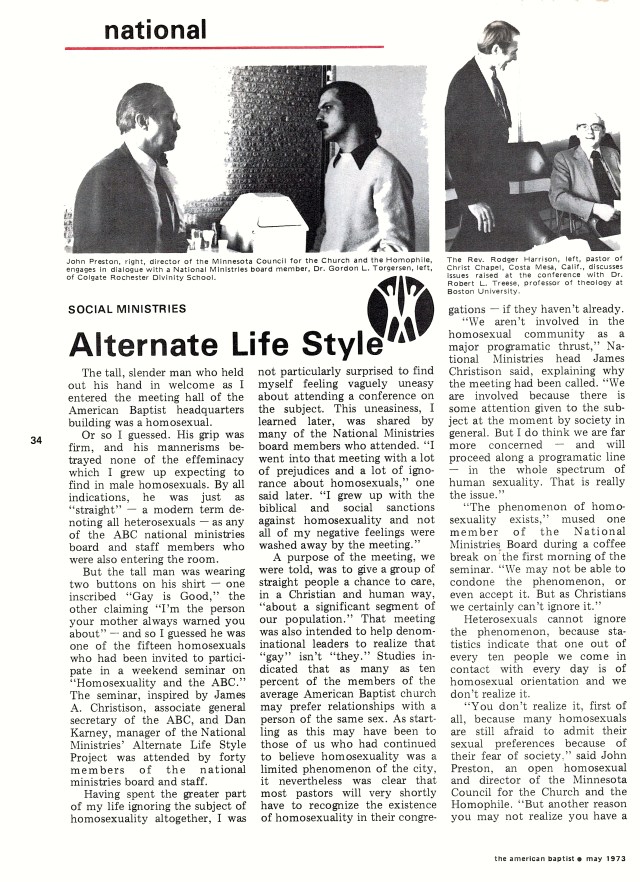

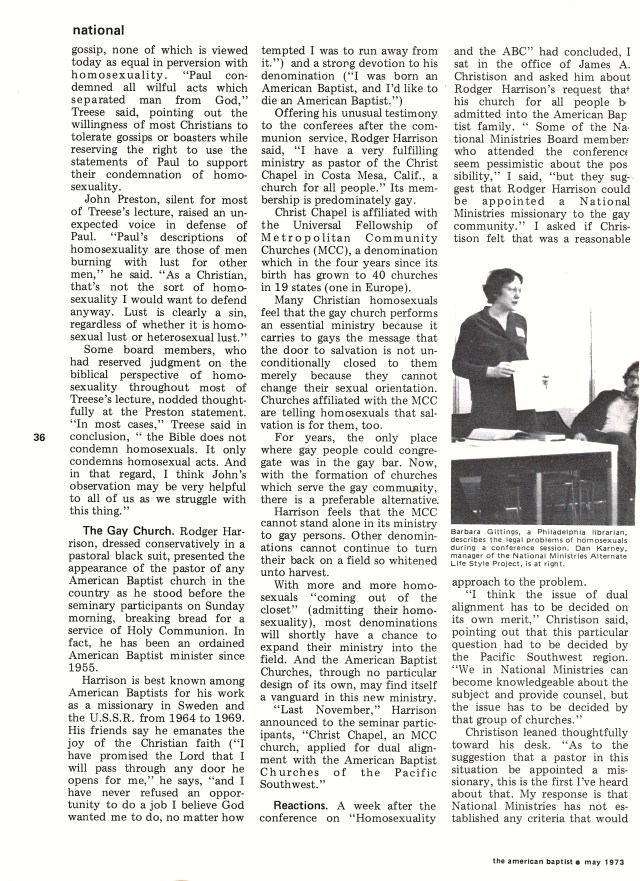
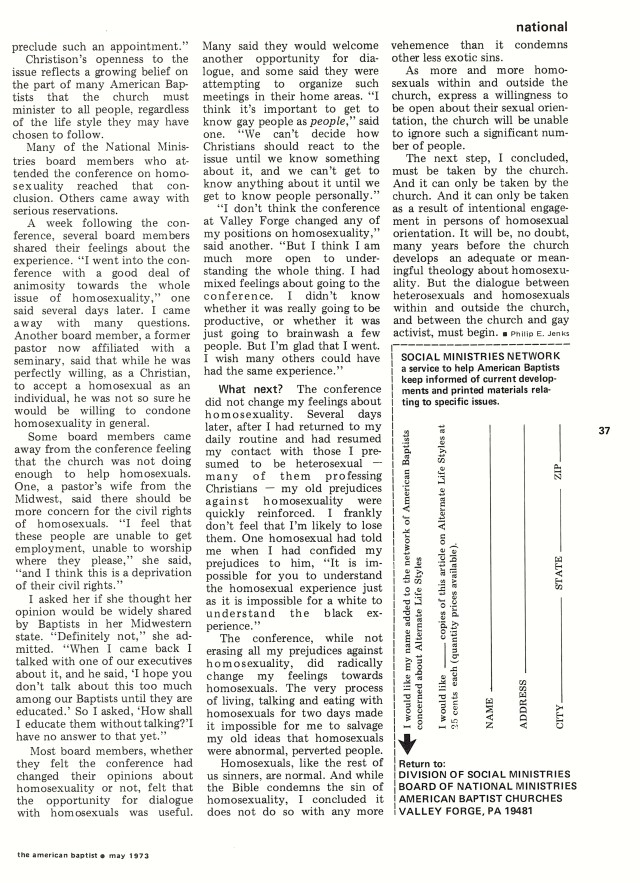


This article appeared in The American Baptist magazine in May 1973 to report a seminar on “Homosexuality and the ABC.”

January 24, 2019 – Winston Churchill’s death 54 years ago today marks a week of vivid personal memories.
Sir Winston died as I was preparing to leave home for a three-year Air Force posting at RAF Stations Bentwaters and Woodbridge in England’s bucolic Suffolk. I was already homesick when I climbed aboard a Boeing 707 at New York’s John F. Kennedy airport en route to London’s Heathrow.
My orders called for me to check in at Douglas House, a military hostel in the heart of London, where I would receive instructions for travel to the bases. I climbed into a luxurious London cab and gave the driver the directions recorded on my mimeographed orders.
The driver, wearing a wool cap and a frayed tweed jacket with shirt and tie, said, “Right-O, Mate.” He took me past Buckingham Palace, where the Union Jack was lowered in Churchill’s honor but the royal standard was at full staff. The driver was apologetic. “The Queen ain’t no better than you nor me, but she can’t lower her flag for Winnie, he warnt a peer.” Later I was told the royal standard is only lowered for the death of the sovereign.
I made my way to RAF Bentwaters on Saturday, the day of Churchill’s funeral. Ray Williams, the NCO in charge of the chapel where I would work, invited me to his family quarters on Woodbridge base, where we watched the funeral procession on a black-and-white telly. We listened respectfully as the BBC broadcast the voice of former U.S. President Dwight D. Eisenhower, who referred to my “old friend Winston.”
I was 18 and let it all flow over me. As time went on I began to wonder if Ike and Winston were really friends or did they constantly annoy each other by their differing views on the conduct of the war?
But on the day of Churchill’s funeral, my first full day so far away from home, I found comfort in Ike’s homely Kansas resonance.
Fifty-four years ago this week, Harold Wilson’s Labour government gave Sir Winston a funeral worthy of the savior of the nation.
But I wonder if some Brits also looked back upon him with mixed feelings. There is no question Sir Winston’s indomitable courage and soaring eloquence galvanized his people in their finest hour. Still, nothing was said during his funeral about his fierce imperialism and stunningly racist views, or his glorification of violence and war.
Even so, I found it an honor to be present in England as the Commonwealth said farewell to this towering figure Time magazine dubbed the Man of the Half Century.
And today I adapt an old admonition from Britain’s days of war: Keep Calm and marvel that you can remember 54-year-old events as if they are frozen in time.

John F. Kennedy had been dead 13 years by the time the first of our six adult children was born. By the time they cracked their first high school history book, JFK had long since passed from flesh to myth. He had become a two-dimensional icon along with Washington and Lincoln and Roosevelt, and his passing was notable primarily because it was one of four presidential assassinations that had to be memorized.
For me, John F. Kennedy’s presidency and his sudden passing were intensely personal events – “the semicolon,” as one writer put it, “of my life.” Boomers will know what I mean when I say everything was different after JFK died. Hope, idealism, and a respect for authority, all dimmed. J. Patrick Moynihan remembered a conversation with journalist Mary McGrory after the assassination. “We’ll never laugh again,” McGrory said through her tears. “Heavens, Mary, we will laugh again,” Moynihan replied. “It’s just that we’ll never be young again.”
I was 17 when JFK died and I did laugh again but the character of my youth changed. Before November 22, 1963, I enjoyed the protection of a close-knit family in a village that provided predictable comfort in a safe middle class cocoon. After that, my youthful optimism was modulated by the realization that horrible things could happen without notice and beyond reason.
My children always observed, if not always with understanding, that the anniversary of Kennedy’s death was a day of mourning for me. They respected that although, I suspect, it would have made as much sense to them to shed tears on the death dates of James Garfield or William McKinley.
And we have learned a lot about JFK in the 55 years since he died, including his chronic womanizing, his painstaking deceptions to hide his poor health, and his patrician inability to fully comprehend what it was like to be poor or a person of color in America. As Professor David Greenberg wrote this week in Politico on the death of former President George H.W. Bush, respect for the dead must coexist with the historical record.
Last week my 12-year-old grandson watched an episode of a television series devoted to museums and science. This particular program examined the logistics and physics of the Kennedy assassination to determine whether he was shot by more than one gunman. The program included a clip from the Zapruder film, which is not family viewing.
“He was very upset by it,” my daughter said. “He said he had no idea what it had been like, ‘but there was all this blood everywhere.’”
Indeed, this vivid Super8mm film of the president’s head exploding is one of the ghastlier artifacts of U.S. history and no child should have to see it (not withstanding the fact that it can be instantly Googled). The rosy Camelot myth of JFK is charming and endearing; the harsh reality not so much. But I will always be charmed by the myth.
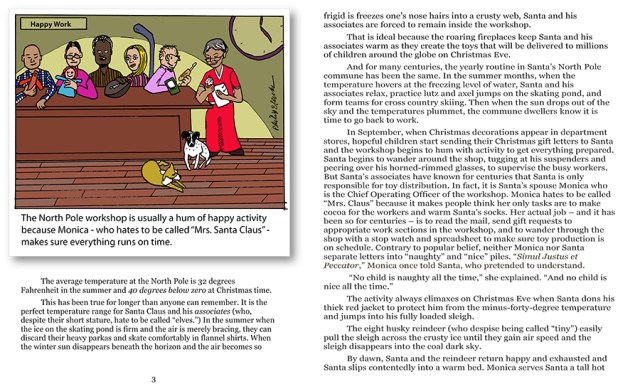
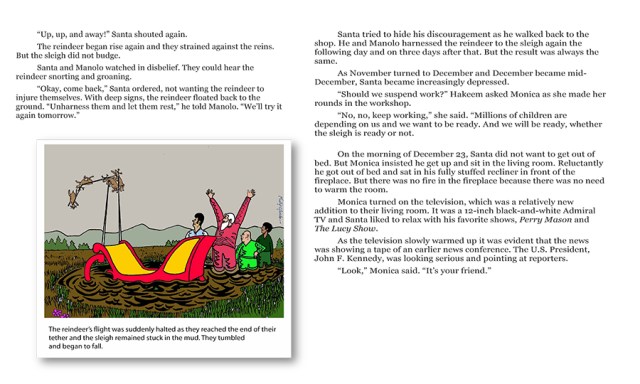
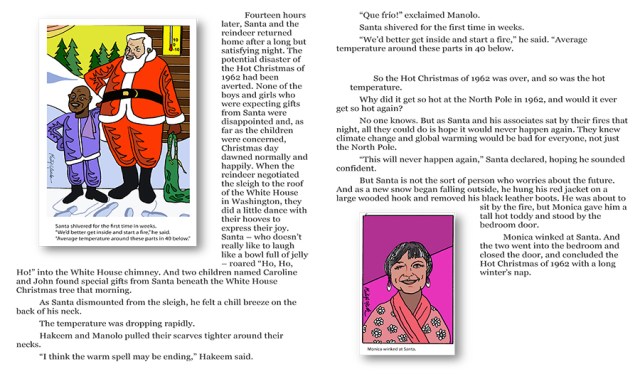
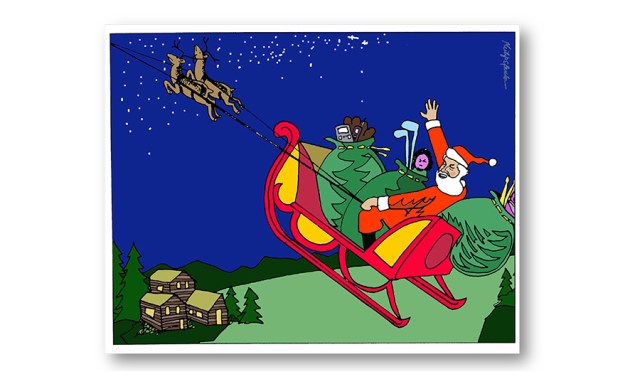
For the past several weeks I’ve been working on a small children’s book for our five grandchildren, The Hot Christmas of 1962. It’s a fanciful story about how Christmas was threatened by global warming until it was rescued by two equally mythological figures: Santa Claus and John F. Kennedy.
Without reopening the debate about the reality of Santa Claus (Yes, Virginia), I will freely admit that there was no such person as the John F. Kennedy of myth.
But when I look back on my own youth, I very much wish that the mythical JFK still walked among us.
And for a few brief moments, in The Hot Christmas of 1962, he does.
And I’ll leave it to my grandchildren to decide whether any of it is real.
For my grandchildren and the children in your life, a story about two mythological figures – Santa Claus and John F. Kennedy – and how they saved Christmas from an early episode of climate change.






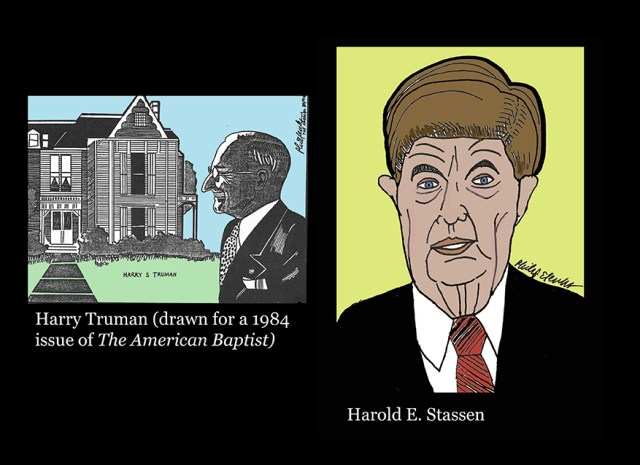
President Harry S Truman and Governor Harold E. Stassen were divided by party lines, but they had more in common than either would have admitted.
Both ordered the racial integration of armed forces under their command, in Truman’s case all branches of the service in 1948 and in Stassen’s case the Minnesota National Guard when he was governor of the state 1939-1943.
Both ran for president of the United States in 1948. Truman was successful and Stassen lost the Republican nomination to Thomas E. Dewey.
And both made a major impact on Baptist history. In 1984 I wrote an editorial about Truman’s centennial in The American Baptist magazine.
(Truman) was never a candidate for a cross and crown pin for perfect attendance, and if he couldn’t bring himself to darken the door of his church every week, his reasoning was familiar enough: “Lot of hypocrites in church,” he observed.
It has also been rumored that he argued with his pastors from time to time. There is a legend that when he announced his intention to appoint General Mark Clark as U.S. ambassador to the Vatican, he showed up for worship at Washington’s First Baptist Church and heard his pastor, Edward H. Pruden, denounce his move as unconstitutional. Mr. Truman never worshiped at First Baptist again. (Like all rumors, this one has more than one interpretation. Dr. Pruden said Mr. Truman had told him that he was not avoiding church because of the sermon; the president had been a recent target of an assassination attempt by Puerto Rican nationalists and he had been advised to stay away from church for security reasons.)
Harry Truman had more than one difference of opinion with his fellow Baptists. His frequent habit of downing a “slight libation” of hard liquor and his love of cards (poker was his game) would have placed him at odds with many (but by no means all) Baptists. And although he was fond of preaching from the Bible, and did so on several occasions, his tendency to “give ‘em hell” did not always have a theological context. His plainspoken, often profane language bothered some of his friends as well as his critics. Mr. Truman once telephoned fellow Baptist Brooks Hays to express his condolences on Hays’s defeat in his bid for reelection to Congress. “Mr. President you’ve taken a lot of heat, I guess I can too,” Hays remembered saying. “No, Brooks, it’s different with me,” Truman replied, “I can cuss, and you can’t.”
In the 1960s and 1970s, Harold Stassen and his wife Esther lived across the street from the American Baptist offices in King of Prussia, Pa. He had a law office in Philadelphia, which I visited in 1969 along with two other students from Eastern Baptist College. We had asked Stassen for an interview for Eastern’s student newspaper, The Spotlight, and he was a gracious host.
We sat in a board room and listened with awe to his reminiscences about people he had known, ranging from 1940 GOP presidential nominee Wendell Wilkie to Joseph Stalin (“Stalin had very little understanding of democracy,” Stassen said with Minnesota understatement). We talked for over an hour and it never occurred to us students how much that time was worth to an international lawyer.
On the way out, I noticed a crude oil painting of Abraham Lincoln on the wall of his office. Thinking it might have been painted by one of his grandchildren, I asked about it. “Yes, Ike painted that for me,” Stassen said. I refrained from further comment.
I encountered Stassen several times during my tenure on the American Baptist communication staff. He would stop by the offices for various meetings. The older staff felt comfortable calling him “Harold,” but I always called him Governor.
Occasionally he would call my office. This was when Johnny Carson and other talk show hosts were renewing Stassen’s national fame by joking about his chronic pursuit of the presidency, so I had to warn the receptionist that if someone called saying he was Harold Stassen, it was probably really Harold Stassen.
It was true that Stassen ran for president every four years when he had no chance of winning the Republican nomination, and a lot of people thought that was amusing. I once asked his son Glen, a prominent Baptist theologian, about his father’s ambitions. “Look, he’s an international lawyer,” Glen said. “I imagine he has clients who are impressed by the fact he’s a presidential candidate. And at least he’s not chasing after women.”*
In the fall of 1972, Harry Truman lay dying in a hospital in Kansas City, Mo. I knew American Baptists would be issuing a statement when Truman died, and it occurred to me that there was no better person to do that than Harold Stassen. If history had unraveled differently, Stassen and Truman might have opposed each other in the 1948 presidential campaign, and I knew they had a lot in common as Baptist politicians. In early December when medical bulletins revealed the gravity of Truman’s condition, I called Stassen and asked if he’d be willing to write a statement.
“Sure,” he said. “I’ll write something and bring it by.”
Later that day Stassen placed a sheet of yellow legal paper with a scribbled note on the receptionist’s desk at the American Baptist offices. I typed it twice, once as a separate statement to read to news outlets when Truman died, and once as a part of a general release that would be mailed by American Baptist News Service. As Truman’s condition continued to deteriorate, I waited.
And waited. Days passed and Truman clung to life. When the holidays approached I took the releases home with me. And waited.
Christmas came and went and still Truman lived. Or so I thought.
I was awakened by a phone call on December 26. It was Stassen.
“Phil,” he shouted in his rumbling baritone. “Where’s the darn release?”
I quickly turned on the television and saw that Harry Truman had died during the night. I told the governor it was “on its way,” and I started calling the Associated Press and other news outlets to read Stassen’s statement to them. (That’s the way it was done in dark ages before email). The statement became part of the evening news cycle and I breathed a sigh of relief.
Over his long life American Baptists frequently honored Harold Stassen. He received the Edwin T. Dahlberg Peace Award in 1972, an honor named for another great Baptist. Stassen gratefully accepted with an eloquent speech, which he had scribbled in pencil on a sheet of a yellow legal pad. When he finished, I discretely stuffed the speech in my brief case to preserve as a historic document. For years I kept the speech in a special file in the communications offices but lost track of it when I left the Baptists in 1991. I hope it still exists somewhere.
When Stassen died in 2001 at the age of 93, several news outlets observed that his protracted pursuit of the presidency had caused many to underestimate him. He had also been a signatory of the United Nations charter, president of the University of Pennsylvania, and president of the American Baptist Churches in the USA. He received the Legion of Merit for his Navy service in World War II, and he served President Dwight D. Eisenhower in cabinet level appointments.
So far as I can tell, he only made two glaring errors in his life.
One was in 1948 when he confronted Thomas E. Dewey in a televised debate over whether the Communist party should be outlawed in the United States. Stassen – perhaps fawning to prevailing public opinion – said the party should be outlawed. Dewey said that, as despicable as the Communists may be, the Constitution forbade that kind of flagrant interference in democracy. Stassen never recovered in the polls from that philosophical misstep. Had he handled it better, he might have been president of the United States.
The other error was a god-awful toupee that he plopped on his head late in life. It was the most unrealistic looking toupee I have ever seen and it looked like a comatose possum.
“I have a very high forehead,” Stassen explained, and he didn’t like the way his bald pate looked on television.
The problem is, there were tens of thousands of news photographs – including a cover of TIME magazine – that showed the high forehead intact. Everyone knew that and, in my opinion, the toupee made him look vain and clownish, I think it contributed to his undeserved image as a comical figure.
But I have long since made my peace with the reality that it was a national misfortune that Harold Stassen was never president of the United States.
And I have also tried to accept the excuse of Stassen’s friend and fellow Baptist Brooks Hays, who also bought an ugly toupee in his later years:
“What God has not wrought,” Brooks explained, “I went out and bought.”
________

The concept of Mary as the Untier of Knots was well known in the 17th and 18th centuries and is best memorialized by a 1700 painting by Johann Georg Melchior Schmidtner.
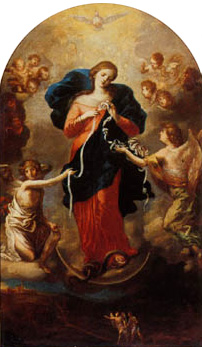 Jorge Mario Bergoglio, now Pope Francis, saw Schmidtner’s painting in the Church of St. Peter am Periach in Augsburg when he was a student in Germany.
When Bergoglio became responsible for protecting the lives of Jesuit priests who were opposing the brutal dictatorship in Argentina, he struggled with conflicting imperatives of justice and safety.
According to tradition, a nun reminded him of the solace of the Untier of Knots, and as Cardinal in Argentina he promoted her veneration throughout Latin America.
 | Frank Vee on … |
| Frank Vee on Mayflower |
| Frank Vee on All We Are Saying is |
| Frank Vee on Bulletin art for September… |
| Frank Vee on Bulletin art for September… |