

NOTE: This is an expansion and update of my previous essays on Jimmy Carter.
August 28, 2019 – Jimmy Carter, now in his 94th year, has been out of office longer than any millennial has been alive.
That makes him extraneous to the majority of living Americans. Even those who remember his presidency dismiss him as a fleeting peculiarity between Watergate and Reagan.
Yet those of us with long memories suspect Carter’s political setbacks were not only due to factors beyond his control but exacerbated by a press that didn’t always get the story right.
Nicholas Kristof suggests the press owes Carter an apology. Recalling the media’s merciless exaggeration of a non-incident – Carter’s alleged encounter with a wild-eyed rabbit that attacked his rowboat – Kristof writes,
“One of our worst traits in journalism is that when we have a narrative in our minds, we often plug in anecdotes that confirm it. Thus we managed to portray President Gerald Ford, a first-rate athlete, as a klutz. And we used a distraught rabbit to confirm the narrative of Carter as a lightweight cowed by anything that came along.”
Lost in the narrative is the image of Carter as an assertive leader who championed civil rights, pressed for human rights around the world, stared down Begin and Arafat, sought international peace, and always tried to do the right thing.
It was that latter trait, some say, that did him in, not only in the press but also in the darker halls of government.
Miles Copeland, a CIA functionary, complained in a 1990 interview with Robert Parry that “Carter was a Utopian. He believed, honestly, that you must do the right thing and take your chance on the consequences. He told me that. He literally believed that.” Parry later recalled that “Copeland’s deep Southern accent spit out the words with a mixture of amazement and disgust.”
There is a dubious conspiracy theory that the CIA and its media cohorts worked hard to damage Carter’s reputation and assure his defeat in the 1980 election. The theory is interesting but doesn’t give due credit to Ronald Reagan, the best presidential campaigner since Franklin Roosevelt.
There are many reasons Carter lost the election of 1980 (including the one cited by George McGovern to explain his disastrous defeat in 1972: “Lack of votes”).
But it is good to see Carter’s reputation slowly restored by journalists and historians, including Kristof and Randall Balmer, whose astute Redeemer, the Life of Jimmy Carter, places Carter in the venerable American tradition of progressive evangelicalism.
It is that tradition, in fact, that first attracted me to Jimmy Carter. I followed his 1976 campaign with interest, and one of my most vivid memories is watching his speech accepting the Democratic nomination that July. Not that the speech was a great one but it took place in the week hours of the morning, and my four-month old daughter Lauren sat wide-eyed on my lap as we watched it. Lauren was a baby who enjoyed the night time, and even Carter’s rhythmic drone could not put her to sleep. As Carter spoke she bounced happily on my lap and studied the flickering black-and-white screen with wide-open dark brown eyes.
Carter did utter some nice phrases that night:
“We can have an America that encourages and takes pride in our ethnic diversity, our religious diversity, our cultural diversity, knowing that out of this pluralistic heritage has come the strength and the vitality and the creativity that has made us great and will keep us great …
“And we can have an America which harnesses the idealism of the student, the compassion of a nurse or the social worker, the determination of a farmer, the wisdom of a teacher, the practicality of the business leader, the experience of the senior citizen, and the hope of a laborer to build a better life for us all!”
Because he was a famously born-again Baptist, Carter’s presidency was a heady period for Baptists north and south. He regularly worshipped at Washington’s First Baptist Church and most Sundays he taught the adult Sunday school class. Many of my Baptist colleagues rushed to attend the class and returned with highly public anecdotes about their private conversations with the president. One story was that a Baptist executive who taught the class on alternate Sundays was called out of town at the last minute. He called the White House and told Carter, “Mr. President, I just can’t be there Sunday.” Carter replied, “That’s okay, I’ll teach the class. I know you’re busy.” The story is probably not apocryphal.
I was among those Baptists who thought it would be advantageous to meet him. As it turned out, my first encounter was a bit of a misadventure.
In 1977 I was 32 years old and editor of The American Baptist magazine, the official organ of American Baptist Churches in the USA. The magazine itself founded in 1803 and billing itself as “the oldest religious periodical with continuous publication in the western hemisphere,” had gravitas. I had no such thing, and I was eager to be seen engaging the president of the United States in Baptist small talk.
That year President Carter signed treaties to turn the Panama Canal over to Panama. Barry Goldwater and Ronald Reagan called upon the Senate to reject the treaties, but John Wayne was for the agreements, and Carter should have known that the Duke trumped a Goldwater and Reagan in any game. But he launched a public relations campaign to win popular support for the treaties, and he invited many maxi- and mini-molders of public opinion to the White House to make his case.
Among the mini-molders were religious journalists who went to the White House to hear the president make his case. A couple hundred journalists came from every religious tradition and we shuffled respectfully into the East Room where rows of folding chairs had been placed.
I had never been to the White House and I prepared carefully for the occasion. I bought a new tan suit and new earth shoes that not only squeaked on the shiny floor but also had unusually low heels that kept me off balance. I carried in my side pocket a copy of Input, the newsletter for American Baptist professional leaders, which published a statement of American Baptist support for the treaties. I wanted to give the statement to the president so I strategically chose a chair near Jim Wall, editor of The Christian Century. Jim, a Georgian, was known to be a friend of Carter’s and I calculated the president would probably notice him in the chairs.
At the appointed hour, a shrill voice called out, “Ladies and Gentlemen the president of the United States.” We stood, and Jimmy Carter strode purposefully into the room. His face was faintly marred with small pink blotches and was dressed in a light-gray plaid double knit suit. He flashed his familiar smile as he headed for the podium. Ambassador Ellsworth Bunker, who was charged with giving the treaties diplomatic heft, and National Security Advisor Zbigniew Brzezinski, flanked him. Bunker, tall and glum, and Brzezinski, with his trademark cowlick, seemed resigned and weary, as if their silent support had been required for more than one presidential briefing.
Carter spoke briefly on the moral obligation and legal logic of the treaties, and stepped away from the podium. The crowd stood at once and we began pressing toward the president, hoping to catch his eye. Jimmy Carter is warm and nearly charismatic when he is pressing the flesh, an attribute never captured on television. He grabbed hands and spoke easily to African American pastors, lavishly dressed bishops, bearded rabbis in black suits, and Baptist editors in white belts and double knit pants. I heard Carter say, “Hi, Jim,” to Wall as I squeezed among the clerics.
I worked my way behind the president’s back as he shook hands with a purple-vested bishop and I reached into my pocket for the copy of Input. Behind me was my friend William Dudde, a Lutheran writer, and behind Bill was an unknown admirer pushing eagerly forward. The admirer thrust himself against Bill, who lost his balance and pushed heavily against me. I lost my footing in my new earth shoes and fell rudely against the president’s back. I smelled his soap and hairspray.
Both Carter and the Secret Service must have been inured to unplanned jostling in crowds, so I was not – as I briefly expected – wrestled to the ground by security agents.
Instead, Carter turned and scowled at me with his clear blue eyes, the “fishy-eyed stare” he reportedly gave to people who annoyed him.
He started to turn away again and I suddenly remembered the copy of Input. “Mr. President,” I said hurriedly, “American Baptists are for you.”
He smiled slightly and took my hand.
“Thanks,” he said. “I need all the help I can get.”
Weeks later, the White House sent a wide-angle black and white photograph to all the participants. It shows President Carter smiling in the midst of the crowd. I am standing a few steps behind Carter, smiling goofily and probably rehearsing a speech I wanted to give the president about Baptist support for the treaties. Providentially, the picture was taken before I could get any closer. I lost it years ago, and it’s just as well.
Happily, I had several more brief encounters with Jimmy Carter over the years without mishap. Each time I was impressed by his graciousness and easy manner.
In the summer 1981, weeks after he left office, he addressed the Baptist World Alliance in Los Angeles and I was struck by his humility. “I spent many hours on the campaign trail telling people about Jimmy Carter,” he said. “Now it’s time to tell people about my Lord and Savior Jesus Christ.”
I edited the Baptist World Alliance assembly newspaper that year so Duke McCall, president of Southern Baptist Theological Seminary, included me in a meeting with Carter. Several of us white guys squeezed into a small, dark room with the ex-president. I don’t remember what he said but he was the only man in the hot room who wasn’t sweating. Only now it occurs to me that another person in the room must have been Pat Pattillo, director of development for Southern Seminary, who became my dear friend and brother when we served on the National Council of Churches staff in 2005.
Jimmy Carter is never an intimidating presence, despite his international fame and the awesome power he once held. As a Baptist editor I attended a meeting on health care sponsored by the Carter Center in the mid-eighties. Carter moved freely among us, and when he addressed the gathering he said something that startled most people in the room.
Undeterred by his reputation of being unable to tell a joke, he attempted to use a humorous anecdote to mock people who refused to take responsibility.
“A guy answers a knock at his door and there stood a man with a mask and a gun,” he began hesitatingly. “The guy says, ‘don’t shoot, you can have my wallet.’ But the masked man says, ‘You don’t understand, Mack! I’m not a robber. I’m a rapist.’ And the guy shouts over his shoulder, ‘Honey, it’s for you.’”
After the initial gasp, some people attempted to laugh. But I was sitting a row behind Rosalyn Carter and I heard her say under her breath, “Jimmeeeee.” Carter heard it too and he paused uneasily before continuing his speech. It was a stupid mistake, and I suspect he never made it again.
The next day I joined my Baptist colleague, Hugh Pickett, at a luncheon buffet offering fruit, veggies, and granola. I began filling my plate but Hugh scowled disapprovingly.
“Statistics show the Mormons live the longest because they don’t use caffeine and eat healthy food like this,” said someone standing just outside my line of sight. I turned and recognized the former president of the United States, also filling his plate.
“This is very healthy food,” I replied redundantly. Hugh did not approve. Whispering loudly enough for the president to hear it, he hissed, “I want steak. I’d rather live with Jesus than in Salt Lake City.”
Jimmy Carter is now 94, and I hope he lives long enough to see more pundits and journalists acknowledge the wisdom, courage, and strength he brought to the White House and in all the years before and after his presidency.
He may have been, after all, the only president in recent memory who genuinely believed “that you must do the right thing and take your chance on the consequences.”
That alone should qualify him for a statue somewhere. And I would like to think more than one candidate in the forthcoming election might honor the model offered by the much-disparaged 39th president of the United States.
But I think it’s more likely that the candidates of 2020 will adopt more cynical approaches to their pursuit of power, and historians will note that the president who always tried to do the right thing remains unique in his time and, sadly, in all time.
“No human race is superior. No religious faith is inferior. All collective judgments are wrong. Only racists make them.” – Eliezer Wiesel.
 An ugly thread twists like a venomous snake through our lives:
Mass murder by a white man in an African American church in Charleston, S.C.; white cops shooting unarmed Black men; the mysterious deaths of African American women in jail; cops allowing minor encounters with citizens of color to spiral out of control; knee-jerk hostility and distrust aimed at all cops.
Now a gunman, who seems to be responding to President Trump’s hateful rhetoric about an “invasion” of Latinos in the U.S., takes a semi-automatic weapon into an El Paso Walmart and begins shooting Latinos.
Where did that ugly thread begin, and why?
Elie Wiesel, a Holocaust survivor and social commentator, has an uncomfortable answer.
All of these hateful events are fueled by the collective judgments all of us make about one another. It doesn’t take a lot of imagination to figure out where we learned to hate or distrust any person who does not look like us, “the other.”
Collective judgments arose the first time a band of Neanderthals attacked a Cro Magnon encampment and ran off with the gourds. From that time on, images of boney-browed, beady-eyed, slack-jawed bad men were cited by Cro Magnon mothers to keep the kids from escaping the cave. The Boogey Man was born.
The Boogey Man – not always male because children in many cultures recoil from female phantasms – represents persons from any group we don’t like, trust or understand. This Boogey Person varies from culture to culture, depending on the particular brand of xenophobia the culture covets. For my Cuban father-in-law, he was “El Italiano.”
The Boogey Man is thousands of years old and was usually a member of an enemy camp or nation. Many historians trace the Boogey Man to Napoleon Bonaparte, whose army periodically threatened British shores. Known as “Boney” by the wary Brits, he was the scariest specter English mothers could conjure when they warned their children to stay close to the house. By the time Napoleon was exiled on Saint Helena Island in 1815, he was more commonly styled the Boogey Man. There is a story that when the British caretakers on the island told their children that they were there to guard the Boogey Man, Napoleon was amused. According to some reports, he would place his index fingers on his head like horns and give chase to children as they ran giggling and screaming.
The Boogey Man is emblematic of the distrust and fear we have for people who are not like us. If we are honest with ourselves, the Boogey Man is lodged firmly in our genes. Those of us who think we’re free of him are in denial.
It is the Boogey Man that persuades depraved white men to launch a xenophobic war against persons of color. It is the Boogey Man that blinds cops to the humanity or persons of color and prompts them to shoot first and ask questions later. It is the Boogey Man that blinds persons of color to the humanity of cops and imagines them as fascist goons.
In our culture today, the Boogey Man is racism, the collective judgment we make against persons who are different from us.
Racism persists in our culture like an infection and many who have the most virulent strain don’t even know they are sick. Today in a million offices, schools, churches, and police stations, white folks will make stupidly racist remarks based on stupidly racist assumptions about persons of color. They will react to persons of color differently and treat persons of color differently – and, when challenged about it, they will be stunned and hurt because – as they will tell you – “I don’t have a racist bone in my body.”
But even before the toxic age of Trump, racism flourished and each day the majority finds a new way to make the minority feel marginalized. One of my daughter, who is racially mixed (as are my five other children), reacted this way a few years ago when President Obama tried to reconcile a cop who arrested a black university professor on his own porch because the cop assumed he was an intruder. Obama invited the cop and the professor to the White House for a beer. My daughter wrote in her Facebook update: “Elita wishes she could have a beer with the president every time she gets racially profiled.”
There were only a handful of African Americans in Madison County N.Y. where I grew up. Some of these persons of color may have been descended from slaves who settled in Peterboro, an outpost of the Underground Railroad operated by the abolitionist Gerrit Smith. Looking back, I am appalled by memories of how the white majority – including me – treated them. Black children were taunted with the ‘N’ word on the playground, or slapped by white teachers in school, and – in one memorable incident – subjected to an incredibly obtuse but well meaning teacher who used the ‘N’ word in a rhyme to select the next person to read from a text book: “eeney, meeney, miney mo …”
I can’t begin to imagine how uncomfortable we made children of color back then. And most of us oppressors would have insisted that we didn’t have a racist bone in our bodies.
I haven’t seen Tony Campolo for years, but judging from his press pictures, he’s the least changed of my Eastern Baptist College professors from the sixties.Tony was known for making startling claims with ex cathedra authority, which was challenging in the day when you couldn’t vet his claims through Google, and he tried out some of his more famous lines on us: “Last night when you were sleeping, 30,000 kids went to bed hungry and you don’t give a shit about it. Worse, you’re more upset that I said shit than the fact that 30,000 kids are hungry.”
Once Tony said something, it was hard to forget it. Among the Tonyisms I remember: “If you grew up in the United States, you are a racist.” I first heard Tony say that in Soc 200 in 1968, and the notion surprised me.
But as the years pass, I find fewer reasons to doubt it. I’m a racist, you’re a racist, all God’s children who grew up in the race-obsessed cauldron of American culture are racist.
Now, that’s not necessarily a peculiar aberration. Racism is a sin, and we all know we are sinners who fall short of the glory of God. To deny our racism is to deny we are sinners.
The next time you hear someone say, “I’m color-blind,” or, “I don’t have a racist bone in my body,” smile ironically and walk away.
Of course, there are also people who are not ashamed of their racism and flaunt it on Twitter and Facebook. Certainly people in the U.S. (and elsewhere) who openly tweet their hatred of the other are to be feared. Particularly scary are those white folks who complain they have lost their freedom and status because a black man was twice elected president, and because that president declared a commitment to universal healthcare, economic justice, immigration reform, and gun control.
Back then (and the Obama years seem so long ago) nervous white folks had difficulty seeing that they hadn’t lost any freedoms on account of freedom being offered to persons they regarded as “others”. In fact, the more races, ages, ethnic groups, and sexual orientations that are empowered in the U.S. system, the more freedom everyone has.
Be that as it may, the violent white reaction to the Obama years was revealed in the election of 2016 when a minority of voters replaced Obama with the obtuse white businessman who promised, amid his racist vitriol, to make America great again Now people of his ignorant ilk are tweeting their racism openly, and on too may occasions backing it up with guns.
The big problem is these people don’t believe they are racists.
That problem group may include you, me, Fox News, Trump, Sean Hannity, Rush Limbaugh, Al Sharpton, or anyone else who supposes themselves to have a dispensation from the sin of racism.
But racism is the Boogey Man that haunts us all. He is the great Satan who lives in every heart, and forces us to cringe in the presence of others we don’t understand or don’t like.
This reality was understood by spiritual savants and mystics since the beginning of time. That is why Hillel, Buddha, Mohammed, Jesus, and others urged us to open our minds and hearts and treat everyone the way we would want to be treated. Because we naturally distrust our neighbor, the Creator added a non-negotiable caveat to our existence: Love Thy Neighbor. Loving our neighbors and loving our enemies is the only defense against the Boogey Man.
Repeating the gospel of Campolo: “You can’t grow up in the United States without being a racist.”
But there is no defense against the Boogey Man if we keep looking for him in the camps of persons we neither like nor trust. The Boogey Man is far closer and far more dangerous than that.
When we examine our own hearts, the unpleasant reality becomes all too clear.
We have met the Boogey Man. And he is us.
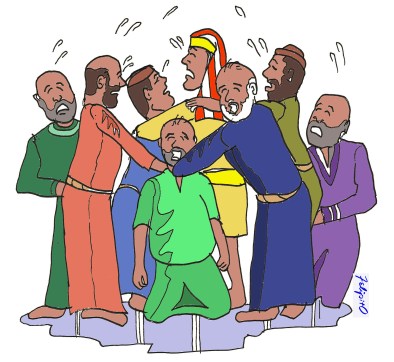 If it hadn’t been for Sid Caesar, I wouldn’t know that Joseph’s reunion with his brothers is one of the funniest schticks in the bible.
“And he wept so loudly that the Egyptians heard it, and the household of Pharaoh heard it … Then he fell upon his brother Benjamin’s neck and wept, while Benjamin wept upon his neck. And he kissed all his brothers and wept upon them.” (Genesis 45:2; 14-15a.)
Call me insensitive, but the scene is hilarious. It’s set up like a spoof of This is Your Life on Caesar’s TV comedy program Your Show of Shows (1950-1954). Caesar plays Al Duncey, a man in the audience who is unwillingly pulled to the stage by Carl Reiner to have his life examined on national television. (Yes, kids, Ralph Edwards actually did have a show like that, but it was never as amusing as Caesar’s send-up.)
The riotous episode reunites Duncey with his long-lost Uncle Goofy, played by Howard Morris. Their reunion is so emotional that it frustrates Reiner’s efforts to move the show along. Caesar and Morris weep and embrace and embrace and weep and can’t keep their hands off each other. Finally, as Reiner insists it’s time to move on, Caesar carries Morris to a chair. But still sobbing convulsively, Morris climbs on Caesar’s back and howls as Caesar awkwardly drags him to back stage. But as additional guests are introduced, Uncle Goofy leaps into the huddles of reunited relatives, all of them blubbering copiously. Treat yourself to the episode below.)
Okay, it gives me pause that I can recall the details a 65-year-old TV show but can’t remember this morning’s Trump Twitter outrage.
Be that as it may, once you see that scene, I dare you to read about Joseph and his weeping brothers without snickering. I try to be piously reflective, but all I can see are these big hairy dudes, their desert burlap soggy with tears, climbing over each other to embrace their gilded brother whose Egyptian mascara is streaking down his cheeks. It has all the homoerotic energy of a Worldwide Wrestling Federation bout. I love it.
Granted, the intent of the story is not so much to amuse as to remind the reader that God is the God of history, and that the brothers’ scheme to sell Joseph into slavery was brought to naught. In the dramatic moment when Joseph reveals himself to his brothers, he tells them not to feel bad because their dastardly scheme was God’s doing, not theirs.
“So it was not you who sent me here, but God; he has made me a father to Pharaoh, and Lord of all his house and ruler over all the land of Egypt.” (Genesis 45:8)
It’s a little difficult, in the latter part of the second decade of the 21st century, to accept the concept of God as the governor of history. The Holocaust, Stalinist genocides, endless wars, chronic human hatred, AIDS, cancer, xenophobic excesses, 9/11, Trump, bad things happening to good people, all make it hard to explain to our children how God watches over us and keeps us safe.
In the late 20th century, evidence of God’s presence was so rare TIME asked, “Is God Dead?” and artists and writers began to insinuate the theme into their work. Prior Walter, the angel-designated prophet living with AIDS in Tony Kushner’s Angels in America, expresses his anger that God has gone missing:
“He isn’t coming back. And even if he did … If He ever did come back, if He ever dared to show His face, or his Glyph or whatever in the Garden again…if after all this destruction, if after all the terrible days of this terrible century He returned to see…how much suffering His abandonment had created, if He did come back you should sue the bastard. That’s my only contribution to all this Theology. Sue the bastard for walking out. How dare He.”
Not everyone believes God has abandoned creation, although theater audiences generally applaud Prior Walter’s bitter complaint. But even if the God-in-history angle takes some sorting out, the central character Joseph remains intriguing. He is a classic literary conceit: the person with issues who, for whatever reason, disappears for a long period of time and reappears at a dramatic moment to save the day.
The conceit often includes an element of mystery, a secret identity, or a masquerade. Joseph the shepherd boy disappears and, for all practical purposes, is lost to history. Then, when he is all but forgotten but when it matters most, he reappears as a person of great power. Modern literature is full of such characters.
The ones we knew when we were children were Superman and the Lone Ranger. Both mythical heroes shared with Joseph a violent banishment from everything they knew. They wandered in an uncertain wilderness and eventually emerged with amazing powers and indisputable moral authority. Superman was a refugee from a shattered planet who wandered the known universe before arriving on earth, where his super strength and moral authority were virtually messianic. The Lone Ranger was a virtuous lawman whose band of Texas Rangers was massacred by the Butch Cavendish gang and who lay dying in the sun until his loyal indigenous associate and life companion Tonto nursed him back to health. Long after Cavendish was no longer around to recognize him as the ranger he couldn’t kill, he wore a mask as a sign of moral authority and justice for all.
There are also interesting Jungian twists on the story of people who, like Joseph, disappear and later reappear with a different image. There are legends in many cultures about soldiers who go away to war and are not heard from for years, until they mysteriously reappear and resume conjugal relations with their startled wives. One such tale was told in the 1993 film, Sommersby, starring Jody Foster and Richard Gere. Jack Sommersby (Gere), a surly and somewhat abusive man, leaves his farm to fight for the Confederacy and never returns. That’s okay with his wife (Foster), who manages very well on her own. But then a man strongly resembling Jack and claiming to be him shows up unexpectedly. He looks like Jack, but there’s something wrong with him: he’s nice. Is he an imposter? And if he is, why does he know so much about Jack’s past life? It’s a mystery and, for those still planning to get the DVD, I won’t reveal the ending. But the story is very Joseph-like: he’s here, he’s gone, he’s back – and he’s very different.
My favorite Joseph character in literature is Jean Valjean, the central figure in Victor Hugo’s massive 1862 novel, Les Misérables and, more recently, lead tenor in the Broadway opera of the same name. The full story of Jean Valjean is too complicated to be told here, and the musical drastically abridged it, but literati who made it through the novel know he was born of poor parents in tiny French village. When he was a child, his parents died. One suspects Hugo is not trying to be funny, but the story goes that Jean’s father, also Jean Valjean, falls out of a tree and his mother, Jeanne Valjean, dies of milk fever. Jean is raised by his sister Jeanne Valjean, but hard times fall upon them and young Jean steals a loaf of bread so they can live.
It’s at that point that Jean, like Joseph, disappears from familiar surroundings. Like Joseph, he is forced into the insidious form of slavery maintained by the French penal system. Assigned prisoner number 24601, his sentence for stealing a loaf of bread is five years. Adding penalties for bad behavior, he’s in the clink for 19 years. When he is finally released, Valjean is taken in by Bishop Myriel, a kindly only man in the town of Digne. But Valjean steals the bishop’s silver and runs off. When police capture him and return him to the bishop, Myriel pretends to scold Valjean for not taking the silver candlesticks as well (“Would you leave the best behind?”).
Chastened, Valjean turns away from temptation and commits his life to God. When we see Valjean again in the musical, he has evolved from hardened criminal to the virtuous mayor of Montreuil-sur-Mer. Just how that happened is voluminously detailed by Hugo, but for theater-goers it’s enough to gauge the dramatic ascendency from prisoner to chief executive. It’s not unlike the rise from slave to Pharaoh’s first minister.
For the rest of the story, Jean Valjean’s life is full ups and downs: he risks his life to protect prostitutes and an escaped prisoner, among others, and when his identify is discovered by police Inspector Javert, he is forced to go into hiding with Collette, his adopted daughter whom he has rescued from a life of poverty and abuse. It’s all in the book, and much, much more. But at the end of the story, Valjean can look back on his life and know that God has brought him from a life of poverty and crime to positions of power and opportunity that he has used in love to protect the weak, the poor, the young, the oppressed and the disempowered. I defy anyone to hear without weeping the song in the final scene of the musical:
Take my hand And lead me to salvation.
Take my love, For love is everlasting.
And remember The truth that once was spoken:
To love another person Is to see the face of God.
That truth once spoken – to love another person is to see the face of God – is the real message in the story of Joseph and his brothers. Despite all the angry, cruel and resentful baggage they are carrying, they still find it possible to love each other.
That’s a major miracle, and it enables all the brothers to see God’s face as they gather in Pharaoh’s pristine palace. It was not, as Joseph told his brothers, God who made them sell their little brother into slavery so many years before. His brothers committed that sin on their own. It can’t be blamed on God. Nor is the story of Joseph and his brothers a confirmation that God controls the events of history.
Evidently, in the fallen world in which we live, God has designated that responsibility to a flawed humanity. So maybe it’s not history, per se, that God controls. What God controls are the hearts and minds of the individuals who make history.
Earlier in Genesis, when Joseph first recognized his brothers after years of separation, he had the power to arrest them, torture them and execute them. But God spoke to his heart, and that potential vindictive history – so common in our time and in all times – never happened.
It is the God of love, not the God of history, who is introduced to us late in the book of Genesis. Love changes everything. And when the brothers repented of their cruelty, their jealousy and their sins and decided to love each other, history was changed forever.
And they knew it had changed because, when they least expected it, they could see the face of God.
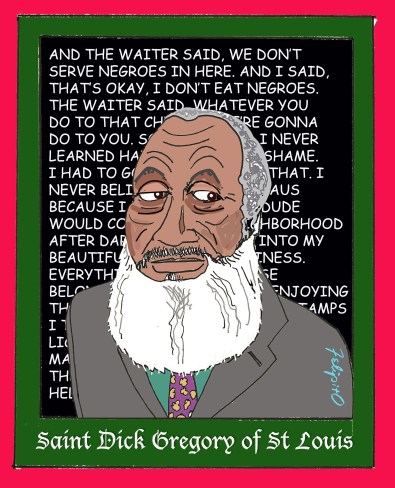 August 7, 2019 – Dick Gregory died two years ago this month in a Washington, D.C. hospital. He was 84.
The anniversary of his passing – especially at a time in our history when we sorely miss his prophetic voice – brings back happy memories. I wrote these observations shortly after he died:
Dick Gregory was a lean, mean running machine in 1974 when he came to the first annual Communication Center at Green Lake, Wis.
The Center was a week-long seminar on interfaith communication planned by the American Baptist Division of Communication, then headed by Norman R. De Puy. The speakers who addressed the conference that week were stellar in their own rights, including editor Norman Cousins, pop-anthropologist Ashley Montague, George Gerbner, legendary chair of the communications department at the University of Pennsylvania, and NAACP head Benjamin Hooks.
All of these luminaries stayed in the Green Lake Center’s elegant but rickety Roger Williams Inn, where the ancient elevator doors clunked open with (in Montague’s words) “the thud of an atomic bomb.” Montague, an elegant Brit who was famous for occasional appearances on the Johnny Carson show, exposed his bony white knees between the hem of his yellow Bermuda shorts and black knee socks, and he was a pain in the neck to the Center organizers. He was an avowed Unitarian who hated the Roman Catholic Church and frowned condescendingly at the Protestant Christians who came to the Center, “The only time I hear Jesus Christ’s name in my church,” he proclaimed in his opening lecture, “is when the janitor falls down stairs.”
Cousins and Hooks, fortunately, were charming and accessible to all attenders. Gerbner cheerfully accepted the uneven surface of the Green Lake tennis courts, saying they were useful lessons for life: “You never know where the ball will bounce.”
But it was comedian and social activist Dick Gregory whose presence was remembered by most. In the summer of 1974, Dick was running from coast to coast to express his opposition to the Vietnam War. He agreed to come to Green Lake if the organizers would allow him to run when he wasn’t making speeches, and that’s how I remember him: brief glimpses of a skinny, sweating, bearded man running quickly through crowds, often accompanied by teen-ager Scott Waterston, the son of one of the Baptist organizers.
But Gregory never refused to stop and talk with people, and he was generous with his autographs. His humor was always present and occasionally cutting. One day the staff was meeting in the canteen, a small snack shop at the rear of the Roger Williams Inn, and Gregory walked in to ask for water. He had removed his running shoes, which created a dilemma for the young woman at the cash register. “I’m sorry,” she said with adolescent firmness, “you can’t come in here without shoes.”
“What?” Gregory said, stifling a smile.
“You can’t come in here without shoes.”
Gregory quickly surveyed the small crowd in the canteen and raised his voice. “JESUS wouldn’t be allowed in here,” he announced loudly. But he stepped outside obediently and slipped into his shoes.
Dick Gregory’s keynote address was brilliant and full of famous lines from his public appearances. “I was told, ‘We don’t serve Negroes in here,’ and I said, ‘That’s okay, I don’t eat Negroes.’” And, “These big white guys surrounded my table and said, whatever you do to that chicken, we goin’ to do you. So I kissed it.”
Not everything Gregory said was scientifically substantiated, including his assertion that feeding cows milk to human babies was the underlying cause of sudden infant death syndrome. But his social observations were usually insightful and always wise.
During the question and answer session following his evening speech, Dick asked for water and sipped from a cup while responding thoughtfully and humorously to each question. As the hour grew late, Division of Communication staffer Milt Ryder, who was presiding over the session, announced there would be time for one more question. The question came, Gregory answered it thoughtfully, and turned to Milt for the adjournment.
But before Milt could get to the microphone, Phil English, an African American pastor, stood to be recognized. Milt looked awkwardly from English to Gregory and back to English.
After a few seconds of enjoying the awkwardness, Gregory intervened.
“Don’t worry, Brother,” he told English. “No way these folks will dare tell you to sit down.”
There were other communications centers at Green Lake, and later gatherings in Mississauga, Ontario, and Valley Forge, Pa. None of them quite matched the power and eloquence of the first one in 1974.
Years later I ran into Dick Gregory by chance, some time in the early nineties. He and I found ourselves on the same commuter plane, probably en route to Philadelphia. His beard was longer and almost white, but he was still lean and his eyes still studied his surroundings in search of irony. As we were shuffling off the plane, he noticed I had recognized him.
Twenty years earlier we had been in daily contact for a week at Green Lake, and he seemed to be studying my face. Perhaps, I thought, he might actually recognize me.
Whether he did or not, he smiled and nodded. “Hello, bro-ther,” he said.
I smiled back and grasped his hand.
That was the last I saw of Dick, but the impression I had of him during these fleeting encounters never dimmed.
He was a great and a good man, and he will be missed.
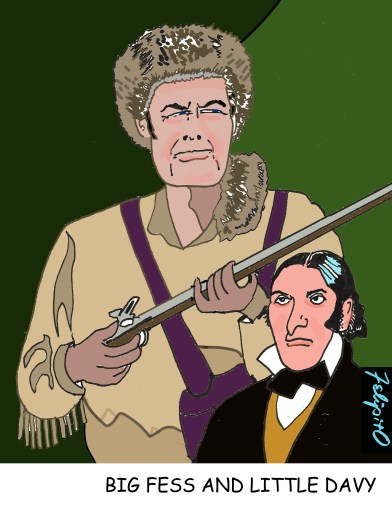 August 17, 2022 – Davy Crockett was born 236 years today.
His birthday was the first historical date I committed to memory, thanks entirely to Walt Disney’s 1954 miniseries, Davy Crockett, King of the Wild Frontier.
The historical Crockett was a bigger-than-life, self-aggrandizing windbag who lied about his exploits to make money and win votes.
Disney’s Crockett was literally bigger. Fess Parker, at six feet-six, would have been a head taller than the coonskin Congressman. And a lot about the TV Davy was also fabricated. If eight-year-old viewers didn’t already know it, it was easy to miss the fact that Davy died at the Alamo. The last scene shows Fess swinging his musket like a fan blade to propel dozens of hapless Mexicans like unfeathered shuttlecocks off the smoking ramparts. When I finally realized, at 9, that Davy died, it was my first sortie into historical reinterpretation.
It was many years later that I realized Disney also hid the reality that the Mexican army was defending its legitimate territory against “Texian” interlopers.
Whatever its shortcomings, however, Disney’s reanimation of the Davy Crockett legend ignited my lifelong love of history. Most of the credit goes to actor Fess Parker, whose laconic portrayal made Davy seem both decent and heroic. Fess played less memorable roles when he was under contract to Disney, and viewers a few years younger than me knew him as TV’s Daniel Boone. I remained a fan of Fess until his death in 2010, and when his grandson created a Facebook account for him, I was one of the first to sign on. (Read more about My Friend Fess here.)
Between Davy and Dan’l, Fess made a career of creating images of historical figures that were more attractive than the real deals. I will go so far as to say Fess exceeded the accomplishments of his historic alter-egos. A Santa Barbara clergy friend of mine remembers him as a genial white-haired giant who stayed faithful to his wife, was generous to the Methodist Church (perhaps to encourage their acceptance of his wine producing business) and was a Ronald Reagan Republican (which, as we learned after the election of 2016, is not the worse thing you can be).
Davy, on the other hand, was a chronic self-promoter. He was a politician who believed elections are not lost by underestimating the intelligence of the American voter.
His image as an Indian fighter, for example, was largely made up. During the famous Creek uprising of 1813 (immortalized in The Ballad of Davy Crockett), historian Michael Wallis said Davy hunted and foraged food for the troops and saw little action (David Crockett: The Lion of the West). Davy left for home before the Creek war was over and hired a substitute to fight for him.
Back home, Davy set his sights on politics in 1821. He entertained crowds with his tall tales and homespun humor and was elected to the Tennessee Legislature and later to Congress.
In Congress he introduced a bill to close the U.S. Military Academy at West Point, which he considered free education for the sons of the rich. Davy’s real claim to historic immortality was being the sole member of the Tennessee delegation to vote against President Andrew Jackson’s 1830 Indian Removal Act. This singular act of courage further damaged Davy’s dubious reputation as an Indian fighter and he was defeated for reelection in 1835.
From that time on, Davy Crockett devoted his time to promoting A Narrative of the Life of David Crockett, Written by Himself, actually a collaboration with Kentucky Representative Thomas Chilton. It was during a book tour that newspapers quoted Davy’s famous message to his constituents, that “they might go to hell, and I would go to Texas.”
That declaration sealed his fate. It seems he had every intention, as The Ballad of Davy Crockett puts it, of “follerin’ his legend into the West.” According to historian Manley F. Cobia, Jr., Davy was followed by large crowds on his way to Texas and he regaled them with speeches about Washington politics and his commitment to Texas Independence.
When he arrived in Nacogdoces, Texas, in January 1836, he enlisted as a Texian volunteer in exchange for a promise of 4600 acres of Texas land. Davy arrived at the Alamo in February, 1836. As is now well known, the little San Antonio mission was placed under siege by General Antonio Lopez de Santa Anna. All we really know is that when the smoke cleared, Davy was dead along with every other Texian.
However, some accounts say a half dozen Texians surrendered to the Mexicans before the fighting was over. And some reports suggest Davy was among those who surrendered.
We will never know the truth, but I’m open to the possibility that Davy tried to quit the battle. He was in Texas to promote a book, himself, and his future as a landowner. He could have quickly assessed his situation to see how dumb it would be to die where he was not famous and in a place that had no apparent strategic importance. I can see how it made sense to surrender.
Unfortunately, Santa Anna was reportedly incensed that his “take no prisoners” order was ignored and he ordered their execution. All they had bought for themselves was a couple more hours of time. That was 183 years ago last March.
As it turns out, it doesn’t really matter how Davy died. There are only a handful of serious historians who know anything about his real life, much of which was camouflaged by fabrications and frontier humor.
For the rest of us, we have the Davy who was played so heroically by Fess, the Davy who believed in justice, who never gave up, who fought for freedom at the Alamo until his last righteous breath. Okay.
Maybe it didn’t really happen that way. But the fact is, in real history, it almost never happens that way.
But 236 years after his birth, we might still remember Davy with fondness for what we think he was and not for what he really was.
So I think we can be excused if we choose to celebrate his birthday with a healthy nip of Tennessee bourbon. Or four.
The more we nip, the less likely we will hear the real Davy bragging to us from his grave.
 | Frank Vee on October 12 |
 | Frank Vee on … |
| Frank Vee on Mayflower |
| Frank Vee on All We Are Saying is |
| Frank Vee on Bulletin art for September… |