Okay, maybe not your cuppa tea biscuits

mrshowlettsacquiredtasteFrom 1946 to 1950, my family lived in an apartment on the third floor of Flora Cramer’s house on Main Street in Morrisville, N.Y. The house was reportedly the first frame house built in Morrisville, whatever that means, and the closest neighbor was Lyndon Howlett, Morrisville’s unofficial historian. I would often escape to the Howletts while my mother was preoccupied with my baby brother Larry.

But it was not Mr. Howlett’s wizened brow or aromatic rum and maple pipe tobacco that attracted me to his house. It was Mrs. Howlett’s kitchen, redolent with sweet smelling cooking aromas and populated with perfumed daughters dressed in slips.

The daughters would welcome me warmly, cooing to each other how cute I was (I was 3),  and lift me onto their seminude laps. I remember so vividly the shaved stubble on their shapely legs that I wonder if this was the beginning of my earliest erotic stirrings. But what I remember most is the molasses cookies they served with milk.

The cookies, in my sometimes lonely opinion, were delicious. They were sweetened entirely by dark molasses, which many people don’t find sweet enough. For me, the  spicy tartness in my mouth, combined with the sensation of warm legs rising and falling beneath my butt, were bliss.

Mrs. Howlett gave the cookie recipe to my mother, who passed it along to me. Over the years I have successfully recreated those cookies on a number of occasions and I loved each bite. However, none of my children liked them very much. In fact, they hated them. Consequently, I have not baked these cookies for years, mostly because five cups of flour combined with two cups of one of nature’s most effective purgatives is too much for a solo endeavor.

Recently, however, I was surprised when daughter Angela called from Southern California to ask for the recipe. I am not sure if she was trying to determine whether her unpleasant memories of the cookies had been a childish error, or perhaps she wanted to share the concoction with her anthropology students to compare it with indigenous mud pastes. Whatever the reason, I am delighted to allow the recipe to resurface.

Mrs. Howlett’s Acquired Taste Molasses Cookies are best in fall and winter, and they add an unusual if not universally appreciated ambience too any meal. I’ll be pre-heating my oven soon. If you are also inspired to try them out, let me know – as politely as you are able – what you think.

Posted in Uncategorized | Leave a comment

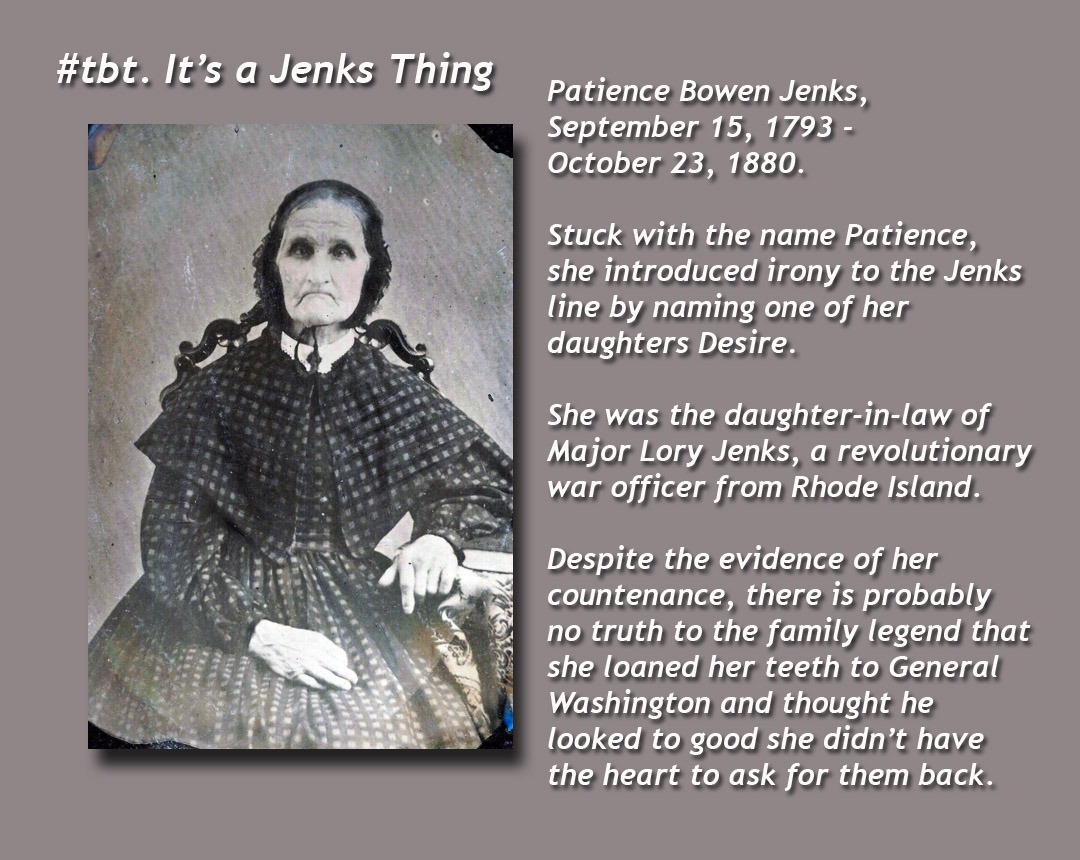
#TBT. It’s a Jenks Thing.

tbtpatience

Grandma Patience was real, and she really had a daughter named Desire.

She also showed her droll wit (and spelling flexibility) in naming her other children: Wata Jencks Veltman, Sally Jencks Hogeboom, Hannah Jencks French, James Jencks Jr, Elmore Jenks, and Sylvester Jencks.

Jencks and Jenks are used interchangeably throughout family history. No doubt the c was dropped to save the cost of ink.

Posted in Uncategorized | 1 Comment

Grandpa and TR

lwetrcollage

Posted in Uncategorized | Leave a comment

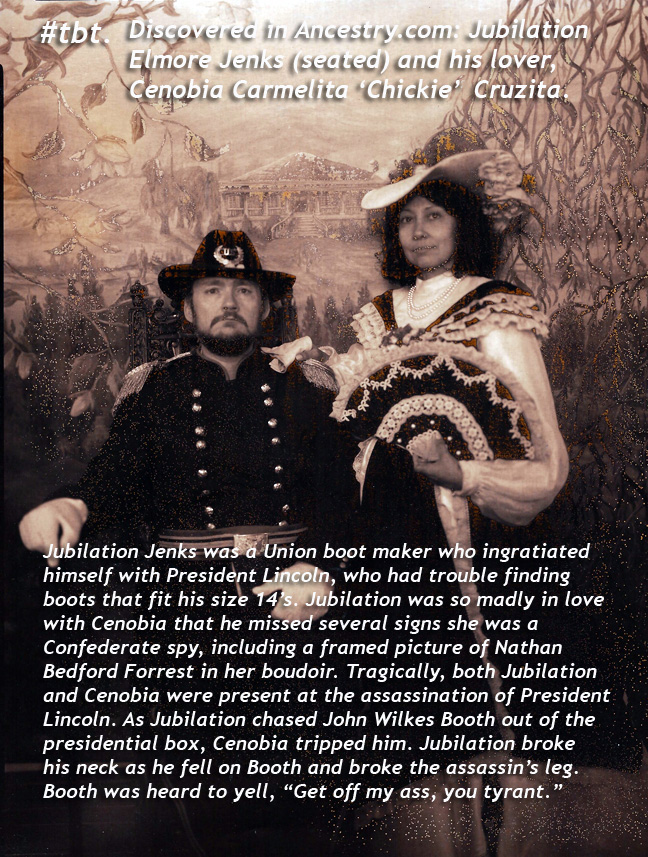
#TBT. The joy of discovering long-lost ancestors.

tbtcarmandjube

Posted in Uncategorized | Leave a comment

Does Media Coverage Thicken the Fog of War?

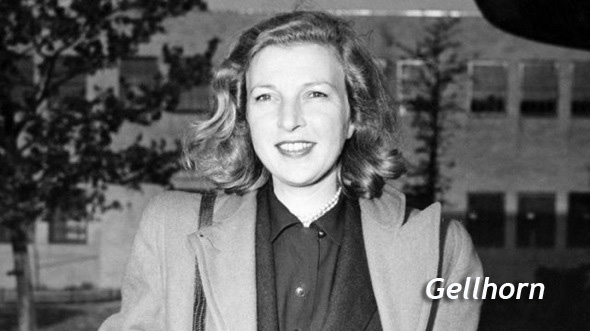
gellhorn[Reprinted from Senior Correspondent.]

By Philip E. Jenks

“War,” said Martha Gellhorn, “happens to people, one by one. That is really all I have to say.”

In two sentences, Gellhorn captured the essence of war reporting.

No matter how graphic the videos of shock and awe on CNN, no matter how insightful the pundits’ advice about how to kill terrorists, no matter how piercing their denunciations of extremist jihadists, it all comes down to this: war happens to people.

Temporarily obscured in the mists of Hemingway when she was his third wife, Gellhorn emerged as a clear-eyed interpreter of human conflict.

It was important to tell the true story of war, she said, because so many people are indifferent to it.

“Unless they are immediate victims,” she observed, “the majority of mankind behaves as if war was an act of God which could not be prevented; or they behave as if war elsewhere was none of their business. It would be a bitter cosmic joke if we destroy ourselves due to atrophy of the imagination.”

Gellhorn saw more of war than most of her contemporaries. She covered the Spanish Civil War, World War II, the D-Day landings, the liberation of Dachau, the Vietnam War, the Six Day War in the Middle East, and more.

Woven tightly throughout her prose was a common thread: war is caused by human stupidity and injustice; war mutilates human bodies in grotesque and ghastly ways; and war happens to people one by one.

Twenty-first century journalists have had ample opportunities to weave their own rhetorical threads. Bloody wars in Afghanistan, Iraq, Sudan, Ukraine, the Middle East, and God knows where, make it clear war correspondents will always be in demand.

What is less clear is whether journalists will be able to convince their viewers and readers that the basic truths of war have not changed: no war is an act of God; no war is inevitable; and wars elsewhere are everyone’s business.

CNN, Fox News, MSNBC and others have their pundits, but few of them work to get beneath the surface of the causes of war. Most discussions focus on whether President Obama is showing wise restraint or weak hesitation, whether ISIS can be defeated without boots on the ground, why Hamas keeps hurling missiles into Israeli territory, forcing Prime Minister Netanyahu to retaliate with troops and bombs.

The result is a public left largely uninformed about the human beings who are directly affected by war, or the underlying reasons wars begin. Is it merely madness and sectarian fanaticism that inspire young men to join ISIS militias? Is Hamas firing missiles into Israel solely because of an ideological bias that Israel should not exist? Are Russian rebels infiltrating Ukraine just because Vladimir Putin has megalomaniacal designs on territory?

If the public accepts those simplistic views, it’s largely due to the headline grabbing summaries of reporters and pundits. In order to attract viewers and advertisers, video coverage of wars makes them look like trailers of blockbuster summer movies, featuring noise, fire, and smoke, and starring two-dimensional politicians.

It takes more than a looping five-minute video clip to tell the whole story of a war.

It takes a reporter willing to spend weeks or months on the ground, talking to people, learning their history, observing the oppressions and injustices that spawn the desperation that leads to war.

And it takes editors and producers willing to provide sufficient time to peer beneath the headlines to tell the complex stories that rarely rise to the surface.

Perhaps if more people understood why wars begin, wars would be easier to prevent.

Very often, detailed and nuanced reporting of complicated stories is the province of freelance reporters who risk their lives to get the details.

One of these reporters was James Foley, a teacher and journalist from Rochester, New Hampshire, who worked for GlobalPost and Agence France-Presse during the Syrian Civil War.

Twice insurgents captured Foley, the first time in 2011 when he was released after 44 days.

He returned to Syria the following year and was captured again on November 22, 2012.

He became the first person with U.S. citizenship to die at the hands of the self-proclaimed Islamic State of Iraq and Syria caliphate movement (ISIS). A crude video shows him being decapitated by his captors on August 19 in the Syro-Arabian desert.

The gruesome nature of Foley’s death sheds little light on ISIS ideology, except to confirm the assumption they are a group of madmen with a theology forged in the seventh century. Sadly, the impressions left by Foley’s death will only harden the riddles Foley returned to unwrap.

In memorial services for Foley, Roman Catholic Bishop Peter Libasci of the Manchester, New Hampshire diocese, said Foley “was living his faith by bringing images t9 the world of people suffering from war and oppressive regimes.”

According to Fox News, Libasci read aloud a letter from the Vatican expressing the condolences of Pope Francis. He also prayed for another captive journalist, Steven Sotloff, and all captives.

“Jim went back again that we might open our eyes,” Libasci said. “That we might indeed know how precious is this gift. May almighty God grant peace to James and to all our fragile world.”

What James Foley knew that many of us miss is that Mideast violence is not the exclusive domain of violence and sectarian bigotries. Much of it has to do with millennia of strife between Sunni and Shi’a sects, and centuries of brutal European colonialism. It has to do with U.S. and European powers propping up brutal dictators to ensure access to oil and ports. In Israel and Palestine, it has to do with walls and roadblocks that prevent Palestinian farmers from attending their livestock or crops, and forces Palestinians — Muslims and Christians — to pass through abusive checkpoints to purchase groceries or visit the doctor.

Unfortunately, too many producers and publishers think it would take too long to tell these stories, which they fear would bore the viewing masses.

But it is in this hidden reality that people live.

Without a deeper understanding of the causes of wars — the “atrophy of imagination” Martha Gellhorn feared — peaceful solutions in the Mideast seem forever futile.

The only hope, it seems, is in reporters like Foley and Sotloff and others who put their feet on the ground and risk their lives to remind us about Gellhorn’s truth:

“War happens to people, one by one.”

And wars will continue to happen to people if we don’t invest the time to heed the reporters who remind us.

Posted in Uncategorized | Leave a comment

September 11

wtcMillions have their memories.

As President Obama escalates the newest war in the Persian Gulf, the question is whether remembering September 11, 2001 eases the pain and makes sense out of all that has happened since.

Martha and I had just settled into our offices in The Interchurch Center that day, more than 100 blocks north of the World Trade Center. On September 11, 2001, Martha directed public relations and communication for the United Church of Christ Pension Boards on the 10th floor (as she still does), and I was communications officer of the U.S. conference for the World Council of Churches on the 9th floor.

I was probably sipping the last dregs of my morning coffee in the 9th floor office of the U.S. Conference for the World Council of Churches when Martha called. “Did you hear a plane has flown into the World Trade Center?”

Instinctively, I turned to my keyboard and typed http://www.ap.org. The Associated Press had moved a tentative story with a file picture of the twin towers.

“What a mess,” I thought. I could imagine a small plane veering off course from Teeterboro and straying into one of the 1,340 foot-high towers. No doubt some office workers in the tower had been injured.

Martha called back. “We have an office on the 19th floor,” she said. “We can see the towers from there.” I met her at the elevator and we went up. Tom, the office IT director, shook his head as we walked in and nodded toward a southerly window.

The towers were nearly seven miles south of us, but in my memory they seemed just a few blocks away. Black smoke billowed from the northern façade of the North Tower, and I still assumed an errant small plane had done the damage. Most of the people in the office had stopped looking out the window and had returned to their tasks.

We watched the smoke streaming eastward for several minutes.

“I have a service downstairs in the chapel,” Martha said.

One of her coworkers had died over the weekend, and Martha, an ordained Baptist minister, was in charge of the memorial. We thanked Tom for allowing us to satisfy our curiosity and walked out. Seconds after we closed the door behind us, the second plane hit the South Tower.

An hour later, when Martha and her colleagues emerged from the memorial service, both towers were fully involved in flames and on the verge of collapse.

Across the river in Hoboken, Martha’s cousin Tony watched in horror as people leaped from the towers to escape the flames and fell to their deaths on the plaza below.

Martha’s cousin Alina was stranded with her colleagues at Brown Brothers Harriman on nearby Wall Street. In the Empire State Building on 34th street, Alina’s husband, Steve, was making urgent calls to her office to see if she was all right.

Back at the Interchurch Center on 120th Street, my colleagues Jean and Sonia were literally holding each other up as news came of the collapse of the North Tower. Jean’s niece, who had been staying with her that summer, worked at one of the buildings adjacent to the towers and Jean had been unable to reach her.

As I sat in my office overlooking the Hudson River, I spun my radio dial, seeking additional updates. I listened briefly to an FM deejay who said he was broadcasting from one of the towers. “They’re telling us to evacuate,” he said excitedly, “But I’m staying at my post as a public service, ‘cause folks need to know what’s goin’ on …” I spun past him looking for 1010 WINS or another all news station and didn’t give the deejay a second thought. But 13 years later, I wonder: did the guy wise up and get the hell out of the tower? Or did I accidentally tune in to his last words on earth?

It wasn’t easy getting news about what was happening outside. I began receiving emails from a World Council of Churches colleague in Geneva, Switzwerland. Martin Robra, a German Lutheran peace activist, was monitoring the news in Europe and it was in one of his emails that I learned a plane had also struck the Pentagon in Washington. “You are at war,” Martin wrote ominously.

Our offices in The Interchurch Center at 120th Street and Riverside were far from Ground Zero and still unaffected by the calamity that was unfolding downtown. Two days later, a foul yellow haze that stung the eyes and burned the throat would spread throughout all of Manhattan. But in the midday hours of September 11, the air was still clear uptown. If you turned northward toward the George Washington Bridge, it was a beautifully pristine late summer day.

Outside the city, persons following the events on television wondered if all New York was in flames. Our son, Will, then a junior at Port Chester High School, left an urgent message on Martha’s cell phone. He had heard the city was under attack by military jets flying out of the White Plains airport and he pleaded with his mother to get in touch with him. Unfortunately, we didn’t get the message until hours later, when we were all safely home.

Daughter Victoria was in sixth grade in Port Chester on September 11 and we felt sure she would be safe with her teachers until the end of the day. However, daughter Katie was in a special education program in an outside school district and needed to take a school bus home. What the traffic situation would be like in Westchester County was anyone’s guess.

“Let’s go pick up Katie,” Martha said. I told Jean and Sonia that we were heading home, and they waved their hands as if to shoo us out. “Be careful,” Jean said. She had just heard that all bridges and access routes to Manhattan has been closed.

“Okay,” I said. “Let’s see how far we can get.”

As it turned out, Riverside Drive was virtually empty. When we got to the Bronx-bound Henry Hudson Bridge, I looked for signs it had been closed. Instead, an MTA officer waved us through the tolls. We made it to Katie’s school in Ardsley in half the usual time.

But there were scores of cars jamming the high school parking lot. Parents from all over the district had come to take their children home. We parked at the far end of the lot and headed for the nurse’s office to sign Katie out. We found ourselves waiting in a line of anxious parents as a stressed-out gray-haired nurse scolded us.

“This is crazy,” she hissed, “You people are over-reacting,” as she impatiently scribbled her signature on dismissal slips.

After several minutes, Katie was escorted to the office by her teacher, Erin. Erin smiled at us but she must have had other things on her mind. She knew her brother, an employee at Cantor Fitzgerald, could have been one of nearly 3,000 people killed at the World Trade Center. It would be weeks before his remains were identified, but hours after the attack his fate was still unknown.

That night, as the sun began to set on September 11, the Port Chester members of the family were safely home on Wesley Avenue. Throughout the tri-state area that night, thousands of shaken people who made it home kept an eye on their neighbors’ homes to see if they returned safely. But many never did.

As supper was being prepared, I stepped outside briefly, probably to retrieve something from the car. A military fighter jet roared overhead at a low altitude; if the jet had been slower, I could have read the words on the fuselage, but it thundered angrily and disappeared. My knees buckled as I ducked instinctively, but in an instant the air was silent again. I thought to myself, “We really are at war.”

It’s difficult to exaggerate the worldwide effects of September 11. The attacks – and our reaction to the attacks – had an indelible impact on billions of people. On September 12 we learned that our British friends John and Bridget had been traveling from London to New York on September 11. When U.S. airports closed, their flight was diverted to Nova Scotia. They and other passengers were taken in by friendly Canadian farmers until the planes started flying again, on September 14.

Our daughter Lauren had planned to fly from Washington State to Philadelphia on September 11.

“I was going to a wedding in Philadelphia on the 15th,” Lauren recalls. “My flight was supposed to be a red eye leaving on the night of the 11th, but it didn’t get out until the 14th. I waited on line at (the Seattle-Tacoma airport) so long that I got free water and snacks from the Red Cross.”

Lauren was in a tiny minority of Americans who still wanted to fly that week. As it turned out, she made it to the wedding on time. “The minister pointed out that weddings are always audacious acts of hope in a world full of tragedy,” she recalls. “It’s hopeful, loving, life affirming acts like marriage that get us through everything else.”

It was not easy to find loving, life affirming acts in the aftermath of September 11. It’s not any easier today as the war in Afghanistan, launched as a direct reaction to the terror attacks, goes on and on. For many of us, the murder of Osama Bin Laden a decade after the attacks did little to ease the anger and salve the grief.

Perhaps one of the most prophetic statements that came out of September 11 appeared within days after the attacks. It was called, “Deny them their victory,” and it was written by four interfaith leaders* and signed by 4,000 people, including Martha and me and perhaps including you.

“We, American religious leaders, share the broken hearts of our fellow citizens,” the statement said. “The worst terrorist attack in history that assaulted New York City, Washington, D.C., and Pennsylvania, has been felt in every American community. Each life lost was of unique and sacred value in the eyes of God, and the connections Americans feel to those lives run very deep. In the face of such a cruel catastrophe, it is a time to look to God and to each other for the strength we need and the response we will make. We must dig deep to the roots of our faith for sustenance, solace, and wisdom.”

The statement continued: “The terrorists have offered us a stark view of the world they would create, where the remedy to every human grievance and injustice is a resort to the random and cowardly violence of revenge – even against the most innocent . . . The terrorists must feel victorious.

“But we can deny them their victory by refusing to submit to a world created in their image. Terrorism inflicts not only death and destruction but also emotional oppression to further its aims. We must not allow this terror to drive us away from being the people God has called us to be. We assert the vision of community, tolerance, compassion, justice, and the sacredness of human life, which lies at the heart of all our religious traditions. America must be a safe place for all our citizens in all their diversity. It is especially important that our citizens who share national origins, ethnicity, or religion with whoever attacked us are, themselves, protected among us.”

Ten years after the attacks, I still can’t bring myself to watch the television images of the planes crashing into the World Trade Center. They are simply too painful.

But there was another historic event that occurred less than a week after September 11, 2001, and many religious leaders have called upon people of faith to recognize it whenever they pray about September 11.

On September 17, President George W. Bush, in an extraordinary act of statesmanship, began his day with a visit to a mosque in Washington.

He bought coffee for a cafeteria full of people as he appealed to Americans to get back to everyday business and not turn against their Muslim neighbors.

The Associated Press reported that Bush removed his shoes in Muslim fashion and “padded through the ornate mosque on Washington’s Embassy Row and heard stories from his hosts about Muslim-American women afraid to leave their homes for fear of prejudiced backlash after last week’s terrorist strikes.”

“Those who feel like they can intimidate our fellow citizens to take out their anger don’t represent the best of America, they represent the worst of humankind and they should be ashamed of that kind of behavior,” Bush said.

He quoted from the Quran and fervently defended the Islam faith: “Islam is peace,” he said. “These terrorists don’t represent peace, they represent evil and war.”

The judgment of history is still pending on George W. Bush, and millions of his admirers and critics engage in spirited debate about his preparedness for a terrorist attack, or his decisions to go to war in Afghanistan – a war that continues to this day.

But on September 17, 2001, he demonstrated the kind of leadership the nation needed most. He made it clear that the terror attacks were the acts of mad and evil men who had no connection to millions of peace loving Muslims around the world. And he said people who felt otherwise “should be ashamed.”

It was a reminder that should engage us all as we look back on those terrible days.

And looking back, we will always wonder if the U.S. response of war and mass destruction was the correct one.

Or would the world be different today if we have responded with a courageous “vision of community, tolerance, compassion, justice, and the sacredness of human life”?
___
* The writers of “Deny Them Their Victory” were Jim Wallis, Wesley Granberg-Michaelson, David Saperstein, and Bob Edgar.

Posted in Uncategorized | Leave a comment

Missing Nixon Yet?

RNfinal

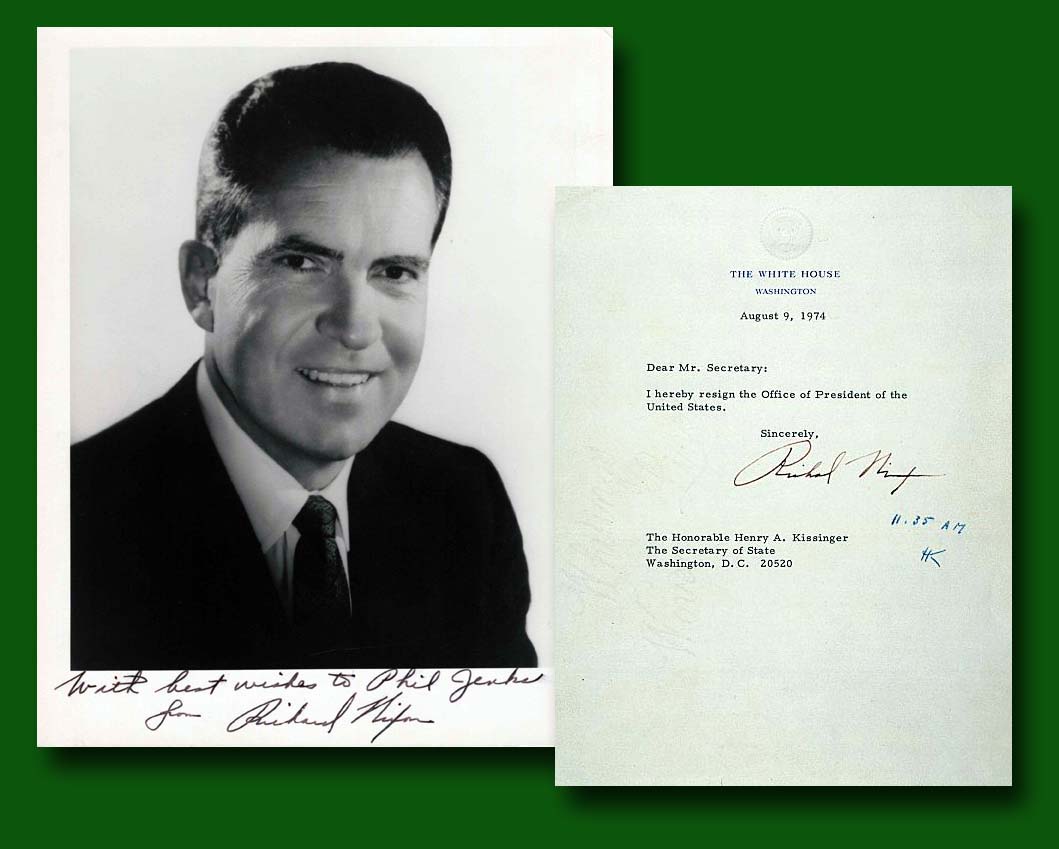
August 9, 2014 – I remember exactly what I was doing and where I was forty years ago today when President Nixon resigned.

I was vacationing at my parents’ home on Route 20 West in Morrisville, N.Y., watching his speech the night before on my parent’s large-screen color television set.

By this time in history, my parents’ support for Nixon had dissipated and we watched the speech with some relief. He was not the first president to secretly record conversations in his office, or lie to the American people, or undertake illegal acts in the dubious cause of national interest. He did arrogate to himself the power to secretly bomb Cambodia, which I thought was a war crime – and which then Rep. Elizabeth Holtzman (D-Brooklyn, N.Y.) of the House Judiciary Committee added to the articles of impeachment.

By August 9, 1974, there was not a lot of goodwill for RN around my parents’ neighborhood. He was never entirely likable but a lot of people ignored his tricky deviousness because he was Ike’s vice president. When I was in elementary school, My Weekly Reader wrote nice articles about him. And in 1962, he seemed benign enough that I included him in my target list of politicians whose autographed pictures I wanted. I told that story here.

Later, when I tried to make an appointment to interview Lawyer Nixon for Smoke Signals, the Morrisville-Eaton Central School student newspaper, I received a polite demurer from Rose Mary Woods, another future Watergate figure.

In later years, I had another Watergate-related encounter with Chuck Colson, the Nixon aide who never lived down his oft-misquoted claim that he would run over his grandmother to assure Richard Nixon’s re-election. Then again, Colson’s is heard on the famous Oval Office tapes boasting to the president, “Woodward and Bernstein [Washington Post investigative reporters] only report the little stuff I’ve done. They have no idea about the really bad stuff.” Nixon passes over the opportunity to ask, “Like what?”

I interviewed Colson for The American Baptist magazine and found him rather likable, although his newly acquired devotion to Jesus seemed as uncompromisingly relentless as his Nixon devotion, and not in a good way. At one point Colson asked if I’d like to do write under his byline for his Prison Fellowship organization. I was never sure if the offer was sincere or gratuitous, but I let it pass. One of my wiser career choices.

Forty years on, there’s little question that Watergate, Nixon’s surreptitious and illicit management style continues to have a complicated impact on presidential leadership. Today overreaching Republicans are hinting about impeaching President Obama for exceeding his authority, and the President sends U.S. bombers to attack militants in Iraq without Congressional approval.

None of this, of course, is Nixonian in its reach.

But all the same, it’s beginning to seem like a never-ending story.

Posted in Uncategorized | Leave a comment

The Bombs of August: “An Extremely Dangerous Precedent”

harryandsam

[Adapted from an article I wrote a few years ago for the National Council of Churches.]

The way Harry Truman saw it in August 1945, there was a sickening possibility that the Second World War would end in a historic bloodbath. The only alternative to a mutual massacre of American and Japanese troops, he believed, was the atomic bomb that his scientists told him was ready to use.

Months earlier, in the battle of Buna-Gona, New Guinea (my Dad was there and wrote about it in his diary, www.bunadiary.com), 2,300 Americans were killed and 12,000 were wounded. In land battles on Iwo Jima and Okinawa, U.S. forces suffered 75,000 casualties. On Iwo Jima, the president was informed, 21,000 Japanese troops fought fanatically to hold the island and 20,000 were killed.

In July, as secret plans were underway for a U.S. invasion of Kyushu, the interception of Japanese messages indicated their military build-up on Kyushu was four times larger than earlier estimates. In Truman’s estimation, the Japanese military government was prepared to fight on until every soldier was dead or wounded.

The atomic bomb, Harry Truman said, was the only way to “end the agony of war.” On Truman’s orders on August 6, an American B-29 dropped a bomb on Hiroshima killing 80,000 people.

The total swelled to 140,000 as people injured and suffering from radiation poisoning succumbed. An additional 80,000 died August 9 when a second bomb was dropped on Nagasaki. Whether the numbers fell short of projected deaths in an invasion of Japan has been the subject of debate for 69 years.

When Truman went on the radio to announce the use of the bomb, many Americans regarded it as a hopeful sign the war was about to end. But even hopeful Americans were sobered by the number of human beings – including civilians, women and children – who were blown away in Hiroshima and Nagasaki. It was immediately clear that the world had entered a dark and uncertain age.

Member churches of the Federal Council of Churches were appalled by the evils the new age had unleashed. Church spokespersons such as Presbyterian John Foster Dulles – known later for his policy of nuclear “brinksmanship” as President Eisenhower’s Secretary of State – urged a moratorium in further use of the bomb.

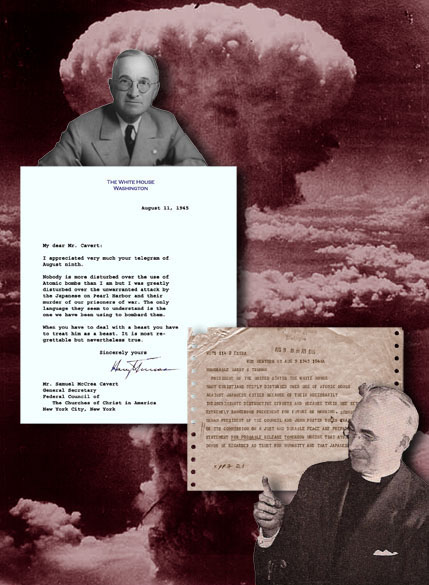
The Rev. Samuel McCrea Cavert, general secretary of the Federal Council, sent a telegram to the president on August 9, the day Nagasaki was bombed:

Honorable Harry S Truman

President of the United States,  the White House

Many Christians deeply disturbed over use of atomic bombs against Japanese cities because of their necessarily indiscriminate destructive efforts and because their use sets extremely dangerous precedent for future of mankind. bishop Oxnam president of the council and John Foster Dulles chairman of its commission on a just and durable peace are preparing statement for probable release tomorrow urging that atomic bombs be regarded as trust for humanity and that Japanese nation be given genuine opportunity and time to verify facts about new bomb and to accept surrender terms. respectfully urge that ample opportunity be given Japan to reconsider ultimatum before any further devastation by atomic bomb is visited upon her people.

Federal Council of churches of Christ in America

Samuel McCrea Cavert general secretary

Harry Truman, in office only five months, struggled with diplomatic language in his terse response. In a letter dated August 11, he wrote:

My dear Mr. Cavert:

I appreciated very much your telegram of August ninth.

Nobody is more disturbed over the use of Atomic bombs than I am but I was greatly disturbed over the unwarranted attack by the Japanese on Pearl Harbor and their murder of our prisoners of war. The only language they seem to understand is the one we have been using to bombard them.

When you have to deal with a beast you have to treat him as a beast. It is most regrettable but nevertheless true.

Sincerely yours,

Harry S. Truman

The nuclear age had begun virtually over night, and Truman’s 11 successors made decisions that built, expanded or maintained the American nuclear arsenal. The political rationale from the very beginning was that the bomb was needed to end conflict or as a deterrent to conflict.

But to millions of church people, the potential for “indiscriminate destruction” of God’s creation became a daily nightmare and the focus of millions of sermons, statements and theological debates.

The churches began preaching that sermon of peace in August 1945, and seven decades later it continues unabated.

Posted in Uncategorized | Leave a comment

Rockefeller Republicans

rocky150

If you remember moderate Republicans, you also remember green stamps and dial telephones.

In the sixties, some Republicans even leaned into the liberal column. They included Mark Hatfield of Oregon, Jacob Javits of New York, and – for a period – Mayor John Lindsay of New York. Lindsay, eyeing a future presidential nomination, abruptly switched to the Democratic Party in 1971, announcing he had singlehandedly rescued the city from Republican misrule.

What all these moderate liberals had in common is that they were called Rockefeller Republicans after Nelson Rockefeller, the four-term governor of New York and U.S. vice president. Rocky was a civil rights activist, an educator who dramatically expanded the State University of New York, a developer of low-income housing, a proponent of Medicaid and welfare, and an expander of state roadways, tunnels, and bridges.

He was so liberal, in fact, that many people wondered why he wasn’t a Democrat. Eager to learn the answer, I pretended to be undecided about which party to embrace and wrote to the governor to ask him why he embraced the GOP.

He replied (perhaps disingenuously considering his reputation as a tax and spend governor) that the Republican Party was fiscally responsible and a “dynamic force” for keeping the economy strong. But he didn’t dismiss the Democrats, either, pointing out “there is plenty of work for young and old in (both) our parties.”

Rocky’s words may not have originated with him, and over the years I’ve noticed that his signature on the letter is precisely identical to the signature on the picture. It is likely the product of a sig-mac machine, not the governor’s hand, and governor may not have seen either document.

After another decade had passed, the harsh Rockefeller Drug Laws and Rocky’s brutal assault on the Attica prison riot raised doubt if he was still a Rockefeller Republican.

But in 1962 he was both popular and charismatic in New York State.

That summer, my Dad was a counselor at New York’s Boys State held at Colgate University and he invited me to tag along and sit in the chapel balcony as Rocky addressed the boys.

The boys stood and cheered lustily as the governor walked on the platform, and Rocky smiled broadly and waved both arms in response to the accolades. He made a brief speech about the importance of youth in government, and I was impressed.

In many ways, I suspect Rocky was more liberal than my idol JFK, but like JFK he had a knack for saying what crowds wanted him to hear. One of the boys asked him what he thought about the Supreme Court’s recent decision to remove prayer from public schools, and he said, “I feel just as badly about it as you do.” But he added that the court’s decision was the law of the land.

Nelson Rockefeller was on Richard Nixon’s short list to be named vice president when Spiro Agnew resigned in disgrace in 1973. If that had happened, Rocky would have become president when Nixon resigned in disgrace in 1974.

Of course the nomination went to Jerry Ford, who did ask Rockefeller to become vice president in 1974. But Rocky did not appear happy in the powerless office and he declined re-nomination to the position when Ford ran for election in 1976.

Rockefeller died January 26, 1979 at the age of 70. Today, there are probably more people who remember the circumstances of his passing than the accomplishments of his long career.

Initial reports of his death said he had been in his office in Rockefeller Center working on a book about his art collection. It was quickly revealed that he had actually been in his 54th Street townhouse when he died, pursuing more strenuous activities with his 25-year-old aide Megan Marshack.

The Rockefeller family did its best to obscure the actual circumstances of Rocky’s last hurrah. They refused to authorize an autopsy and issued statements absolving Marshack and others from accusations they delayed calling medics to revive him.

The family also declined comment on New York Magazine’s suggestion for an epitaph: He thought he was coming, but he was going.

Posted in Uncategorized | Leave a comment

The Fog of Bygone Wars

The Fog of Bygone Wars

June 28, 2014 – One hundred years ago today, the Archduke Ferdinand was assassinated in Sarajevo by a Bosnia Serb nationalist.

In addition to causing consternation at the archduke convention (as reported by The Onion), the act is considered the spark that ignited the Great War.

The Onion also reported: ‘WAR DECLARED BY ALL;’ ‘AUSTRIA DECLARES WAR ON SERBIA DECLARES WAR ON GERMANY DECLARES WAR ON FRANCE DECLARES WAR ON TURKEY DECLARES WAR ON RUSSIA DECLARES WAR ON BULGARIA DECLARES WAR ON BRITAIN;’ OTTOMAN EMPIRE ALMOST DECLARES WAR ON ITSELF.’

The only thing clear about these events in the summer of 1914 is that 100 years is not too soon to make fun of one of the great cataclysms of world history.

Probably the folks who went through it didn’t think the war was amusing. But they’re all gone now, and it’s too late to ask.

When I was young, I knew scores of World War I veterans. But being the self-absorbed adolescent I was, it didn’t occur to me ask them what they did in the Great War. We were still preoccupied by the PTSD fallout of World War II, Korea, and Vietnam. World War I seemed long ago and far away.

Looking back a hundred years, it’s clear the First World War swept away all the rotting detritus of European royal houses and geopolitical power centers, clearing the way for all the revolutions, reforms, and bloodletting of the next century.

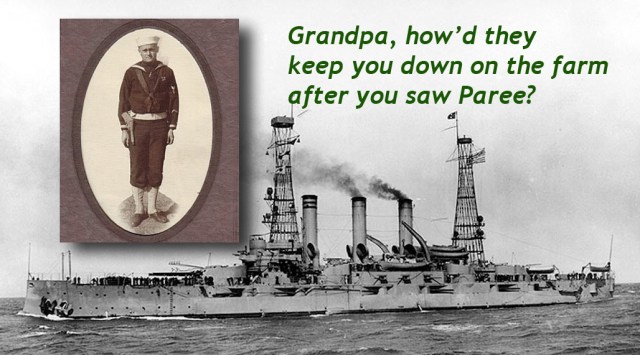
I’d love to discuss the details of the war with some eyewitnesses, but I waited too long. Both my grandfathers were in uniform during the war. Grandpa Addison was a corporal who never left the U.S. Grandpa Lawrence was a sailor who went to France, learned to speak French fluently, and returned home to Minnesota. He not only stayed on the farm after he saw Paree, he soon purchased his own acreage in the Catskill Mountains and operated a dairy farm.

I never asked him what he did in France. There is a picture of him dressed in a Shore Patrol uniform, and I could make up colorful stories of breaking up fights in Parisian bars, hauling drunken sailors to the brig, or whispering sweet nothings to some douce jeune fille across a bistro table. But none of those things sound like the Grandpa. And, sadly, I will never know.

I can only assume, then, that like others of his generation, Lawrence was profoundly affected by the war that cost 6 million lives, uprooted millions more, and changed the world forever. But he never talked about it.

If I had it to do all over again, I’d ask him about it. I can’t be sure he would have broken his lifelong taciturnity to tell the tales. But I wish I had asked.

Now all I can do is offer him a posthumous thanks for his service.

Whatever it was.

Posted in Uncategorized | 2 Comments