New Yorkers on the Money

newyorkersonthemoneyTreasury Secretary Jack Loo has announced a woman’s face will appear on U.S. paper currency in 2020 to commemorate the centennial of women’s suffrage.

It’s about time.

Now begins the debate about which woman should be on the money, and which man’s face should disappear.

Millions of U.S. spenders have already nominated their favorite great woman. Leading candidates include Susan B. Anthony, Rosa Parks, Sojourner Truth, Sacagawea, and Harriet Tubman. Any one of these women would enhance the righteousness if not the intrinsic value of U.S. lucre.

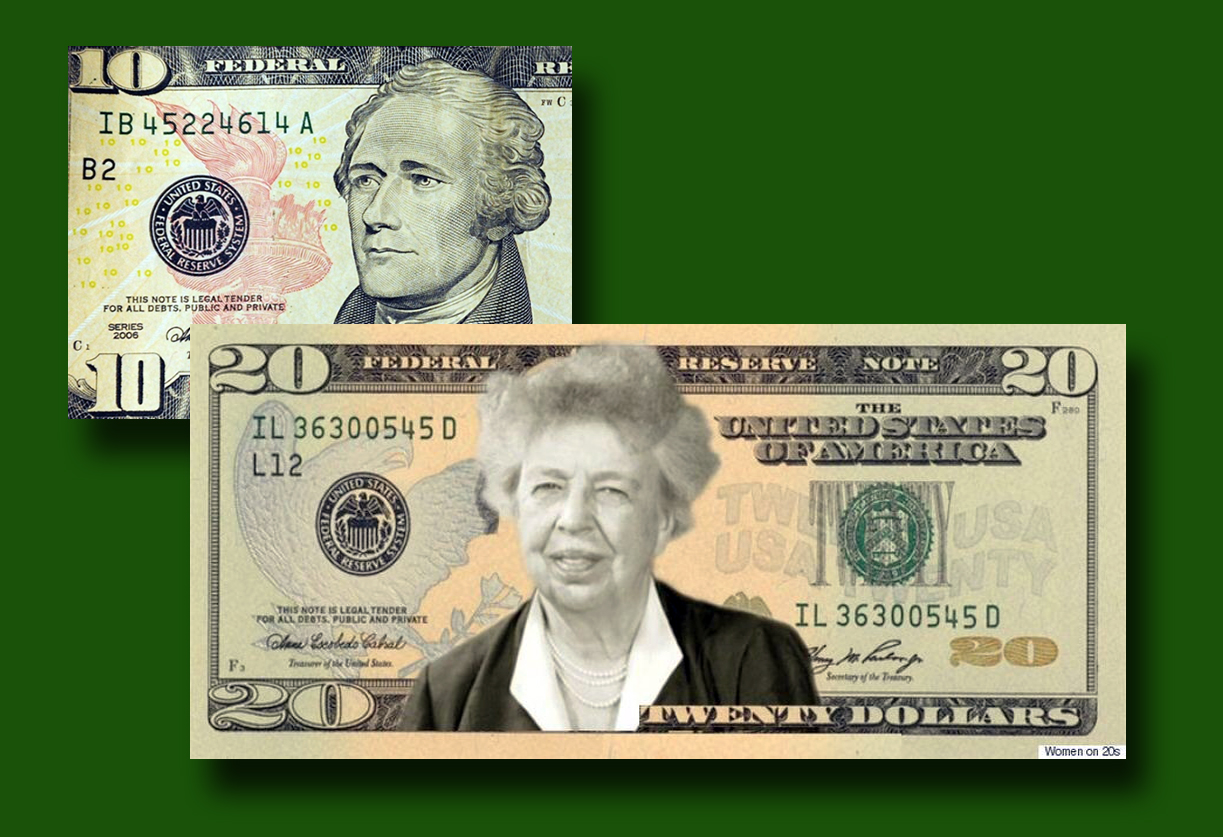
My own candidate to honor the money has long been Eleanor Roosevelt, one of the great figures of the 20th century, a defender of the poor and a tireless proponent of human and civil rights.

When I was a teenager, I wrote to Mrs. R several times and she always wrote back. She was her own typist, using an L.C. Smith Super Speed typewriter now on display at the Roosevelt Library in Hyde Park, N.Y., and her letters were always exemplars of concise warmth.  In 1962, I typed out my own list of seven questions and sent them to her as an interview-by-mail for my high school paper. Again, she replied with conscientious precision.

Frances_Perkins_TIME_FC_1933I’d be happy, of course, if the Treasury named any of the women named above because they all played an indispensable role in U.S. history. If I could nominate another name, it would be Frances Perkins, the first woman to hold a cabinet post (under FDR and Truman) and an unflagging advocate of the U.S. Labor movement.

But Secretary Loo has proposed that a woman replace Alexander Hamilton on the $10 bill.

That’s the wrong way to implement a great idea.

Hamilton is one of the indisputably great founders of the United States. He was the nation’s first Treasury Secretary and, according to his biographer Ron Chernow, set in place “the building blocks of a powerful state: public credit, an efficient tax system, a customs service, and … a strong central bank.” He was also – virtually alone among the founders – a lifelong opponent of slavery.

Many historians believe that Hamilton was singularly responsible for the success of President Washington’s administration, and some rank him above Jefferson and Madison in the pantheon of founders. He is not, however, a vivid figure in the U.S. collective memory, so it may have been easy for Loo to pass him over.

Hamilton’s prestige may grow now that Broadway virtuoso Lin-Manuel Miranda’s Hamilton has become the Great White Way’s second most successful musical (behind The Lion King). Clearly A. Ham. (as he signed his name) has the stuff of legendary lore, and our progeny may come to think of him as a folk hero.

Whether that happens or not, he is a far more preferable male candidate to stay on the money than Andrew Jackson, who currently adorns the $20 bill.

Jackson was a charismatic populist and undeniably colorful. He was even a bit of a childhood hero to Boomers who remember “Old Hickory” in The Adventures of Davy Crockett, and Charleton Heston’s spot-on portrayal in The Buccaneer.

Even before he won the Battle of New Orleans, Jackson earned a reputation as a brutal and sometimes sadistic Indian fighter. Among native peoples, Jackson is the evil author of the Trail of Tears and the genocidal remover of native peoples from their tribal lands. Jackson also stubbornly opposed abolitionist efforts to eliminate or curtail slavery in the U.S.
If ever there was a likely candidate to be fired from the money, it’s Andy Jackson.

Secretary Loo, here are my modest proposals:

Alexander Hamilton: keep him on the ten in honor of his immeasurable contributions to our country.

Andrew Jackson: take him off the twenty so his racist, xenophobic image will fade from our view.

Eleanor Roosevelt: put her on the twenty where her countenance may remind us of all that is right and decent about our native land.

Posted in Uncategorized | Leave a comment

We Are the Boogey Man

Reprinted from Senior Correspondent.

isBy Philip E. Jenks

“No human race is superior. No religious faith is inferior. All collective judgments are wrong. Only racists make them.” – Eliezer Wiesel.

An ugly thread twists like a lethal snake through our lives: Mass murder by a white man in an African American church in Charleston, S.C.; white cops shooting unarmed Black men; the mysterious deaths of African American women in jail; cops allowing minor encounters with citizens of color to spiral out of control; knee-jerk hostility and distrust aimed at all cops.

Where did that ugly thread begin, and why?

Elie Wiesel, a Holocaust survivor and social commentator, has an uncomfortable answer. All of these hateful events are fueled by the collective judgments all of us make about one another.

It doesn’t take a lot of imagination to figure out where we learned to hate or distrust “the other,” any person who does not look like us.

Collective judgments arose the first time a band of Neanderthals attacked a Cro Magnon encampment and ran off with the gourds. From that time on, images of bone-browed, beady-eyed, slack-jawed bad men were cited by Cro Magnon mothers to keep the kids from escaping the cave. The Boogey Man was born.

The Boogey Man – not always male because children in many cultures recoil from female phantasms – represents persons from any group we don’t like, trust or understand. This Boogey Person varies from culture to culture, depending on the particular brand of xenophobia the culture covets. For my Cuban father-in-law, he was “El Italiano.”

The Boogey Man is thousands of years old and was usually a member of an enemy camp or nation. Many historians trace the Boogey Man to Napoleon Bonaparte, whose army periodically threatened British shores. Known as “Boney” by the wary Brits, he was the scariest specter English mothers could conjure when they warned their children to stay close to the house.

By the time Napoleon was exiled on Saint Helena Island in 1815, he was more commonly styled the Boogey Man. There is a story that when the British caretakers on the island told their children that they were there to guard the Boogey Man, Napoleon was amused. According to some reports, he would place his index fingers on his head like horns and give chase to children as they ran giggling and screaming.

The Boogey Man is emblematic of the distrust and fear we have for people who are not like us. If we are honest with ourselves, the Boogey Man is lodged firmly in our genes. Those of us who think we’re free of him are in denial.

It is the Boogey Man that persuades depraved white men to launch a xenophobic war against persons of color. It is the Boogey Man that blinds cops to the humanity or persons of color and prompts them to shoot first and ask questions later. It is the Boogey Man that blinds persons of color to the humanity of cops and imagines them as fascist goons.

In our culture today, the Boogey Man is racism, the collective judgment we make against persons who are different. Racism persists in our culture like an infection and many who have the most virulent strain don’t even know they are sick.

Today in a million offices, schools, churches, and police stations, white folks will make stupidly racist remarks based on stupidly racist assumptions about persons of color. They will react to persons of color differently and treat persons of color differently – and, when challenged about it, they will be stunned and hurt because – as they will tell you – “I don’t have a racist bone in my body.”

But even in the age of Obama, racism flourishes and each day the majority finds a new way to make the minority feel marginalized. My daughter, who is racially mixed (as are my five other children), reacted this way a few years ago when President Obama tried to reconcile a cop who arrested a black university professor on his own porch because the cop assumed he was an intruder. Obama invited the cop and the professor to the White House for a beer. My daughter wrote in her Facebook update: “Elita wishes she could have a beer with the president every time she gets racially profiled.”

There were only a handful of African Americans in Madison County N.Y. where I grew up. Some of these persons of color may have been descended from slaves who settled in Peterboro, an outpost of the Underground Railroad operated by the abolitionist Gerrit Smith. Looking back, I am appalled by memories of how the white majority – including me – treated them. Black children were taunted with the ‘N’ word on the playground, or slapped by white teachers in school, and – in one memorable incident – subjected to an incredibly obtuse but well meaning teacher who used the ‘N’ word in a rhyme to select the next person to read from a text book: “eeney, meeney, miney mo …”

I can’t begin to imagine how uncomfortable we made children of color back then. And most of us oppressors would have insisted that we didn’t have a racist bone in our bodies.

I haven’t seen Tony Campolo for years, but judging from his press pictures, he’s the least changed of my Eastern Baptist College professors from the sixties.

Tony was known for making startling claims with ex cathedra authority, which was challenging in the day when you couldn’t vet his claims through Google, and he tried out some of his more famous lines on us: “Last night when you were sleeping, 30,000 kids went to bed hungry and you don’t give a shit about it. Worse, you’re more upset that I said shit than the fact that 30,000 kids are hungry.”

Once Tony said something, it was hard to forget it. Among the Tonyisms I remember:

“If you grew up in the United States, you are a racist.”

I first heard Tony say that in Soc 200 in 1968, and the notion surprised me. But as the years pass, I find fewer reasons to doubt it. I’m a racist, you’re a racist, all God’s children who grew up in the race-obsessed cauldron of American culture are racist.

Now, that’s not necessarily a peculiar aberration. Racism is a sin, and we all know we are sinners who fall short of the glory of God. To deny our racism is to deny we are sinners.

The next time you hear someone say, “I’m color-blind,” or, “I don’t have a racist bone in my body,” smile ironically and walk away.

Of course, there are also people who are not ashamed of their racism and flaunt it on Twitter and Facebook. Certainly people in the U.S. (and elsewhere) who openly tweet their hatred are to be feared.

Particularly scary are those white folks who complain they have lost their freedom and status because a black man has twice been elected president, and because the president declares a commitment to universal healthcare, economic justice, immigration reform, and gun control.

Those nervous white folks have difficulty seeing that they haven’t lost any freedoms because freedom is being offered to more people. In fact, the more races, ages, ethnic groups, and sexual orientations that are empowered in the U.S. system, the more freedom everyone has.

Be that as it may, the most dangerous people in America are not those who tweet their hatred openly.

The big problem is people who don’t believe they are racists.

That problem group may include you, me, Obama, Bill O’Reilly, Fox News, Rush Limbaugh, Al Sharpton, or anyone else who is supposed to have a dispensation from the sin of racism.

But racism is the Boogey Man that haunts us all. He is the great Satan who lives in every heart, and forces us to cringe in the presence of others we don’t understand or don’t like. This reality was understood by spiritual savants and mystics since the beginning of time. That is why Hillel, Buddha, Mohammed, Jesus, and others urged us to open our minds and hearts and treat everyone the way we would want to be treated. Because we naturally distrust our neighbor, the Creator added a non-negotiable caveat to our existence: Love Thy Neighbor.

Loving our neighbors and loving our enemies is the only defense against the Boogey Man.

Repeating the gospel of Campolo: “You can’t grow up in the United States without being a racist.”

But there is no defense against the Boogey Man if we keep looking for him in the camps of persons we neither like nor trust.

The Boogey Man is far closer and far more dangerous than that. When we examine our own hearts, the unpleasant reality becomes all too clear.

We have met the Boogey Man. And he is us.

Posted in Uncategorized | 1 Comment

Harold Wilke and the ADA

haroldwilkepicsBy Philip E. Jenks

July 28, 2015 – Harold Wilke stared thoughtfully into his coffee cup and swirled the dark liquid in a gentle arc.

It was the 1980s, and we were sitting together at the head table of an ecumenical banquet, unusual for me but not for him. I was asking him for some biographical details so I could introduce him to the group.

Wilke, trim and distinguished in a dark suit and clerical collar, betrayed his puckish sense of humor. He raised the cup to his lips and smiled. “Tell them how I get dressed in the morning,” he said. “People always want to know.”

“How does that work?” I asked.

He put the cup on the table and leaned toward me with a conspiratorial grin. “My trousers, shirt, and jacket are sewn together into a single garment,” he said. “I lay them flat on the floor and slither into them like a snake.”

His grin broadened and his eyebrows danced like small centipedes. I didn’t mention Harold’s sartorial tactics in my introduction, but I laughed. One thing everyone remembers about Harold, who died in March 2003, is that he had a knack of making people around him feel comfortable.

He knew most people don’t have a social plan for engaging an armless man, and polite people may feel awkward around a person who uses his left foot to write, eat, and swirl his coffee, all with graceful motions. But by the time I had dined with him for fifteen minutes, his unaffected manner and warm conversation had diverted my attention from his uncommon style of eating.

Harold H. Wilke, a United Church of Christ minister, was born without arms on a farm in Washington, Mo, in 1915. In rural America prior to World War I, his disability was considered freakish and his first test in life was to avoid being shunted aside to a dark bedroom or soulless institution.

Without arms, he naturally used his feet to grasp food and other items. As he grew to adulthood, he could stretch his left foot to his head to scratch his nose, wash his hair, feed himself, and hold a pen. His foot writing was elegantly legible.

All of this he accomplished on his own. There were no social programs in pre-World War II America to assist him. His local elementary school in Missouri thought he would be a distraction to the other children so they told him not to come. According to Fred Pelka, a historian of the disabilities rights movement, Harold was forced to walk miles each day to another school.

He faced similar discrimination in college where he was forced to eat apart from his fellow students in the kitchen. In later life, Wilke rarely talked little about being a target of adolescent taunting when he placed a fork between his toes to eat, but it must have been intense. Sadly, the disdain never entirely disappeared. In the mid-1980s, a staff supervisor summarily rejected my recommendation of Harold as a keynote speaker for a Baptist banquet supporting Christian education. “I can’t imagine the boss sitting with someone who eats with his feet,” she said.

Wilke was ordained in 1939 by the Evangelical and Reformed Church, a conservative branch of what later became the United Church of Christ. He attended Eden Theological Seminary in St. Louis and Union Theological Seminary in New York, where he was a student of Paul Tillich and Reinhold Niebuhr.

I remember watching Harold preach as he stood erect behind a pulpit dressed in a black robe and clerical collar. His homiletical style was understated but engaging and his eyes scanned the room to connect with each member of the congregation. He would stress certain points by tossing his head in the manner of FDR, the paraplegic president whose hands were locked on the podium with white-knuckled ferocity to keep from falling.

“When I’m wearing a robe, people don’t notice I don’t have arms,” he’d say, smiling. “But some people tell me, ‘I see you’re not one of those preachers who pounds the pulpit.’”

Harold Wilke was an early advocate for the rights of disabled people, both in the church and in government. Elaine Woo, writing his obit in the Los Angeles Times, quoted Hugh Gallagher, a polio victim who drafted early legislation supporting the rights of disabled people:

“(Harold) was recognized by disabled people across the country as a leader and innovator — one of the first of the people to believe in disability rights as a movement. We’d all been disabled for years, but in a medical context: We were sick people who never got well. The disability rights model is that we are oppressed people who were denied our civil rights. Harold was instrumental in developing this concept, which is the key to the whole disability rights movement.”

Americans With Disabilities Act

Harold was also instrumental in the passage of the Americans With Disabilities Act (ADA), signed by President George H.W. Bush 25 years ago this month.

The act was born in the gone-but-not-forgotten era of political bi-partisanship. Poppy Bush was experimenting with “kindler, gentler conservatism,” and not even Strom Thurmond was cold-hearted enough to ignore persons who reminded him of wheel-chair bound baseball hero Roy Campanella or blind and deaf Helen Keller, both adored by voters.

Today, two realities stand out about the ADA.

One, nearly all Americans benefit from the act, or will when the ravages of age and disease catch up with them.

And two, it could not pass in the partisan morass that paralyzes Congress today – an analysis affirmed by former Senator Bob Dole, a disabled veteran who was a sponsor of the bill.

It’s that latter point that makes me wish great leaders like Harold Wilke still walked among us.

The Americans With Disabilities Act requires employers to provide “reasonable accommodations” to employees with disabilities, and obliged businesses to make all public places accessible to everyone.

It is the ADA that requires mechanical lifts on buses, curbside ramps on street corners, ramps bypassing steep steps, and other accommodations for wheel chairs. Telephones, televisions, computers, and other electronic media are now designed to assist persons unable to see or hear their messages. Virtually none of these things existed a quarter century ago, and there was widespread criticism that businesses would be bankrupted by the ADA’s requirements. Today, all of these improvements are taken for granted.

A list of conditions considered disabilities embraces vast numbers of Americans: deafness, blindness, an intellectual disability (formerly termed mental retardation), partially or completely missing limbs or mobility impairments requiring the use of a wheelchair, autism, cancer, cerebral palsy, diabetes, epilepsy, Human Immunodeficiency Virus (HIV) infection, multiple sclerosis, muscular dystrophy, major depressive disorder, bipolar disorder, post-traumatic stress disorder, obsessive compulsive disorder, and schizophrenia.

My family – and certainly yours – has members in more than one category of disability. My mother was legally blind until she received cornea transplants in the 1960s. My father, a World War II veteran of the bloody Buna campaign in Papua New Guinea, showed signs of post-traumatic stress disorder. Cousin Donny had Down Syndrome. Cousin Grace lived her life in a wheel chair.

Closest to home, daughter Katie, 28, is autistic. I can’t imagine what life would have been like for Katie and our family were it not for the Americans With Disabilities Act and other government services that were made possible by the ADA.

In the same way, I can’t imagine what our life would have been like without the advocacy of Harold Wilke and others who helped the public understand that persons with disabilities have unalienable rights that the government is bound to recognize, and who helped push the ADA through Congress.

Harold, dressed in a crisp dark suit, stood directly behind President George H. W. Bush when he signed the Americans With Disabilities Act on July 26, 1990. When the president turned to give Harold a souvenir pen, Harold slipped his left foot out of his loafer and grasped the pen with his toes. The president beamed and the crowd applauded.

Twenty-five years later, we continue to applaud the act and all it has met to millions of Americans. And we continue to thank God for Harold Wilke, whose birth defect first created the illusion God had played a terrible joke on him.

But God had actually given him gifts beyond measure, and millions today still benefit from his life among us.

For more about Harold Wilke, read his memoir, Angels on my Shoulders and Muses at My Side (Abingdon Press, 1999).

Posted in Uncategorized | Leave a comment

Stars and Bars and Scars

starsandscarsSouthern heritage has been on the hot seat recently.

In South Carolina, politicians are forced to recognize the Confederate flag for what it is, an icon of white supremacy and racism.

And in the literary world, fans of Harper Lee’s To Kill a Mockingbird are scandalized that Lee now reveals the heroic Atticus Finch as a racist segregationist.

The New York Times reports:

“Shockingly, in Ms. Lee’s long-awaited novel, Go Set a Watchman, Atticus is a racist who once attended a Klan meeting, who says things like ‘The Negroes down here are still in their childhood as a people.’ Or asks his daughter: ‘Do you want Negroes by the carload in our schools and churches and theaters? Do you want them in our world?’”

We all have lawyer acquaintances who were inspired by the earlier Atticus to become attorneys. My heart breaks for them.

At the same time, I wonder if the Atticus of Watchman, which takes place in the 1950s civil rights era, is all that different from millions of righteous white southerners of the era. I have known quite a few decent, caring people who thought like Atticus.

In the early 1960s, one of my mentors when I was an Air Force chaplain’s assistant at RAF Station Bentwaters/Woodbridge in England was a Southern Baptist chaplain from Arlington, Va. He was soft-spoken and kind. He treated everyone with respect, regardless of race, age, or gender (or, I might add, their military rank). He stood up for African American airmen when they were mistreated in the barracks. He was horrified by the mistreatment of blacks in the south.

I regarded him as a model of Christian decency and propriety. And yet, in retrospect, I’m sure that in 1967, he thought a lot like the latter day Atticus. Like most of us in this era (of course I include myself), it was difficult for even the most righteous to gauge the true depth of our racism. Racism was so deeply entrenched in our culture, north and south, that we lost the ability to recognize it for what it is.

The armed forces of the United States were integrated in 1948, and by the mid-sixties blacks and whites lived in the same barracks, reported to the same duty sections, ate in the same mess hall, and worshipped side by side in the same chapel.

But it wasn’t easy. Many of my white friends would wait until a black airman had left the room and launch a vicious verbal attack. “Ain’t that just like a lazy, stupid n—–?” they’d complain, expecting I would agree with them. I didn’t have the courage to protest, and I told myself that if things got out of hand, the chaplain would intervene. *

The chaplain and his family rotated back to the states six months before I did, and when my tour was up I arranged to visit him at his new station, Shaw Air Force Base in Sumter, S.C.

I stopped by to see the chaplain and his family in February 1968 before reporting to my new assignment at McConnell Air Force Base, Kans. The first thing the chaplain did was take me to Sunday services at a small white Southern Baptist Church near Sumter. The visit was memorable, for me, because the pastor – also white – kept punctuating his sermons with “wise words” from “an old n—– preacher.” He used an exaggerated Joel Chandler Harris accent to complete the effect.

Perhaps he was making the point that wise sayings are not racially exclusive, but I told the chaplain I was shocked to hear the ‘n’ word used from a pulpit.

“Aw, everyone uses it here, both colored people and white people,” he explained. “It doesn’t mean anything.”

The next day, the chaplain and I decided to take a trip from Sumter to Charleston, where a mutual friend Bentwaters/Woodbridge was waiting to take us to lunch. We invited a staff sergeant friend of the chaplain’s to join us and hopped into a cavernous Chevy wagon for the three-hour drive to Charleston.

Even in February, the South Carolina countryside was beautiful and the chaplain and I began telling the sergeant diverting tales of our last assignment in rural England. After about an hour, the car engine began to gasp and the chaplain pulled off the road.

“Out of gas,” he said. We were in the middle of nowhere, a long way between Sumter and Charleston.

“I have an old gas can in the back,” the chaplain said. “When was the last time we passed a gas station?”

“I think there was one back there,” the sergeant said, gesturing down the long road we had just traveled.

The chaplain got out of the car to retrieve the gas can and handed it to me. Military life simplifies many decisions, and the fact that both my companions outranked me made it obvious that I would volunteer to buy the gas.

“Wait here,” I said, stressing the irony. And I took the can to the side of the road and stuck out my thumb.

Even in bucolic South Carolina in the sixties, a hitchhiking stranger was suspicious and several speeding cars ignored my honest white face.

Finally, a beige Lincoln Continental pulled over. The driver was a large, middle-aged white man wearing a crisp blue blazer and a Stetson hat like Harry Truman’s. The man was smoking a Winston cigarette, which was not unusual in South Carolina in 1968.

“Where to, Son?” the man asked, stifling a wheeze.

“Ran out of gas,” I said. “Can you take me to the nearest gas station?”

“Hop in,” he said. The man tossed his Winston out the window and pressed his dashboard lighter against another one.

“We see a lot of GIs in these parts,” he said, although I was in civilian clothes and had not mentioned I was an airman. I sat quietly as he reminisced between drags on his cigarette and raspy wheezes about his own service in Texas during the Second World War.

“Never fired a goddamn shot,” he said.

As his anecdotes unfolded, I noticed a gas station ahead and was a little surprised when he passed it. Trying to keep the conversation going, I told him why I was in South Carolina and where I was headed. He nodded attentively and sped passed a second gas station on the right hand side. I rustled the gas can in my lap to remind him of my mission.

When we surged past a third gas station I pointed it out to him. The man coughed wetly and tossed another cigarette out the window. “Yeh,” he said. “Well, shit, Son, those is n—– garages.”

Obviously, he intended the explanation to suffice. A full cigarette later, he pulled into a gas station that had his approval and I jumped out.

I filled the tank and went back to the road to stick out my thumb. Immediately, a battered pick-up pulled over and I jumped in. The driver was a black man wearing a cloth cap and overalls.

“Thanks for stopping, Sir,” I said. “My car is down the road a few miles.”

The man nodded and the transmission grated loudly as he put the truck in gear. He didn’t say much, but he smiled when we passed the first gas station that I had obviously spurned.

When we passed the second, I shifted uncomfortably in my seat. When we passed the third, I feigned good humor and said, “Almost there.”

“Yes, Sir,” the driver drawled.

When we pulled up to the stranded car, the chaplain and sergeant were engaged in quiet conversation. They didn’t notice the driver of the truck who had delivered their gas to them.

“Let me give you something for your trouble,” I told the driver as I fumbled for my wallet.” “No, Sir,” the driver said, adding inscrutably, “Angels unawares. Angels unawares.” And the truck’s muffler popped loudly as he eased onto the highway.

I told the chaplain and the sergeant what had happened, but they soon lost interest in my account and changed the subject.

It was my first encounter with the Jim Crow south, and it stayed on my mind all my life.

I have also never forgotten the chaplain who met so much to me when I was young and considering what Southern Baptists call “full time Christian service” as a career.

In many ways, he was a perfect embodiment of Jesus, a devoted Christian who tried to love God and to love all his neighbors, regardless of race, as he loved himself.

But, perhaps like Atticus Finch as Harper Lee saw him in his later years, he was so immersed in the racist culture in which he lived that he lost the ability to see it clearly.

This, of course, is not unique to the American South. It’s a condition of growing up in the United States, and it affects us all. And as we watch Atticus develop in the subsequent chapters of Harper Lee’s new novel, I hope we will not be so quick to condemn him with our righteous disappointment.

Atticus is, after all, a mirror image of most of us: a good and righteous person struggling to discover the human truths that are hidden in the dense fog of our upbringing. And who can condemn him for that?

See also http://thelittlescroll.blogspot.com/2009/07/racists-r-us.html

________

* Another figure who made white airman hesitate to express their racism on Bentwaters/Woodbridge was the vice wing commander, Colonel Daniel N. “Chappy” James, a charismatic but physically intimidating giant of a man. James went on to become the first black 4-star general in the Air Force.

Posted in Uncategorized | Leave a comment

Welcome Back, Carter

jcBy Philip E. Jenks

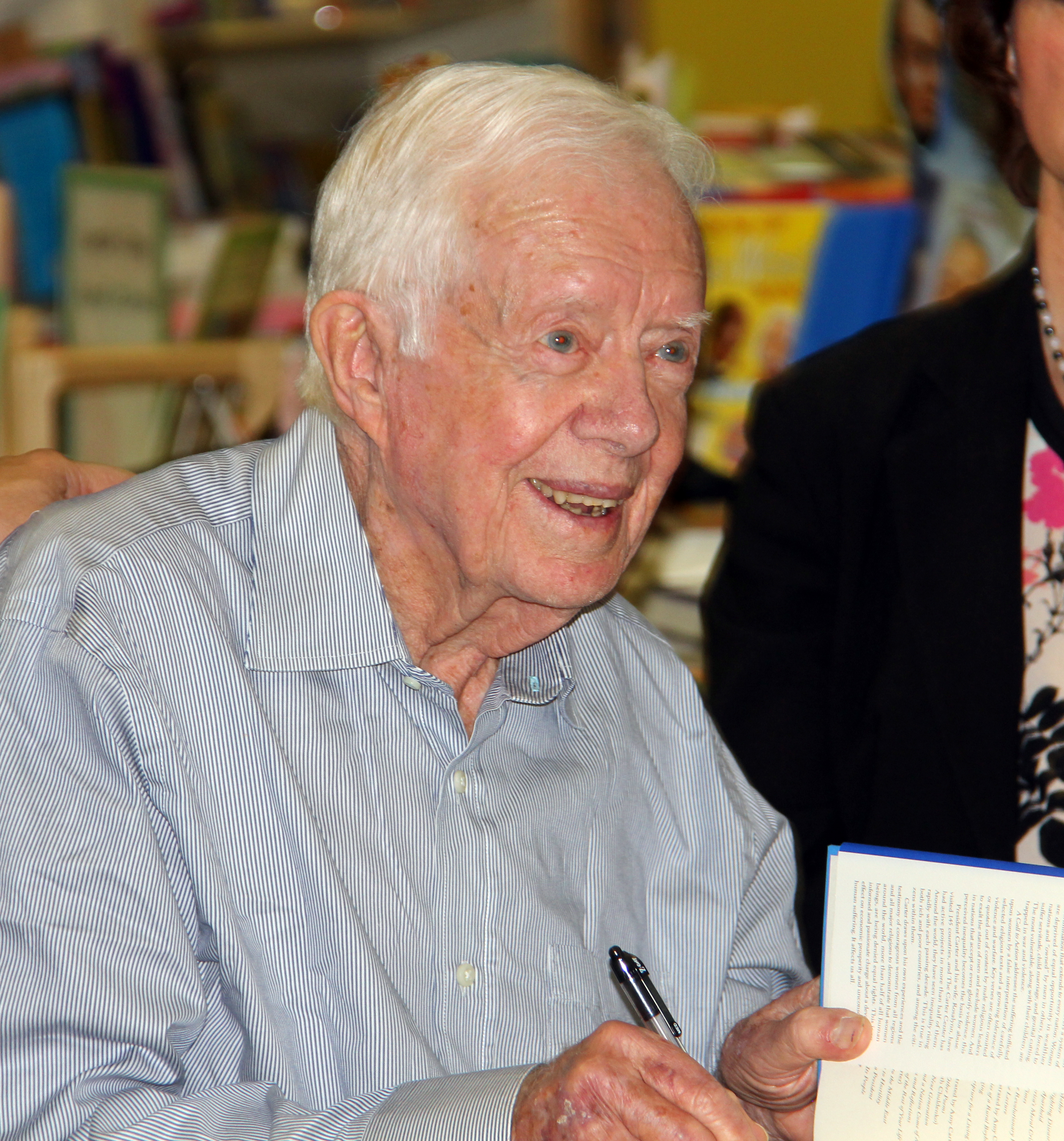
July 10, 2015 – Jimmy Carter, now in his 91st year, has been out of office longer than any millennial has been alive.

That makes him extraneous to the majority of living Americans, and even those who remember his presidency dismiss him as a fleeting peculiarity between Watergate and Reagan.

Yet those of us with long memories suspect Carter’s political setbacks were not only due to factors beyond his control but exacerbated by a press that didn’t always get the story right.

Nicholas Kristof, writing this week in the New York Times, suggests the press owes Carter an apology. Recalling the media’s merciless exaggeration of a non-incident – Carter’s alleged encounter with a wild-eyed rabbit that attacked his rowboat – Kristof writes,

“One of our worst traits in journalism is that when we have a narrative in our minds, we often plug in anecdotes that confirm it. Thus we managed to portray President Gerald Ford, a first-rate athlete, as a klutz. And we used a distraught rabbit to confirm the narrative of Carter as a lightweight cowed by anything that came along.”

Lost in the narrative is the image of Carter as an assertive leader who championed civil rights, pressed for human rights around the world, sought international peace, and always tried to do the right thing.

It was that latter trait, some say, that did him in, not only in the press but also in the darker passages of government.

Miles Copeland, a CIA functionary, complained in a 1990 interview with Robert Parry that “Carter was a Utopian. He believed, honestly, that you must do the right thing and take your chance on the consequences. He told me that. He literally believed that.” Parry later recalled that “Copeland’s deep Southern accent spit out the words with a mixture of amazement and disgust.”

There is a dubious conspiracy theory that the CIA and its media cohorts worked hard to damage Carter’s reputation and assure his defeat in the 1980 election. The theory is interesting but doesn’t give due credit to Ronald Reagan, the best presidential campaigner since Franklin Roosevelt.

There are many reasons Carter lost the election of 1980 (including the one cited by George McGovern to explain his disastrous defeat in 1972: “Lack of votes”).

But it is good to see Carter’s reputation slowly restored by journalists and historians, including Kristof and Randall Balmer, whose astute Redeemer, the Life of Jimmy Carter, places Carter in the venerable American tradition of progressive evangelicalism.

It is that tradition, in fact, that first attracted me to Jimmy Carter.

When he moved into the White House he became the world’s most famous Baptist.

Naturally, ambitious Baptist bureaucrats scrambled to meet him so they could drop his name.

I admit I was among those Baptists who thought it would be great to meet him. At it turned out, my first encounter was a bit of a misadventure.

In 1977 I was 32 years old and editor of The American Baptist magazine, the official organ of American Baptist Churches in the USA. The magazine itself founded in 1803 and billing itself as “the oldest religious periodical with continuous publication in the western hemisphere,” had gravitas. I had no such thing, and I was eager to be seen engaging the president of the United States in Baptist small talk.

That year President Carter signed treaties to turn the Panama Canal over to Panama. Barry Goldwater and Ronald Reagan called upon the Senate to reject the treaties, but John Wayne was for them, and Carter should have known that the Duke trumps a Goldwater and Reagan in any game. But he launched a public relations campaign to win popular support for the treaties, and he invited many maxi- and mini-molders of public opinion to the White House to make his case.

Among the molders were religious journalists who went to the White House to hear the president make his case. A couple hundred journalists came from every religious tradition, and we shuffled respectfully into the East Room of the White House where rows of folding chairs had been placed.

I had never been to the White House and I prepared carefully for the occasion. I bought a new tan suit and new earth shoes that not only squeaked on the shiny floor but also had unusually low heels that kept me off balance. I carried in my side pocket a copy of Input, the newsletter for American Baptist professional leaders, which published a statement of American Baptist support for the treaties. I wanted to give the statement to the president so I shrewdly sat a few chairs from Jim Wall, editor of The Christian Century. Jim, a Georgian, was known to be a friend of Carter’s and I calculated the president would probably notice him in the chairs.

At the appointed hour, a shrill voice called out, “Ladies and Gentlemen the president of the United States.” We stood, and Jimmy Carter strode purposefully into the room. He was dressed in a light-gray plaid double knit suit and he flashed his familiar smile as he headed for the podium. Ambassador Ellsworth Bunker, who was charged with giving the treaties diplomatic heft, and National Security Advisor Zbigniew Brzezinski, flanked him. Bunker, tall and glum, and Brzezinski, with his trademark cowlick, seemed resigned and weary, as if their silent support had been required for more than one presidential briefing.

Carter spoke briefly on the moral obligation and legal logic of the treaties, and stepped away from the podium. The crowd stood at once and we began pressing toward the president, hoping to catch his eye. Jimmy Carter is warm and nearly charismatic when he is pressing the flesh, an attribute never captured on television. He grabbed hands and spoke easily to African American pastors, lavishly dressed bishops, bearded rabbis in black suits, and Baptist editors in white belts and double knit pants. I heard Carter say, “Hi, Jim,” to Wall as I squeezed among the clerics.

I worked my way behind the president’s back as he shook hands with a purple-vested bishop and I reached into my pocket for the copy of Input. Behind me was my friend William Dudde, a Lutheran writer, and behind Bill was an unknown admirer pushing eagerly forward. The admirer thrust himself against Bill, who lost his balance and pushed heavily against me. I lost my footing in my new earth shoes and fell rudely against the president’s back. I smelled his soap and hairspray.

Both Carter and the Secret Service must have been inured to unplanned jostling in crowds, so I was not – as I briefly expected – wrestled to the ground by security agents.

Instead, Carter turned and scowled at me with his clear blue eyes, the “fishy-eyed stare” he reportedly gave to people who annoyed him.

He started to turn away again and I forgot all about the copy of Input. “Mr. President,” I said hurriedly, “American Baptists are for you.”

He smiled slightly and took my hand.

“Thanks,” he said. “I need all the help I can get.”

Weeks later, the White House sent a wide-angle black and white photograph to all the participants. It shows President Carter smiling in the midst of the crowd. I am standing a few steps behind Carter, also smiling and probably rehearsing a speech I wanted to give the president about Baptist support for the treaties.

Providentially, the picture was taken before I could get any closer. I lost it years ago, and it’s just as well.

Happily, I had several more brief encounters with Jimmy Carter over the years which ended without mishap. Each time I was impressed by his graciousness and easy manner. He is never an intimidating presence, despite his international fame and the awesome power he once held. I once attended a meeting on health care sponsored by the Carter Center and was filling my plate at a buffet offering fruit, veggies, and granola.

“Statistics show the Mormons live the longest because they don’t use caffeine and eat healthy food like this,” said someone standing just outside my line of sight. I turned and recognized the former president, also filling his plate.

“This is very healthy,” I replied redundantly. A Baptist colleague who thought the buffet was sadly lacking whispered loudly enough for the president to hear it, “I want steak. I’d rather live with Jesus than in Salt Lake City.”

Jimmy Carter is now 90, and I hope he lives long enough to see more pundits and journalists acknowledge the wisdom, courage, and strength he brought to the White House and in all the years before and after his presidency.

He may have been, after all, the only president in recent memory who genuinely believed “that you must do the right thing and take your chance on the consequences.”

That alone should qualify him for a statue somewhere. And I would like to think more than one candidate in the forthcoming election might honor the model offered by the much-disparaged 39th president of the United States.

But I think it’s more likely that the candidates will adopt more cynical approaches to their pursuit of power, and historians will note that the president who always tried to do the right thing remains unique in his time and, sadly, in all time.

See also: https://cakesandale.org/2014/03/27/jimmy-carter/

Posted in Uncategorized | 1 Comment

Stan Freberg. Cue the Cherry.

Stan_Freberg_2009This morning I’m celebrating the life and mourning the passing of Stan Freberg, a closet Baptist and certifiable communications genius.

His LP album, “Stan Freberg Presents the United States of America,” was widely regarded as the best comedic audio recording in the English language. I can still recite long passages from it, including Freberg’s send-up of patronizing liberals as the pilgrims sing, “Take an Indian to Lunch.”

Freberg would have left fictional Mad Man Don Draper in his dust. In the sixties and seventies he generated some of the most effective commercials on television, including the incomparable “Hi, Ho Pizza Roll,” which elevated a mundane snack to a sublime experience.

In the seventies, Freberg was a powerful influence on my colleagues and me in the American Baptist Division of Communication, and we listened with conviction to his minute-long demonstration showing radio stretched the imagination more effectively than television:http://youtu.be/ppZ57EeX6vE

Great bit, Stan. Cue the Cherry.

Posted in Uncategorized | Leave a comment

Religious Extremists. What’y’a gonna do?

Charlie Hebdo terrorism attackReprinted from Senior Correspondent. This was written before so-called Islamic State terrorists burned a captured Jordanian pilot alive — an unspeakably depraved act that has enraged Muslims and the Arab world.

By Philip E. Jenks

What ‘y’a gonna do? The question, accompanied by a weary shrug, is rhetorical. Some problems are so big nothing can be done.

So it is with the scourge of religious extremists who populate sinister organizations with which the U.S. is at war: Al Qaeda, the Islamic State, and a host of collateral groups with common goals. And while they directly threaten few in the U.S., it is chilling to know one of their goals is to kill Americans.

The so-called war on terrorism is 161 months old but the threats continue unabated. Horrible images appear on our HDTV screens with nauseating clarity. Masked terrorists coolly decapitate innocent captives whose only crime was to be in the wrong place at the wrong time. Boko Haram extremists kidnap schoolgirls to use as pawns in their fight against a corrupt and ineffectual Nigerian government. In Paris, Islamist gunmen seeking to avenge slurs against the Prophet slaughter writers and cartoonists. A triple suicide bombing in Iraq mutilates and kills 58 civilians.

Who are these people? Why do they hate us so much? And what are we going to do about it?

The answers to these questions are elusive for several reasons. One is that most westerners have scant understanding who these radical extremists* are, and – if they are Muslim as they claim – why they appear to have lost touch with the basic truths of Islam.

Virtually all radical extremists would identify themselves as strictly adherent Muslims.

Yet most observers – including most of the world’s 20.8 billion Muslims – see little connection between the extremists and the teachings of Mohammed. “Show mercy to those on earth so that He who is in heaven will have mercy in you,” the Prophet said. (Sunan At-Tirmidhî) “Whoever is deprived of gentleness is deprived of all good.” (Sahîh Muslim)

Mohammed also offered advice that would benefit all persons of faith. “The religion (of Islam) is easy,” he said. “No one ever made it difficult without it becoming too much for him. So avoid extremes and strike a balance, do the best you can and be cheerful, and seek Allah’s help (through prayer) in the morning, and evening, and part of the night.” (Sahîh Bukhârî)

Following the attack on Charlie Hebdo journalists in Paris, Muslims around the world rose up in protest against bloody acts by extremists that do more harm to Muslims than their intended targets. Arab Journalist Abdul Rahman al-Rashad, quoted by Thomas L. Friedman in the New York Times, called upon Muslims to go even further to repudiate extremism. “The story of extremism begins in Muslim societies,” wrote al-Rashad, “ and it is with their support and silence that extremism has grown into terrorism that is harming people. It is of no value that the French people, who are the victims here, take to the streets. … What is required here is for Muslim communities to disown the Paris crime and Islamic extremism in general.”

Even so, if the words of the Prophet himself are insufficient to nudge violent extremists toward God’s truth, how are the rest of us to understand what motivates them? And, short of confronting them with superior military strength, is there anything that can be done to stop them?

These questions are heatedly discussed in Christian and Jewish circles. Christians in particular, who follow the paradigms of the Prince of Peace, claim a vast gulf between their own idealistic faith and the wild-eyed perpetrators of cruel violence.

But perhaps the gulf is not as wide as it appears, and perhaps violent extremism is not so much an aberration as a dormant impulse in the unconscious minds of persons of faith. Of course we recoil at the carnage brought about by fundamentalist extremists. But our horror may be a reaction to genetic memories of our own Christian barbarism that took place not so long ago.

It is appalling indeed to be reminded that similar brutal acts — and worse — have played a pivotal role in Christianity’s own dark history. Our past is sated with live burnings, disembowelments, and the drawing and quartering of human bodies, all theologically designed to give heretics a suitable send-off to eternal damnation. An Internet search of torture implements of the Inquisition makes simple decapitation seem humane by comparison.

At the root of all these tortures is the conviction of some religious people that their faith is correct and those who have a different faith ought not be allowed to live. And despite relatively rare examples of saints whose lives were loving and kind, the main story of Christianity since the third century has been one of murderous crusades, anti-Semitic pogroms, religious wars, and the sadistic torture of perceived heretics.

One of the more telling examples of misdirected sanctimony took place in Holland in 1569. A Mennonite preacher named Dirk Willems was so sure he was acting Christ like by rejecting the state church that he refused to back down when his Dutch Lutheran neighbors jailed him for heresy. When Willems escaped from jail, his Lutheran neighbors, in order to be Christ like, hotly pursued him. In the heat of the chase across a frozen pond, one Lutheran fell through thin ice and was about to drown. Willems, being Christ like, stopped running and pulled the man to safety. The Lutheran, being Christ like, arrested Willems immediately – and burned him at the stake.

It’s small wonder that oppressed religious minorities hopped on the first Mayflower to the new world, where freedom from persecution seemed assured. But freedom didn’t come immediately. The Puritans — one of whom was Oliver Cromwell, infamous for his genocidal murders of Catholics in Ireland — sought religious liberty for themselves but denied it to others. In 1651, the Puritan establishment in Boston arrested and whipped the flesh off the back of Baptist Obadiah Holmes because he held an unauthorized worship service in Lynn, Mass.

Today, of course, Christians are more ecumenical, and in 2015 we are pained to remember how our ancestors deviated from the path of the Prince of Peace. Not that we have changed that much. “I like your Christ,” said the Hindu Mahatma Gandhi. “I do not like your Christians. Your Christians are so unlike your Christ.”

Gandhi knew Christians didn’t burn each other at the stake any more, but neither were they were entirely free of the primordial drive that made them do it in the first place. It is, after all, a distorted application of Christian views that inspired the beating, rape, and lynching of African Americans, the bombing of churches and public buildings, the murder and beating of LGBT persons, and more.

Religion is a nasty business. And as we seek to understand what motivates extremists, we can get some insight by peering into a mirror darkly. We are humans, and we share ontological weaknesses. Our innate human ability to hate aggressively is at the heart of the human soul. Why do extremists hate us so much? Because they can.

Even so, extremists don’t hate us just because they don’t like our looks or the cut of our credos. We have given them ample reason to mistrust and despise us.

Meetings between U.S. religious leaders and Iran President Mahmoud Ahmadinejad in January and February 2007 revealed remarkably different views about the two countries.

The Rev. Dr. Shanta Premawardhana, then associate general secretary for interfaith relations at the National Council of the Churches of Christ in the USA (NCC), was part of a 13-member delegation in Iran representing the Mennonite, Quaker, Episcopal, Roman Catholic, Baptist and United Methodist churches.  They spent six days talking with Iranian religious leaders, government officials and general citizens.

Premawardhana said the group reminded Iranian leaders of the simmering U.S resentment over Iran’s capture of 52 U.S. hostages for 444 days from November 4, 1979 to January 20, 1981. The brazen act sanctioned by the Ayatollah Ruhollah Khomeini continues to enrage Americans.

But the Iranian narrative is quite different, Premawardhana pointed out. For them, the enduring image of the U.S. is the bully that overthrew the democratically elected Prime Minister Mohammad Mosaddegh in 1953 and replaced him with the hated Shah Mohammad Reza Pahlavi, who was regarded as a tyrant.

The Iranian story is one of many outrages and indignations suffered by Muslim caliphates and governments at the hands of European powers, ranging from the bloody medieval crusades to remove Muslim “infidels” from the Holy Land to the systematic seizing of land and redrawing of traditional national boundaries by imperialistic European oppressors. U.S. and European citizens who wonder why they are hated scantly notice this history, but Muslim children are thoroughly immersed in the tradition.

Today, a new narrative has formed. U.S. drones and aircraft that target suspected extremist leaders in Pakistan, Afghanistan, Somalia, and Yemen are also killing uncounted numbers of civilians, including children and first responders. In addition, scores of suspected terrorists have been held for years in Guantanamo and other prison facilities without charges and, in many cases, without convincing evidence. For a generation of Muslims who played no role in the terror attacks of September 11, 2001, it may be regarded as heroic to support extremists or join their ranks.

So what are people of faith going to do about this inextricable mess? How are we going to stop the killing, the drones, the suicide bombings, the terror?

It’s tempting to suggest that religious leaders already have the answers in their own traditions. Mohammed and Hillel both spoke out against violence and hatred, and the loving words of Jesus have been amplified by panoply of saints: Teresa, Ignatius, Francis, Romero, and more. Few have been listening to them so far, and there is no good reason to believe their words will have an impact now.

On the other hand, it beggars belief that the three Abrahamic faiths that changed the world no longer hear God’s true voice, or embrace their power to speak God’s truth to one another.

Abdul Rahman al-Rashad is partly right. His call for Muslim communities to rise up and repudiate terrorism and extremism is important.

But equally important is for Muslims and members of all faiths, especially the Abrahamic trio, to rise up and renew the message of love that emanates from the God they all worship. The young terrorists who believed virgins in heaven would reward their martyrdom somehow missed the cautionary words of the Prophet himself: “You will not enter paradise until you have faith. And you will not complete your faith until you love one another.”

For U.S. leaders, most of who reside in the Abrahamic tradition, an important next step would be to acknowledge errors in foreign policy that enraged Muslims and pushed them to the brink of murderous extremism.

No one, of course, expects that to happen, and I can’t imagine any president of the United States admitting that launching CIA-led coups, propping up brutal regimes, or launching deadly drones were errors.

So if truth is to be told, it falls to religious leaders to tell it. Alas, as any priest, minister, rabbi or imam will tell you, speaking God’s truth in any house of worship can be politically hazardous.

But the truth that must be told, as hazardous as it may be.

The late Bob Edgar, former general secretary of the National Council of Churches and President of Common Cause, never hesitated to speak truth to power, said, “A central tenet of the Christian faith is that Jesus is the Son of God, that he is God, and that in the Bible he speaks for God,” Edgar wrote in 2006.

“There are ‘red-letter’ editions of the Bible with the words of Jesus printed in red,” Edgar said. “In one of those red letter paragraphs Jesus says, ‘love your enemies and pray for those who persecute you…’” (Matthew 5:44)

“A lot of people stop at that verse,” Edgar said. “But right after that, Jesus continues ‘…so that you may be children of your Father in heaven; for he makes his sun rise on the evil and on the good, and sends rain on the righteous and on the unrighteous.’” (Matthew 5:45).

“God takes no side in war,” Edgar concluded. “Do not let anyone tell you differently.”

That’s an inexplicable reality for Americans who felt the sting of 9/11 and cry out for vengeance against radical extremists who killed thousands of innocent people.

But it is also unfathomable to extremists as well as innocent Muslims who live in the path of U.S. drones and bombs that God does not endorse violent retribution against their murderers.

The difficult truth is that God’s love extends to both sides. Accepting that truth may be close to humanly impossible.

But it is a truth declared by Jesus, Mohammed, and volumes of Holy Scripture from many traditions.

And it is a truth all participants in the “War on Terror” will have to embrace if there is any hope of bringing it to a close.

Posted in Uncategorized | 1 Comment

Clergy: advocates or mediators?

mainReprinted from Senior Correspondent:

By Philip E. Jenks

Winter has not chilled the ongoing protests over the summer slayings of unarmed African American men by police.
Clergy and religious leaders have been major players in the demonstrations. Some, like Al Sharpton, are national figures. Many are lesser-known pastors in local communities who want to see justice done.

The National Council of Churches governing board went to Furguson, Mo., where the unarmed black teenager Michael Brown was shot and killed August 9 by a police officer, to be a prophetic presence when a grand jury decision about the culpability of the officer was handed down.

The Council also deplored the July 17 death of Eric Garner, an unarmed black man who died after a police officer subdued him with what some witnesses said was a choke hold.

“These killings, as well as those of hundreds of other Americans each year at the hands of militarized police forces, is of great and growing concern,” said National Council President Jim Winkler.

“A peaceful, healthy society requires trust and positive relationships between citizens and law enforcement.” Winkler said. “That can best occur in circumstances in which … racism and inequality are being addressed.”

At first glance, these and other clergy statements appear to accuse law enforcement officers of reacting out of racist impulses.

No doubt racism accounts for many police assaults on persons of color, and no doubt religious leaders have a responsibility to condemn the sin of racial enmity wherever they see it.

But do religious leaders also have responsibilities that extend beyond condemnation?

Historically, religious leaders have played pivotal roles in weeding out social evils in U.S. society. In most cases, leaders have taken clear stands against the evils they confronted. Prohibitionist Carrie Nation was an imposingly large woman known for chasing men out of bars with an ax, shouting, “I am a bulldog running along at the feet of Jesus, barking at what he doesn’t like.”

Other religious crusades against evil left little doubt who leaders thought the bad guys were. For abolitionists, the evildoers were slave owners. For suffragists, the malefactors were males who jealously guarded their electoral supremacy. For authors of the 1908 Social Creed of the Churches, scoundrels were capitalists and factory owners who forced children to work twelve hours a day. For the For civil rights marchers of the fifties and sixties, it would be hard to imagine more maliciously ignorant adversaries than Bull Connor and his police dogs. For anti-war protestors of the sixties, the bad guys were soldiers, sailors, and the military industrial complex.

Readers of the bible and other religious scripture know the authors of holy writ were not interested in exploring the causes of evil. Slaveholders, boozers, capitalists, oppressors of women, Jim Crow cops, and arms merchants are bad people. Period.

For those who march to protest shootings of unarmed African American men and grand jury inactions, the bad guys are racist cops.

It all seems so simple. And so traditional.

Yet in the long history of religious social engagement in the U.S., one activist declined to condemn all the bad guys as irredeemable scum. John Woolman, an 18th century Quaker preacher, was an abolitionist, pacifist, and animal rights advocate. What distinguished him from other activists is that he didn’t believe the bad guys were automatically hell-bound.

Woolman must have cut a comical figure as he traveled around the primordial areas of New Jersey, Pennsylvania, and Philadelphia. Once he realized the caustic dyes used to blacken traditional Quaker wool coats were blinding the slaves of tailors, he discarded his own coat. According to legend, he wore wrinkled white muslin suits instead. When he saw coach drivers whip their horses, he decided to walk instead.

Most notably, Woolman, an itinerant notary public, refused to endorse the wills of clients who intended to bequeath slaves to their successors. “Many slaves on this continent are oppressed,” he would explain to his patrons, “and their cries have reached the ears of the Most High. Such are the purity and certainty of his judgments, that he cannot be partial in our favor.”

John Woolman must have been an exceptionally persuasive man, because most of his clients released their slaves. He could have condemned them as evil sinners. Instead, he convinced them to step into the light.

That was an amazing accomplishment, and not one that was entirely consistent with the one-sided traditions of U.S. protest movements.

Amid the swirling passions unleashed by the tragic events in Ferguson and New York, is such Woolman-like reconciliation possible?

It’s possible, perhaps, but it would require a radical empathy on all sides that hardly seems possible.

Scripturally and theologically, as Woolman knew, the foundation of such reconciliation was laid millennia ago. Jesus put it this way: “You shall love the Lord your God with all your heart, and with all your soul, and with all your mind … And you shall love your neighbor as yourself.” (Matthew 22:37)

This variation on the golden rule is found in most religions. Rabbi Hillel said, “What is hateful to you, do not do to your fellow: this is the whole Torah; the rest is the explanation; go and learn.” The Prophet Muhammad said, “As you would have people do to you, do to them; and what you dislike to be done to you, don’t do to them.”

It’s bewildering that a tenet proclaimed at such high authority, and so universally held, plays such an insignificant role in human engagements.

In the recent protests over the deaths of Michael Brown and Eric Garner, even expressions of empathy were polarizing. Protest signs emblazoned, “Black Lives Matter,” were instantly countered with, “Police Lives Matter,” and Garner’s sad last words, “I Can’t Breathe,” are still chanted in protest against the New York police.

Yet the key to reconciling these conflicts remains obvious. Protestors and cops alike need to reflect on the ancient principle: what is hateful to you, don’t do to your fellow.

In New York, the conflict between Mayor Bill de Blasio and the police union has become emblematic of the standoff. De Blasio, a white man, is the father of Dante, a bi-racial son. The mayor is one of the few white fathers who must face a common dilemma of black fathers. He has to warn his son to be especially cautious when confronted by white police officers.

When de Blasio expressed his anxiety about that, the police union excoriated him for not backing up the police.
“The mayor should be teaching his son that police are his friends,” a union leader said.

The union said the mayor should not appear at the funerals of two New York police officers who were shot down in cold blood December 20 by a mad man who seemed to be seeking vengeance for the death of Eric Garner. The assailant, an African American male with a history of mental illness, killed himself.

The mayor, religious leaders, and police may be looking at these tragedies with partially obstructed views. The main obstruction is racism, which continues to be endemic in U.S society. For decades, Christian sociologist Tony Campolo has contended, “You just can’t grow up in the United States without being a racist.”

The election in 2008 of an African American president has convinced many U.S, citizens that they live in a post-racial age. But in many respects, Mr. Obama’s presence in the oval office has only exacerbated racist views and allowed them to rise to the surface.

As the winter of conflict between law enforcement officers and their critics continues, some religious leaders are calling on all participants to take a closer look at their own attitudes toward race, and examine them in the light of God’s greatest commandment — the “golden rule.”

Let me add to that a few personal observations.

As a parent of six adults of color, I recognize that my particular vantage point does not make me any less a racist than anyone else. I wouldn’t be surprised if Mayor Di Blasio feels the same way. By the standard of my former sociology prof Tony Campolo, of course I am a racist. I grew up in a society where racist threads were intricately woven into the social fabric. My prayer is that by recognizing my racism, I can minimize its pernicious effects on my life and the people around me.

And as the son-in-law of a cop, I also recognize that law enforcement officers are true heroes in our society, and that the vast majority of them have felt a profound calling to be of service in their communities.

But still, some cops racially profile individuals by the color of their skin. And some cops will tend to react out of fear or an abundance of caution when they confront males of color in ambiguous situations.  Horrific anecdotes include the 1991 beating of Rodney King in Los Angeles; the 1999 shooting in New York of Amadou Diallo, a Guinean immigrant who was reaching for his wallet when he was shot 19 times by police; and in the wake of Hurricane Katrina in 2005, a New Orleans officer fatally shot an unarmed black man named Henry Glover and several of his fellow officers burned his body to cover-up their crime. NOPD officers also shot and killed two unarmed black men on the Danziger Bridge.

The tragic events of 2014 have locked police and protesters in a merciless grip of fear, suspicion, animosity, and hatred. As a result, it can hardly be denied that men of color have good reasons to fear the police, and police have good reasons to fear for their lives when they believe they are being confronted by men of color. Life in the U.S. is too often a double-edged sword of racial tension that will lead inevitably to more tragedies in the years to come.

The only hope is that more religious leaders will be able to extricate themselves from this quagmire of racism and lead all participants to regard one another in the light of history’s most quoted and least applied guideline for living: “love your neighbor as you love yourself.”

The Rev. A. Roy Medley, general secretary of American Baptist Churches USA and chair of the National Council of Churches governing board, recently made it clear that that everyone must embrace as never before the call of religious leaders like Jesus, Mohammed, Hillel, and many more: “What is hateful to you, do not do to others.

“Regardless of the color of our skin,” Medley said, “we all have skin in this crisis.”

For a wider report of religious reaction to the crisis, see http://bit.ly/1D0Ugs6

Posted in Uncategorized | 2 Comments

Take Your Selfie Stick and Stick It

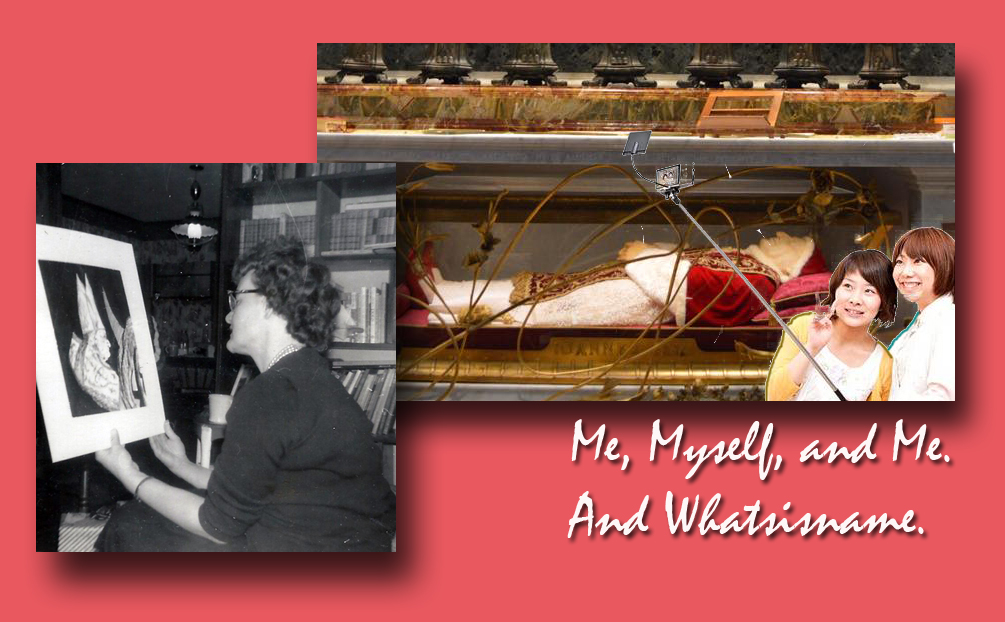
The woman on the left is my mother, forming an artistic opinion about my drawing of John XXIII. And wondering if I got his nose right.

The woman on the left is my mother, forming an artistic opinion about my drawing of John XXIII. And wondering if I got his nose right.

For four members of our family, a trip to Rome in November was the spiritual highlight of the year.

Yes, we saw Pope Frank. Twice. (I included some details in an earlier piece: http://bit.ly/1tAiweK). The man in white is an undisputed international celebrity, and charismatic and photogenic to boot. He is certainly important enough to stare at and photograph, and we did both.

Thanks to Martha and Victoria, two photographers with a great eye, we returned home with a superior photographic record of the trip. Their pictures, which can be found on Facebook if you know where to look, include studies of some of the world’s greatest art and architecture. Plus some nice pictures of Katie and me trying to look like beautiful Americans.

In fact, I would go so far as to say Martha’s and Victoria’s photographs are the best souvenirs we brought home with us. There we are, frozen in time in well-lit and superbly blocked portraits, gazing at Rome from the top of St. Peter’s cupola, stepping gingerly between fallen columns at the Forum, standing in the ruins of Augustus’ reception room on the Palatine, staring at invisible gladiators in the Colosseum, or gazing at dead popes in St. Peter’s basilica.

You can’t go to Rome without some kind of camera. Martha and Victoria carried SLR cameras with several lenses and filters, but you can do almost as well with your smart phone. You’ll be looking at your pictures of Rome for the rest of your life.

However. Thousands of tourists have supplemented their photographic gear with something called a selfie stick. This is an expandable wand that holds your smart phone a couple of feet beyond your head so you can photograph yourself at a perfect angle. The damn things have caught on in Rome, and hundreds of street peddlers insinuate themselves in your path on crowded historic streets to offer you a stick for 10 euros.

I first became aware of selfie sticks during our visit to the Vatican Museum. Two young men kept stepping between our group and our guide to take selfie pictures of themselves with some of the world’s greatest art as background. Every few feet they would pause to frame their vacuous smiles into their pictures. Some where there is a Facebook posting that preserves a bizarre album. Here are Andres and me blocking your view of beautiful medieval tapestries. Here are Andres and me and, out of focus behind us, a beautiful Bernini statue. Here are Andres and me and — what is that — the Pieta? 

One of the holy places I wanted to visit was the tomb of Pope John XXIII in St. Peter’s Basilica. John’s body has been perfectly preserved since his death in 1963 — a miracle, perhaps, due more to mortuary artistry than divine favor — and it is on display in the Basilica.

John XXIII, now Saint John, was one of the heroes of my youth. He was — as Andrew Greeley wrote about his fictional creation Blackie Ryan — one of the three Johns of one’s adolescent hall of heroes: John XXIII, John Kennedy and John Unitas.

Martha and I decided to sit at one of the kneelers that have been set up around John to say a prayer. As I stared at his perfectly preserved face, I kept thinking of my efforts to draw an India ink portrait of him when I was in high school. Struggling to capture his likeness, I thought I was drawing his nose too large. “No one has a nose that big,” I thought, and I kept erasing it to try again. But as I gazed at the remains of this kind old man, I realized I had been right all along. His nose is enormous.

As I was meditating on John,  a short, middle-aged priest stepped in front of the body with a selfie stick. The priest removed his glasses and held the stick out at arm’s length so he could take a picture of himself and John. The priest smiled broadly and the camera flashed. Saint John XXIII remained impassive. Or maybe he frowned a little. The priest stopped smiling and scampered away.

After we returned home to New York, I mentioned the selfie stick phenomenon to a friend.

“I can’t imagine using them in New York,” she said. “It would make it far too easy to steal your phone.”

Perhaps that caution is the one think that will keep selfie sticks out of the Bronx.

But it could well be that selfie sticks will catch on at family reunions, graduations, Christmas parties, and other places where you don’t want to leave anyone out of your pictures.

But still. How is that priest who was so eager to place himself in John XXIII’s catafalque going to use the selfie he took?

And how is he going to respond to puzzled parishioners who see the framed picture of the less than dynamic duo on his desk and whisper to themselves, “Father! What the hell were you thinking?”

Posted in Uncategorized | Leave a comment

Presidents in the Attic

I was in the attic this morning, searching for a drawing I made in 1964. I didn’t find the drawing but I discovered several long-lost items including two scrapbooks, a large framed family portrait, and a functional paper cutter. I hauled the items to the living room, where they will be set aside to make room for Christmas decorations and will soon be consigned to the attic again. Such is the cycle of life.

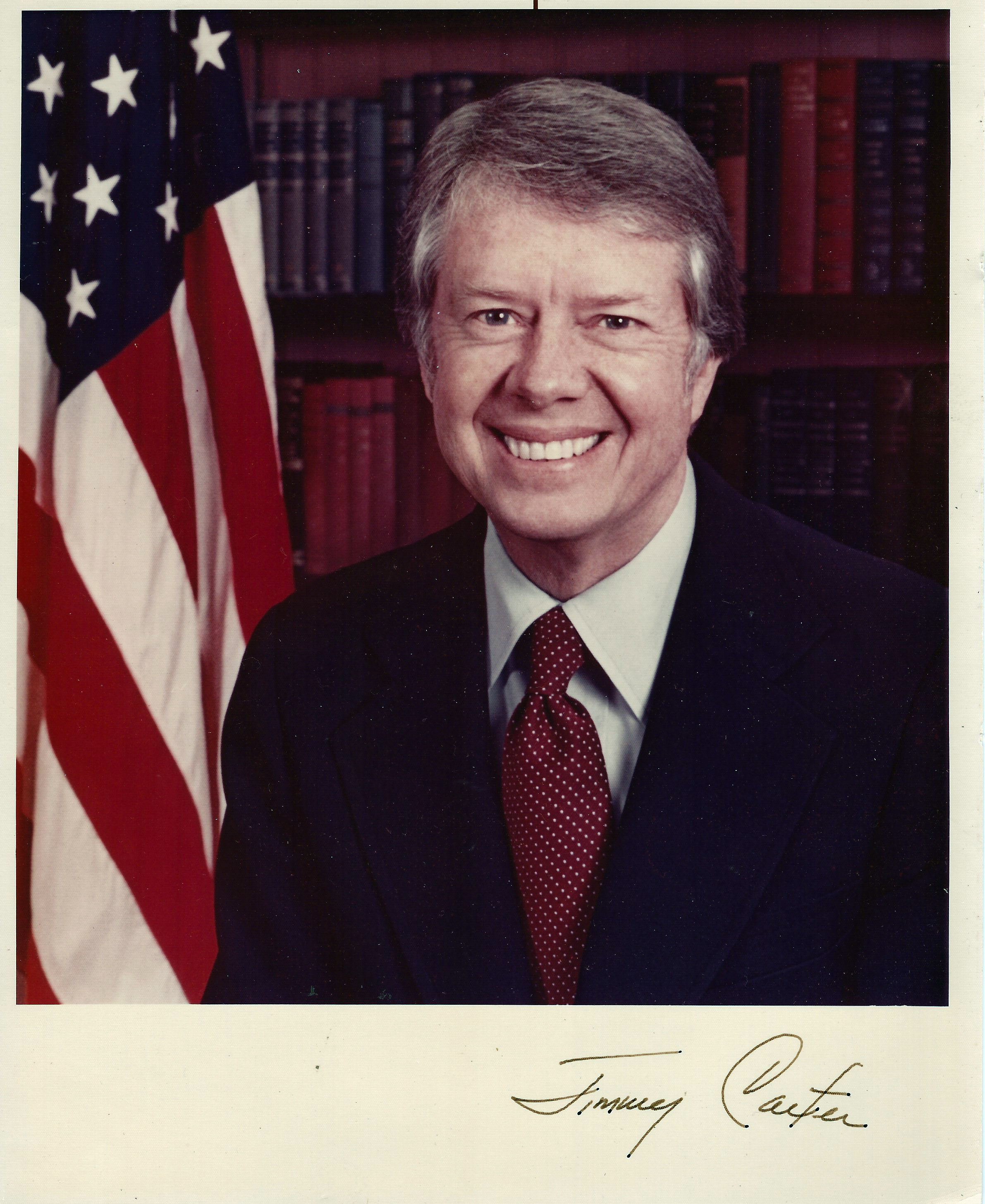
But I also found two minor presidential artifacts: a letter and an autographed picture from Harry Truman dated August 6, 1964; and an autographed White House portrait of Jimmy Carter, probably signed in 1977 or 1978.

I have written about my correspondence with both presidents before (See http://bit.ly/12nzPIm and http://bit.ly/1iEmxeL), but I thought these particular items had been lost forever and I was delighted to find them.

The photograph of Truman, signed more than two years after my earlier correspondence with him and eight years before his death in 1972, was personalized with my name. The “P” appears to have been reinforced after a hesitant beginning, leading me to wonder if the 80-year-old ex-president was squinting through his thick lenses to read my name. Whatever was happening — and it is impossible to understate the actual historical significance — it was a very nice touch by a retired politician who was no longer seeking votes.

HST080664

The picture of Jimmy Carter was a gift from a Baptist colleague, the Rev. Mary Ann Forehand, who was working for the White House correspondence office in the Old Executive Office Building when I invited her to join the American Baptist communication staff. She used her insider influence to request autographed pictures of the president, and I was the lucky recipient of one of them. This was the original official portrait of J.C. when he assumed office in 1977. As Carter’s single term began to encounter long stretches of political turbulence, some members of his staff whispered the smiling portrait looked too sappy for the leader of the free world and it was updated with a more presidential pose. But I am delighted that, after years in the attic, this one has re-emerged into the light of day. I have, alas, lost touch with Mary Ann.

jimmycarterpic

Posted in Uncategorized | Leave a comment