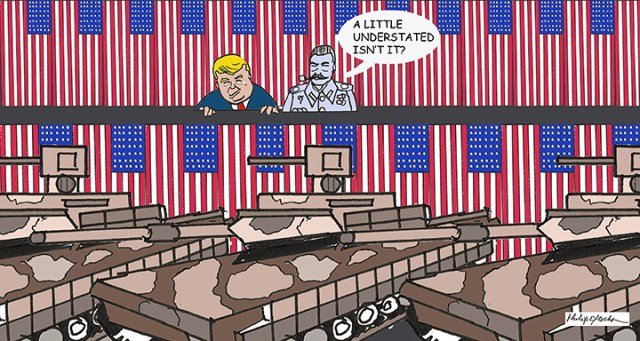
Stalin loved a good parade.

TrumpParade72a

Posted in Uncategorized | Leave a comment

#NeverAgainIsNow

NeverAgainIsNow2

Posted in Uncategorized | 2 Comments

“Anything You Can Imagine is Real.” Picasso

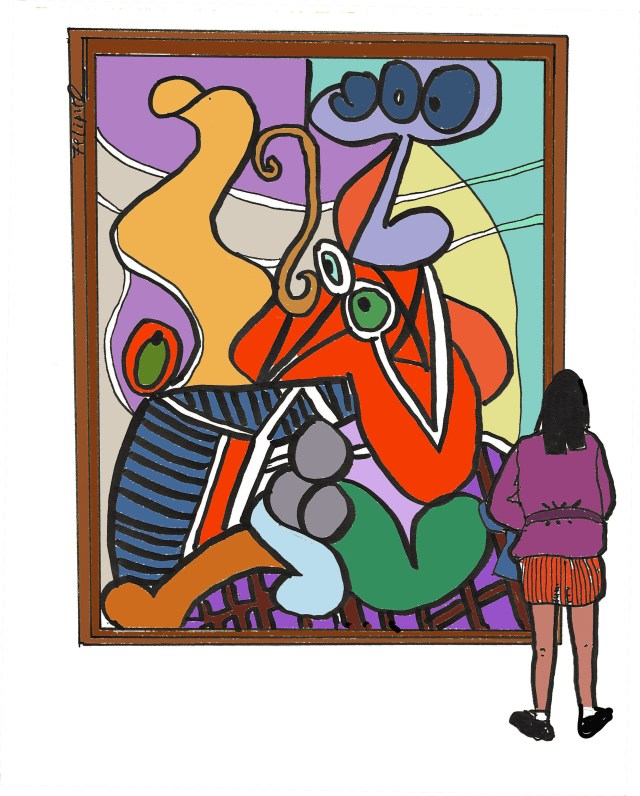
picassoMy mother imagined great things for all five of her children and her support knew no bounds. In high school my younger sibs showed great promise for careers in architecture, medicine, health care, and engineering. My only talent was cartooning and I spent hours copying drawings from Superman and Lone Ranger comic books. Mom chose to think of these scratchings as art. We visited an art museum once and she stared critically at a painting by Pablo Picasso. Mom looked at me and declared loudly, “You can do better than that!”

Sometimes Mom personified Picasso’s own adage, “Todo lo que puedas imiginar es real” – anything you can imagine is real. I thought of her loving but vast overestimation of my art recently when I cartooned a fake Picasso to illustrate a blog about how God’s messages are sometimes hard to read.

Needless to say, I am no Picasso. But both Picasso and Mom believed that even the most unattainable aspirations are never silly.  And anything you can imagine may take on a reality no one else can see.


Posted in Uncategorized | Leave a comment

This Savior Loves YOU

thissavilor

Posted in Uncategorized | Leave a comment

God Bless America. No, really.

magatrumpAs Independence Day approaches, our hearts and minds turn to holy writ.

At least, it sounds like holy writ.

Immigrant Irving Berlin writ it as a fervent prayer, and Kate Smith belted it out:

God Bless America, Land that I love.
Stand beside her, and guide her,
Through the night with a light from above.

From the mountains to the prairies,
To the oceans, white with foam,
God bless America,
My home sweet home.

If you remember the Kate Smith you probably also remember John Cameron Swayze. I remember each with fondness and was a fan of both Swayze’s NBC Camel News Caravan (1949 to 1956) and the CBS Kate Smith Hour (1950 to 1954). I remember she read charming stories to children. In 1939, President Franklin D. Roosevelt introduced her to King George VI of England, saying, “Miss Smith is America.”

As it turns out, that was all too true.

Recently both the New York Yankees and the Philadelphia Flyers stopped playing Kate Smith’s recording of God Bless America at games when it was revealed she also belted out this cringe-worthy ditty in 1931:

Someone had to pick the cotton,
Someone had to pick the corn,
Someone had to slave and be able to sing,
That’s why darkies were born.

It seems that God Bless America and Someone had to pick the cotton form an apt metaphor of where our nation finds itself in the 243rd year of its independence.

Founded by white men who either owned slaves or co-depended with slave owners, our forebears pursued a virulently racist agenda climaxing with a bloody civil war that was supposed to free the slaves. But as Bryan Stevenson, founder of the Equal Justice Initiative, points out, slavery never completely disappeared in America. “The greatest evil of American slavery was not involuntary servitude but rather the narrative of racial differences we created to legitimate slavery,” Stevenson says. “Because we never dealt with that evil, I don’t think slavery ended in 1865, it just evolved.”

There was a naïve temptation in 2008 to think the election of Barack Obama signaled a post-racial epoch in American history.

In actuality, American racism lurked beneath the surface during the Obama years and often gurgled through the sewer grate as African Americans continued to die openly in confrontations with white cops, or die mysteriously in dark prisons. “Black Lives Matter,” a movement aimed at protesting the systematic lack of justice for persons of color, was dismissed as dangerous militancy. White persons who tell you they don’t have a racist bone in their bodies would whisper among themselves that Michelle Obama looked like monkey. White GOP politicians in Congress, anxious lest the black President appear to be an effective leader, coalesced to block Obama’s programs and nominations. Donald Trump, then a shady self-promoter and quirky television personality (described by the New York Daily News as a clown), said he had proof Obama was born in Kenya and was constitutionally ineligible to be president.

If American racism hadn’t been lurking so breathlessly in the sewers for the eight years of Obama’s presidency, it wouldn’t have burst forth like projectile diarrhea to support Trump’s “Make America Great Again” campaign – a slogan to declare his intention to rescue America from the Obama years.

Trump’s Electoral College victory was not due entirely to racism, of course, and had there been no Electoral College he would have lost the election by 2.8 million votes.

But a racist and xenophobic bloc in the U.S., undergirded by an intransigent syndicate of Republican reactionaries in Congress, backed Trump’s bigoted policies. Even before he was inaugurated, Trump declared a ban on the immigration of persons from Muslim countries. He began to build a wall on the U.S.-Mexican border to discourage immigrants and asylum-seekers from crossing the border. He established a blanket policy of separating immigrant children from their parents and, when challenged, lied, and said Obama started it. He is now detaining thousands of brown people in centers that can only be described as concentration camps, many of which do not provide  basic necessities of survival such as toothbrushes, soap, and blankets. When Nazis and Ku Klux Klan white supremacists rioted in Charlottesville, he described some of them “as very fine people.” And he literally wraps himself in the American flag, embracing Old Glory with an orgiastic smirk.

Future generations will undoubtedly look back on the Trump years as a fleeting clown show, a political aberration. His racism is just part of his unhinged personality but so far his base – estimated at 30 to 40 percent of voters in polls – continues to embrace him as doltishly as he embraces the flag. It is enough for them that he promises to protect then from encroaching black and brown people and Muslims and they are willing to overlook the fact that 22 women have accused him of sexual assault, that he is a chronic and perhaps pathological liar, that he doesn’t pay his creditors, that he hides his tax returns behind a web of secrecy. Just how much longer his base will believe his claims that these realities are “fake news” remains to be seen.

Perhaps one of the reasons his base adores Trump is that they mistook the Obamas’ view of America as unpatriotic. Michelle Obama, in an unguarded moment during the 2008 campaign, said, “For the first time in my adult life, I am really proud of my country because it feels like hope is finally making a comeback.” President Obama sought to acknowledge the injustices persons of color face in the U.S. and, in statements that alarmed the Trump base, called for increased controls on gun ownership. But, obviously, the thing about the Obamas that seemed most un-American to Trump’s base was the content of their character and the color of their skin.

Fired by a patriotic zeal that is fueled by an international surge toward xenophobic Nationalism, his base seems willing to allow Trump unlimited license so long as he maintains America’s historic bigotry. So long as he “Makes America Great Again.”

As Independence Day 2019 approaches, I think I will be celebrating not what America has been historically, or what it is now, but what it could be if all of us live up to the American ideals of justice for all.

Love of one’s country is an honorable thing, especially when one loves it enough to see its flaws and want to correct them. This is the right of all Americans.

And love of one’s country is enhanced when it includes an understanding that citizens of other nations are entitled to a patriotic fervor based on their own quest for freedom, opportunity, and justice.

So, thank you, Mr. Berlin, for the stirring strains of God bless America.

But as we celebrate our nation’s untidy birth, let us also stand and sing the more inclusive hymn written by Lloyd Stone in 1934 and supplemented by Georgia Harkness in 1864:

My country’s skies are bluer than the ocean,
and sunlight beams on cloverleaf and pine;
but other lands have sunlight too, and clover,
and skies are everywhere as blue as mine:
O hear my song, thou God of all the nations,
a song of peace for their land and for mine.

May truth and freedom come to every nation;
may peace abound where strife has raged so long;
that each may seek to love and build together,
a world united, righting every wrong;
a world united in its love for freedom,
proclaiming peace together in one song.

Posted in Uncategorized | 8 Comments

Does It Mean Nothing to You, All Ye Who Pass By?

donaldtrumpworse

Posted in Uncategorized | 1 Comment

Mac the Knife

mactheknife

NOTE: Robert McNamara died ten years ago July 6 after a long delayed confession that the Vietnam War had been a terrible mistake. Our leaders then, who were “the best and the brightest” of their generation, didn’t have to listen to McNamara because he remained silent out of a misguided sense of patriotism. And that is hard to forgive. I wrote this essay the week he died.

They called it “McNamara’s War” after the intellectual car maker who masterminded it.

By early 1967, Robert Strange McNamara had already concluded that the Vietnam War had been a terrible mistake. It blows my mind (to borrow a phrase from the era) that Secretary of Defense McNamara realized it before I did.

In May 1967, when McNamara wrote a secret memo urging President Johnson to end the war, I was still fighting the Cold War at the Bentwaters-Woodbridge Air Bases in bucolic Suffolk, England. F4C fighter pilots from the 81st Tactical Fighter Wing were routinely assigned temporary duty in Thailand to drop bombs on Hanoi before resuming their Cold War duties in the U.K. I’d see the returning pilots in Sunday worship at the chapel where I worked, silently flexing their jaw muscles while grasping their wives’ hands. I’d ask them how it went, and they’d shrug. “Had to be done,” they’d say, avoiding eye contact.

I don’t think any of us understood why it had to be done. I was a 21-year-old chaplain’s assistant who could have been the model for M*A*S*H’s Radar O’Reilly and I got most of my war news from the Stars and Stripes newspaper. All of us, officers and GI’s alike, worked in duty sections that had black-and-white pictures of LBJ and Robert McNamara staring suspiciously at us. The portraits were hung just below the metallically glistening Air Force motto: “Peace is Our Profession.”

Oddly enough it all made sense: as a product of our profession of peace we dropped bombs on people in North Vietnam because it “had to be done”. Even if we were inclined to analyze it, we’d be distracted by inspiring speeches at Commander’s Call by officers like Colonel Robin Olds, the Vietnam War’s first flying “ace”, and the awesome Colonel Daniel N. “Chappie” James, later the Air Force’s first black four-star general. Neither enjoyed a good debate with subordinates, so we’d nod and salute.

Meanwhile, and unbeknownst to us, Robert McNamara had digested a CIA report that the so-called enemy was intractably committed to reuniting the country and there was nothing the U.S. could do to prevent it. McNamara, who was skilled at pursuing facts to their inevitable conclusion, realized his original judgment about the winnabilty of the Vietnam War had been wrong.

His memo to President Johnson is quoted in his obituary in the New York Times: “The war is becoming increasingly unpopular as it escalates – causing more American casualties, more fear of its growing into a wider war, more privation of the domestic sector, and more distress at the amount of suffering being visited on noncombatants in Vietnam, South and North.” Americans, McNamara told LBJ, “want the war ended and expect their president to end it. Successfully. Or else.”

When McNamara wrote that memorandum on May 19, 1967, I still had 17 months to go on my Air Force enlistment. The Vietnam War itself would continue for eight more bloody years.

Nearly 38,000 Americans died in Vietnam in the years after McNamara concluded the war had been a mistake. I didn’t reach that conclusion until September 1968, my first year in college.

Within weeks after his memo to LBJ, McNamara found himself ushered out of the Pentagon and installed as head of the World Bank. Although it’s clear now that Johnson fired him, at the time it looked like he was promoted for faithful service. McNamara gave no indication that he was having second thoughts about the war.

And that’s what I can’t forgive. When his voice could have thundered around the world, he chose to be silent. There are thousands of gravestone monuments to the price of his silence.

Years later, after McNamara finally revealed his regrets, my wife Martha and I visited the U.S. Military Academy at West Point, where her immigrant father once worked as a dish washer after he left Cuba. The cemetery at West Point tends to be organized by the war in which the soldiers fell, and as we passed by the graves of Vietnam veterans I became bitterly mindful of McNamara’s change of heart. A lot of those graves were of men and women who died after 1967 — after their Secretary of Defense had concluded the war was unnecessary and unwinnable.

Why didn’t McNamara speak up? Did he feel honor-bound to be loyal to an intransigient president? What were his thoughts when the casualty figures continued to mount: 16,592 in 1968? 11,616 in 1969? 6,081 in 1970? — all for a cause he knew to be lost from the beginning?

In his later years, Robert McNamara was eloquent in his contrition. In a 1995 memoir he declared the war had been “wrong — terribly wrong.” He spent the rest of his life trying — futilely, it turned out — to prevent similar American disasters.

But the terrible question hanging over McNamara’s life can’t be avoided: what if he had spoken up sooner? Would the timely confession by the architect of the war that he had been wrong all along have forced LBJ to halt it? Would it have given subsequent warriors, Nixon and Kissinger, sufficient pause to sue for peace? Would it have saved thousands of lives?

Tragically, we’ll never know. Personally, I think a public admission by Robert McNamara in May 1967 would have been loud enough to suck the air out of public opinion and silence the bombs over Hanoi.

When Robert McNamara died July 6, 2009, his aged and sallow face appeared once more on our television screens and it was moving to hear the agony in his voice as he admitted his terrible mistakes.

Quite evidently he has lived in a hell of contrition since 1967. I hope our nation’s leaders listened carefully, because his confession was starkly convincing and no doubt saved his soul.

I only wish it had come sooner.

Posted in Uncategorized | Leave a comment

Johnny, Who the Hell Were Ye, Anyway?

mojackMay 29, 2019 – Jack Kennedy – that rich, sex addicted, dissembling, amoral philanderer who charmed a generation and kept the world from blowing up – would be 102 today.

I still miss him. Here’s an essay I wrote last year on the 55th anniversary of his assassination.

November 22, 2018 – Today is Thanksgiving and also the 55th anniversary of the assassination of John F. Kennedy. As Billy Joel put it, “JFK, blown away, what else do I have to say?”

After more than half century, the ironies we feel at our Thanksgiving tables have nothing to do with JFK. This year other things mitigate the blessings we count. In 1963, we knew the occupant in the Oval Office had stirred the idealism of a generation by favoring Civil Rights, planning fair housing and fair employment opportunities for struggling working people, seeking an end to the arms race, calling for humane immigration laws, and sparking the greatest technological advances in history by setting a goal to land a human being on the moon. All that made it possible, even in the gloom a week after his death, to celebrate a day of thanks.

Today our thanks are mitigated by another dweller in the Oval Office, a chief executive whose racism and xenophobia are palpable, who doesn’t believe in science or global warming, who believes tax cuts should benefit the rich and not the poor, who believes teachers and pastors should be armed with guns, and who has slammed the door on millions of would-be immigrants to the United States.

In many respects, it’s harder to be thankful today than it was November 28, 1963, a time of deep national mourning.

Those of us of a certain age remember John F. Kennedy with unfeigned fondness. As one whose memories of November 22, 1963 will always be painful, I rarely see a picture of JFK without thinking how much better it was when we admired and trusted the Oval Office occupant and when most people respected the President regardless of party.

I would hate to think those days are gone forever and in my more rational moments I sense the current circus in Washington will be gone in an election or two.

But also – in my more rational moments – I am beginning to sense that my scorn for Trump is making it hard to be objective in my idealistic affection for Kennedy.

One thing Jack and the Donald had in common: they were both rich men’s sons with a strong sense of sexual entitlement and misogyny on steroids. I’d like to think JFK was too much of a gentleman to grab genitalia without warning, but Stormy Daniels’ description of Trump’s assault reminded me of White House intern Mimi Alford’s description of how she lost her virginity to JFK in the White House residence: “The next thing I knew he was standing in front of me, his face inches away,” she writes. “He placed both hands on my shoulders and guided me toward the edge of the bed.”

Another thing JFK and DJT have in common is the ability to get away with it. Most reporters and all Secret Service agents knew Kennedy was having trysts with different women on the average of once a week, but no one thought it was appropriate to invade the president’s privacy. When a reporter asked White House Press Secretary Pierre Salinger about Kennedy’s affairs, Salinger said, “Listen, he’s the president of the United States. He has to work 16, 17, 18 hours a day. He’s got to handle foreign policy. He’s got to handle domestic policy. If he’s got time for mistresses after that, what the hell difference does it make?” The reporter laughed and nothing was ever written.

That was a time when the press and most Americans believed the private life of the president was no one else’s business. But even before the #MeToo movement cast light on the widespread abuse of women by powerful men, politicians knew they were under greater scrutiny. A Republican House of Representatives impeached President Bill Clinton over his 1990s affair with Monica Lewinsky, and earlier this year Senator Kirsten Gillibrand (D-NY) said “looking back on it, Clinton should have resigned.”

Trump’s misogyny, on the other hand, has taken place under the full glare of the klieg lights and scores of women have come forward to accuse him of abusive behavior. Still, his popularity polls, which hover at just over 30 percent, are unaffected and Trump’s base remains strongly supportive of him. But I have serious doubts whether history will be as kind to Trump as it has been to JFK.

Looking back on the 55 years since he has been gone, I confess I still think JFK was a great and effective president and I still miss him greatly. There was so much that he did right, and millions of Baby Boomers were inspired by his example to lead constructive lives that made the world better.

But there was so much about John F. Kennedy that we did not know when he was alive, principally, that he was a powerful man who took advantage of scores of powerless women.

How much difference would it have made if we had known?

That’s a contextual question that is difficult to answer in 2018. It’s a little like condemning Washington because he owned slaves in the 18th century, or scorning Lincoln because he was a racist in the 19th century. In the 1960s, Kennedy’s sexual conduct was placed in the category of “what the hell difference does it make?” and in 2018 the same behavior is clearly monstrous.

But that is the point. The behavior is clearly monstrous.

And the current occupant of the Oval Office – and his minions – would do well to remember that.

Posted in Uncategorized | Leave a comment

Saint Sophie of Forchtenberg

saintsophieSophia Magdalena Scholl died in 1943 when she was 22. That was about three years, psychologists reckon, before her cerebral cortex was fully developed.

But despite that, or perhaps because of it, she was one of the most conspicuous heroes of the Second World War.

Sophie Scholl was born May 9, 1921 in Forchtenberg, Germany. She was the daughter of socially active Lutheran parents. When Adolf Hitler came to power in 1933, many German Lutherans stepped back, recalling Martin Luther’s instructions to obey civil authority.

But the Scholls were early members of the resistance, and Sophie and her brother instigated anti-Nazi activities in college. They formed a group called the White Rose and in 1942 and 1943 they distributed thousands of leaflets urging Germans to passively resist the regime.

They were not subtle about it. According to the Holocaust Research Project, “On February 18, 1943, the Scholl’s brought a suitcase full of leaflets to the university. They hurriedly dropped stacks of copies in the empty corridors for students to find when they flooded out of lecture rooms. Leaving before the class break, the Scholl’s noticed that some copies remained in the suitcase and decided it would be a pity not to distribute them. They returned to the atrium and climbed the staircase to the top floor, and Sophie flung the last remaining leaflets into the air.”

That dramatic and impetuously reckless move attracted the attention of the Gestapo. The Scholls were arrested and brought to trial on 21 February 1943. Sophie was unrepentant.

“Somebody, after all, had to make a start,” she said. “What we wrote and said is also believed by many others. They just do not dare express themselves as we did.”

Sophie and her brother, Hans, were executed the following day by guillotine. According to witnesses, her last words were, “Die Sonne scheint noch.” The sun still shines.

Sophie’s singular defiance is a judgment on millions of Germans, most of them Lutherans and Catholics, who stood back while Hitler’s atrocities moved forward.

But her death was not unnoticed.

At the end of her life, Adolf Hitler’s personal secretary remembered Sophie Scholl.

“I was satisfied that I wasn’t personally to blame and that I hadn’t known about these things, I wasn’t aware of the extent,” said Traudl Junge, referring to the Holocaust.

“But one day I went past the memorial plaque which had been put up for Sophie Scholl. And I saw she was born the same year as me, and she was executed the same year I started working for Hitler.

“And at that moment I actually sensed that it was no excuse to be young.”

Posted in Uncategorized | 2 Comments

Mom

saintmary2019

May 13, 2019 – Mom – Mary Christina Emerson Jenks – would have been 96 today.

On a cold, rainy May day here in Port Chester, N.Y., I am remembering how she used to love the warmth and flowers of May.

In the Catskills where she grew up, and in Central New York where she lived most of her life, May is the month when Spring declares its final victory over the bleak and snowy winter.

Mom hated winter and was hoping to retire in Florida, but she died in a Syracuse hospital days after her 60th birthday so it was not to be.

Happily, Mom was vibrant and active right up until the sudden onslaught of Acute Myloid Leukemia. She had just returned from a trip to the Soviet Union where she met with other nurses and complained of being tired when she got back. I called her to ask if she would be up to a visit and she said of course, she would certainly feel better in a week. But the tiredness got worse. She was already in the hospital when I made it home, sitting up in her bed and blithely handing out gifts and souvenirs from her Soviet trip.

As a registered nurse, she had no illusions about the particularly devastating form of leukemia she had but she remained positive until the end. The last night I saw her in the hospital she was breathing through an oxygen mask and couldn’t converse freely, so she asked me to read the 23rd psalm to her – authorized version – until she fell asleep.

I find it comforting that she packed a lot into her 60 years, and when people ask me about her I’m reminded how remarkable she was.

As a young adult she was legally blind. She and her brother had a genetic disease that caused the progressive deterioration of their corneas and during my teen years she could see only dark silhouettes of the images in front of her. “It was like seeing the world through wax paper,” she explained.

But her poor vision was not sufficiently disabling to keep her from entering the house building and real estate business, which she did when I was still in high school. She formed a small business called Morrisville Quality Homes and I remember watching the first of the sturdy houses go up in a lot behind our street. She couldn’t help with the actual construction but she spent hours sanding walls and feeling the smoothness with her fingers.

She was working inside one of the houses in 1963 when the radio reported the assassination of John F. Kennedy. In a strange way she was not surprised by that because she had for years talked about a premonition that a Democrat would be elected in 1960 and would die in office. Mom’s eclectic religious views were Presbyterian-plus. She also believed in disambiguation and seances and she admired the works of the clairvoyant Edgar Cayce.

When I was in the Air Force in the 1960s, she had a cornea transplant and her vision was completely restored. This type of eye surgery was still rare and her head had to be immobilized between two sandbags as she recovered in the hospital bed. When she removed the bandages, her immediate reaction became part of family lore: “Oh, my, that coffee is so black and that saucer is so white.”

Mom and two of my sibs – Larry and Jim – visited me in England in 1967, in part, she told one of my high school girl friends, “so I can see what he really looks like.” We toured London, saw Dr. Zhivago in a theater filled with cigarette smoke, and visited the Air Force base where I lived. Mom was particularly delighted by the English flower boxes in front of every home and she absorbed everything with moist, clear eyes.

The following year she enrolled in the nursing program at the State University of New York in Morrisville and I’m sure all my siblings remember helping her memorize the names of bones, tissues, and human organs. Once she had her degree she went to work as a nurse in the Gerrit Smith Nursing Home in Eaton. She enjoyed working there with my sister Susan, sister-in-law Colleen, Darrin, and others she loved.

Mom loved her children and grandchildren unconditionally, and she showed her Depression-era sensibilities by making sure everyone had enough to live on and, in some cases, had everything we wanted. I once mused it would be nice to have a microwave oven and she whipped out her credit card before I could finish the sentence.

Mom was a nursing supervisor when she fell ill. Becoming a nurse was a lifetime ambition for her, and I’m glad she was able to fulfill that goal so happily. She modeled a life that helped the rest of us face life’s hills and valleys with courage, optimism, and grace.

Thirty-six years on, it still seems unfair that she was taken from us so early. In my reveries I like to imagine her as an old lady handing out little gifts to her grands and great-grands, surfing the internet, which she would have loved, following the Yankees on a huge HDTV screen, and expressing her horror over what Donald Trump is doing to her beloved country.

How she would have loved talking about all that in the weekly phone conversations she used to have with her offspring who had moved away.

And how I miss those conversations even after so many years.

_____

For a local television station’s documentary of Mary Emerson Jenks’ cornea transplant experience, click here.

The drawing above was inspired by the copious work of Brother Robert Lentz, OFM, who has created icons for hundreds of non-canonical saints.

Posted in Uncategorized | Leave a comment