How Quickly We Forgot

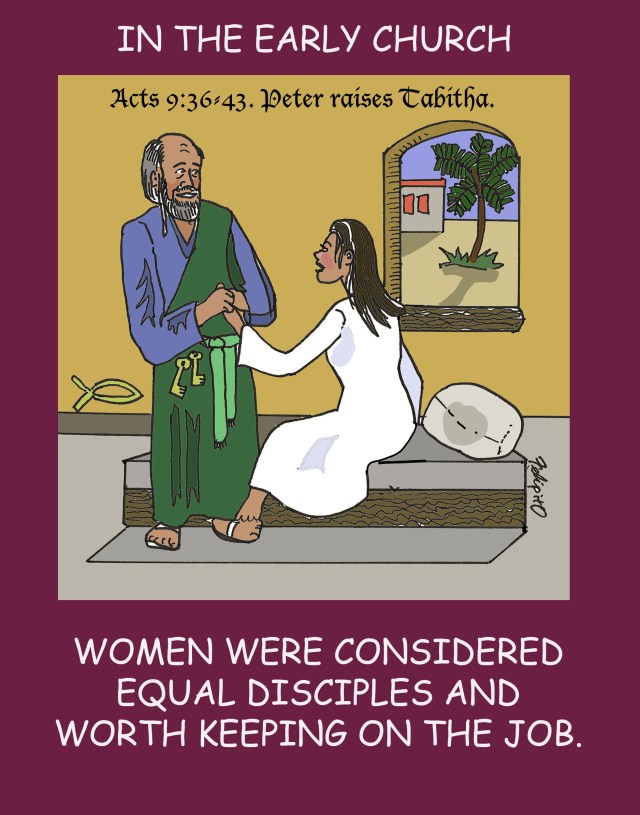
INTHEEARLYCHURCH

Posted in Uncategorized | Leave a comment

Memoir. Ten Commandment Patio Break

partiosmokeIn the fall of 1964, I completed the first phase of my Air Force Basic Training at Lackland Air Force Base, Texas. The second and final stage of basic would continue at Amarillo Air Force Base, Texas, where I would also attend the Chaplain Services Specialist tech school.

Our flight trainees received assignments to various Air Force tech schools during the fifth week of training at Lackland. Airman First Class Elihu Ellefson, our training instructor, read the assignments to us as we stood at parade rest in front of the barracks. Until that moment, I had been a perfectly invisible trainee. Ellefson changed all that.

Reading off our names in alphabetical order, Ellefson elicited both groans and sighs of relief as he announced various assignments. Some would go to Air Police Training at Lackland. Others would go to jet mechanics training in Illinois. Some would be trained as file clerks, and at least one other would be sent to language school to serve as an interpreter.

When he got to my name, Ellefson looked stunned. He took off his hat and threw it on the ground.

“Jenks,” he said. “Chaplain. God damn.”

My fellow trainees looked at me with curiosity. Actually, I was not going to be a chaplain but an enlisted assistant to chaplains, who were commissioned officers. But nobody made that distinction, and for the first time in five weeks, everyone seemed to know my name.

“Chaplain! Jenks! God damn!” Several airmen, still at parade rest, broke ranks to echo Ellefson’s reaction. Later, airmen smiled at me and shook their heads. I sensed they jumped to the conclusion that I was “religious,” which was a peculiar concept to most of them, or gay. I did my best to fade back into the crowd of basic trainees, which was usually easy, because we looked alike with our shaved heads and baggy green fatigues. But guys who had never noticed me before were now remembering my name.

One or two nights before we were bused out to our new assignments, the flight was given a final patio break. There were several outdoor break areas strewn around the base that included benches and soda machines so trainees could have occasional respite from relentless marching. I looked forward to the patio breaks as a chance to indulge in the two main pleasures allowed us, namely, smoking cigarettes and drinking Dr. Pepper (two unsavory habits I broke years ago).

On this last break we were finally allowed to shed our heavy fatigues and wear our special tan summer uniforms that the Air Force dubbed 1505’s. As I sat down on a bench, an airman I had never seen before sat beside me. He seemed to know who I was, perhaps because he had heard rumors I was going to be a – God damn! – chaplain.

I never did get the young man’s name. He was tall and deeply tanned, the stubble on his head was black, and I think he would have described himself as Chicano.

We exchanged light talk about the steamy warm weather in San Antonio, how glad we were the Lackland phase of basic training was almost over, and what might happen next.

“I think,” the airman said, “that if I still don’t have a girlfriend when I get out of the Air Force and finish college, I might become a priest.”

“That’s good,” I said. Actually, I had similar plans to become a Protestant minister, which, of course, would not be complicated by celibacy.

“But it’s not easy, believing all that stuff,” the young man said. “That’s why I’m always glad to read about miracles that science can’t explain.”

He began listing phenomena about which I hadn’t thought a lot or had already dismissed as trickery: the plaster Madonnas whose eyes seemed to brim with tears, the statues of Jesus with hands apparently oozing with blood, or the unearthing of long-dead saints whose bodies had been perfectly preserved.

I shrugged. There was nothing in my Protestant experience to help me evaluate these spectacles.

“These miracles give such an oomph to my faith,” the airman said, drawing deeply on his cigarette.

I lit up a Lucky and we sat quietly for a few minutes, wreathed in blue smoke and the heavy Texas air.

“But it’s not easy,” the airman repeated. “Look at the Ten Commandments.”

I didn’t need to look because I had already memorized them as part of a Junior High Sunday School exercise at the United Church of Morrisville, N.Y. The church had promised us new bibles if we could recite from memory the Decalogue and three other scripture passages (specifically excluding “Jesus Wept”) during our Sunday morning assemblies. We memorized verses from the King James Version and the new gift bibles were Revised Standard Version, which changed all the words, so some of us thought it was a gyp. But I still had in my head the Ten Commandments, albeit with a Medieval cadence.

A Squadron Bell signaled the end of the Patio Break. The airman took one last drag on his cigarette and tossed it into a red-painted butt can.

“You know,” he said sadly, “I’ve already broken all but two of the Ten Commandments.”

I tossed my cigarette into the can and tried to think of something wise to say. But when I turned to say goodbye he had already disappeared into the darkness. I never saw him again.

When I got back to the barracks I climbed into my upper bunk and waited for Airman Ellefson to turn off the lights.

I started to wonder – and I have been wondering ever since – which two of the ten this young man had never broken.

I assumed he had never killed, so I concluded he was safe from the perils of the fifth commandment.

But what of the other nine? Which had he never broken?

I began to realize it was a claim I might not be able to make. Even at 18, I had often acted as if the One God did not exist. I had certainly taken the Lord’s name in vain. I had slept in and ignored many a Sabbath. I had often disrespected my parents. I had stolen dime comic books from the local drug store. I had coveted my best friend’s English bicycle and exquisitely detailed model train set. At 18 I had no opportunities to commit adultery, but I knew I had lusted in my heart. And I wasn’t so sure I had escaped the injunction against killing if that included the small game that I shot at with my .22 rifle.  Later I would learn that some theologians, including Martin Luther, said that the commandment not to murder meant that “we neither endanger not harm the lives of our neighbors, but instead help and support them in all of life’s needs.”* I could not be sure I had lived up to the exacting command to not kill either.

So what kind of saint had I encountered on that patio on a hot night in Texas fifty-five years ago – a young man who actually believed he had kept two of the ten commandments?

I never saw him again. Maybe he did become a priest. Maybe he’s a bishop or cardinal somewhere. Maybe he’s teaching young seminarians about the strident requirements of the Ten Commandments.

Then again, maybe he ended his short life in Vietnam, as so many did in that era.

The strange thing is, out of all the young men I marched with, bunked with, showered with, and chowed down with in basic training, he is the one I remember most vividly.

I think of him every time I read the Decalogue.

He reminds me that God’s standards of moral comportment are high.

“God threatens to punish all who break these commandments,” Martin Luther wrote. “Therefore we are to fear his wrath and not disobey his commandments.”

But Luther also wrote, “God promises grace and every good thing to all those who keep these commandments. Therefore we also are to love and trust him and gladly act according to his commands.”*

God has set high standards for our behavior, but God’s love for us is not conditional on whether we are able to behave ourselves.

In fact, all of us will find this impossible at many points in our lives.

But even when we despair at the depth of our sinfulness, God’s love and grace remain unconditional.

As I think back on that young man I knew for one short hour in my life, I wonder if he has reached the same conclusion.


* Luther’s Small Catechism

Posted in Uncategorized | Leave a comment

Singing the Internationale

MAY12019VERSION

Posted in Uncategorized | Leave a comment

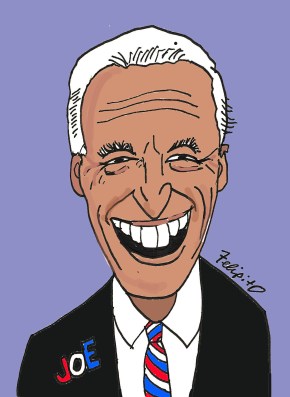
Joe Biden and Jesus Talk

joecolor

“We oughta be ashamed,
We oughta be ashamed,
We use and abuse
such a wonderful name.”
– Johnny Cash and Elvis Costello duet

April 25, 2019 – Joe Biden’s entry into the 2020 presidential sweepstakes today is no surprise. Many Americans yearning for a more traditional political landscape may welcome his hat in the ring.

The former vice president is by far the most experienced candidate for the presidency and from that some may deduce that he is also the best qualified. He sat in tight proximity to the oval office for eight years and was an active partner to Barack Obama when important domestic and foreign policy decisions were made.

Some will say his main impediment is his age, 76, but that doesn’t bother me. Joe is only four years older than me and he, Donald Trump, and I were all in elementary school at the same time. Within this unlikely trio, I don’t doubt Joe is the most physically and mentally healthy.

Some will say he has been too much of a hands-on politician, occasionally making women feel uncomfortable with his hugs and shoulder massages. In that case, voters will have to decide for themselves whether his touches are benign or malign, but he is not the only politician who slaps backs, squeezes arms, or massages shoulders. Who can forget Chancellor Angela Merkel’s stunned surprise when President George W. Bush snuck up behind her and squeezed her shoulders?

If Biden does have a problem with style and longevity, it may be due to the fact that his public record extends all the way back to 1970 the he was elected to the New Castle, Del., County Council. There are a lot of opportunities in 49 years for misjudgments and gaffes to stain one’s otherwise stellar performance.

For many, Biden’s greatest public error was his performance as chair of the Senate Judiciary Committee in 1991 when he and other senators peppered Anita Hill with harsh and occasionally humiliating questions. Hill had credibly accused nominee Clarence Thomas of sexist and inappropriate behavior. Biden said last month he regretted his performance 9n 1991, but he has not personally apologized to Hill.

Biden is also known for his spoken gaffes, though when he misspeaks it is rarely because he wants to hide the truth. He inadvertently announced his support for marriage equality weeks before the Obama Administration had decided its policy on LGBTQ rights.

The gaffe I remember most vividly, because I was still on the staff of the National Council of Churches at the time, appeared in a 2009 interview in the Wall Street Journal.

Joe said: “I can see Putin sitting in Moscow saying, ‘Jesus Christ, Iran gets the nuclear weapon, who goes first? Moscow, not Washington.’”

Many will see nothing wrong with that statement, but it shook many church persons to the core. Here was the vice president of the United States using the Lord’s name in vain.

The statement attracted much more attention in 2009  than would a similar utterance by Donald Trump today.

In many churches and church agencies, people were saying, “Say it ain’t so, Joe. A nice Catholic boy like you, using and abusing such a wonderful name?

I’d like to say I was shocked by Biden’s use of Jesus Christ, but that would be a slight exaggeration. Most of us hear the name used every day, often devoid of its intended theological significance. For many, the name has lost its power.

Even so, Mark Tapscott, the editorial page editor of the Washington Examiner was sorely offended by the then Vice President’s use of the JC word and asked, “How many more stupid comments does it take before his handlers in the White House realize it’s time for this dunce to retire?”

Of course Biden is no dunce, but I was puzzled why he let his guard down during a press interview. Didn’t he remember his constituency was now larger than Wilmington and there might be folks out there who would be deeply pained by the casual way he used the wonderful name?

For many, this kind of rhetorical carelessness leaves scars that last for decades.  In 1974,  American Baptists organized a theological communications center in Green Lake, Wis., and invited media luminaries like Dick Gregory and Norman Cousins, who came, and ABC science reporter Jules Bergman, who didn’t.

In lieu of Jules, the agency sent Ashley Montagu, the British anthropologist and humanist known for his appearances on Johnny Carson and who had changed his name from – and I’m sure that wouldn’t have bothered Baptists in the slightest had we known – Israel Ehrenberg.  Montague and his saintly wife Marjorie spent a week at Green Lake, Marjorie memorable for her sweetness and Ashley for his Bermuda shorts, black knee socks and surly disposition.

Ashley was, as I recall, a brilliant presenter, but for decades I would run into conferees who were still angry about only one of his sentences: “I am a Unitarian,” he told us, “and the only time you hear Jesus Christ mentioned in my church is when the janitor falls downstairs.”

So let’s not forget that a faux pas like Biden’s will hurt and dismay a lot of folks. Ashley’s reference may have been insensitive, but I think he understood Who he was talking about when he said “Jesus Christ.”

I suspect it might have been different with Joe. If you grow up in certain parts of the United States – including blue collar Wilmington and Philadelphia – you quickly learn there’s more than one Jesus. Joe probably moves back and forth between them, deferring with due respect to the Savior and relating more casually to the others. There is, of course, the second Person of the Trinity Jesus, the Son of God, the Savior of the World, the figure Baptists know as a “personal Savior” and Catholics like Joe encounter in prayer, hymns and the awesome power of the Eucharist. Believe me when I say (and listen up Mark Tapscott of the Washington Examiner), Joe Biden is not dunce enough to speak that name with disrespect.

Without delving too analytically into Joe’s political record, it’s obvious it reflects a good Christian upbringing and an understanding that Jesus Christ loves and accepts everyone, notwithstanding a bias for the poor, and calls on us to treat one another like good neighbors. I am sure Joe would never take the name of that Jesus in vain.

But there are Jesus figures that Joe also knows, and they have little to do with the One who was in the Beginning with the Word.

First of all, of course, there is the Jesus of the epithet whose name often springs to tongue but who is not regarded by those who use it as the Second Person of the Trinity. It is a name used for emphasis, as in, “Putin is sitting in Moscow saying, ‘Jesus Christ,’” or for emotional release when you need a quicker way of saying, “Please, dear, stop spilling your molten coffee into my lap.”

Then there is the unJesus whose name is removed in vain from Christmas and Easter so it doesn’t get in the way of holiday marketing, or the nonJesus whose name is used by televangelists Pat Robertson to justify “taking out” foreign leaders, or the fauxJesus quoted in Vice President Mike Pence’s condemnation of LGBTQ humans. And let’s not forget Action Jesus, Bobblehead Jesus, and I don’t care if it rains or freezes Jesus.

When my wife Martha was in seminary in the early 80s, she and her suite mate would exchange stories of their educational experiences, including student pastorates and clinical pastoral education. The suite mate’s CPE assignment was a psych ward where she encountered the full range of mental illnesses: addiction, depression, agoraphobia, obsessive compulsive disorder and the classic delusions of schizophrenia. Citing patients of special interest, she reported, “I have three Jesi.” No doubt each of them preferred to be called Jesus Christ, and that’s just one reason the name has lost its power.

But names are merely words and words only have the power we assign to them. I don’t think Joe Biden’s use of the words Jesus Christ implies in any way a disrespect – or a lack of awe – for the Second Person of the Trinity. He may think twice about using them in a press interview again – but that would be a political judgment, not a matter of faith.

In the context of faith, the power of the Trinity will never diminish. The power of words, on the other hand, is subject to individual understanding, and context.

In my own context, when I was growing up I never heard Jesus’ name spoken disrespectfully. My mother’s angriest condemnation was, “Piffle,” which was embarrassing enough. But the anglicized name of the Lord was always used with respect, and I still wince when I hear it used as an epithet.

But I’ve got to wonder: does – He – wince when he hears it?

In fact, Jesus never heard it uttered during his time on earth.

The name he answered to was Yeshua Bar Joseph.

Posted in Uncategorized | 1 Comment

Easter 2019

lordhasrisen

Posted in Uncategorized | Leave a comment

Saint David, Patron Saint of Wales

DROVETHEHOMOPHOBES2

Posted in Uncategorized | Leave a comment

Reconciling Churches

jesusrainbow

I never miss a copy of LivingLutheran, the monthly magazine of the Evangelical Lutheran Church in America, in part because it’s a superb denominational magazine.

As I leafed through the February 2019 issue I came across the lead in an article on “Grace and God’s Welcome:”

“Joseph Castañeda Carrera first sensed a call to ministry as a teen, but as a gay man of color, he found no ready place in the church.”

The article goes on to describe the ELCA’s Reconciling Works, “which has worked since 1974 for the full welcome, inclusion and equality of lesbian, gay, bisexual, transgender and queer (LGBTQ) Lutherans in all aspects of the life of their church, congregations and community.”

My home church is a Reconciling in Christ Lutheran congregation that extends its welcome to all people, and I am grateful for that.

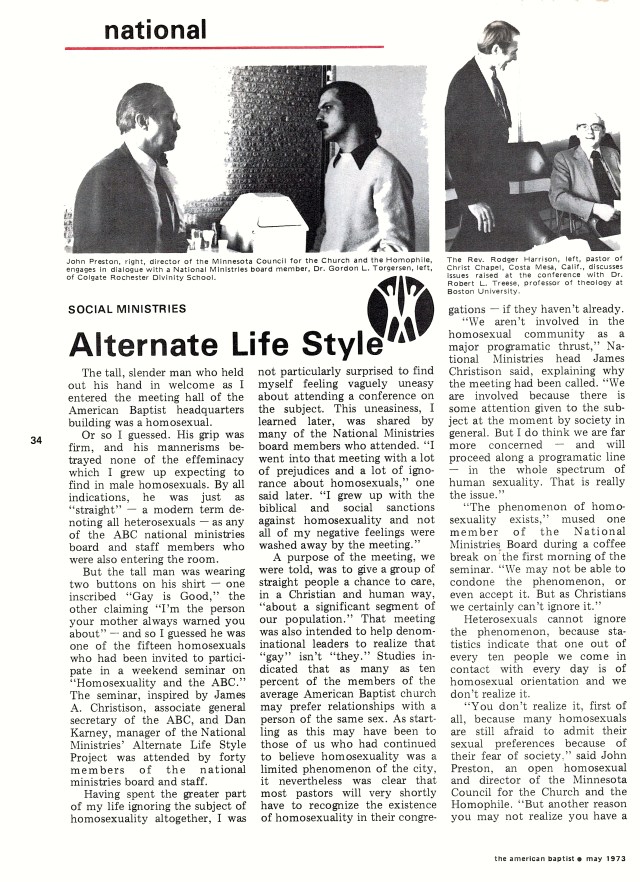
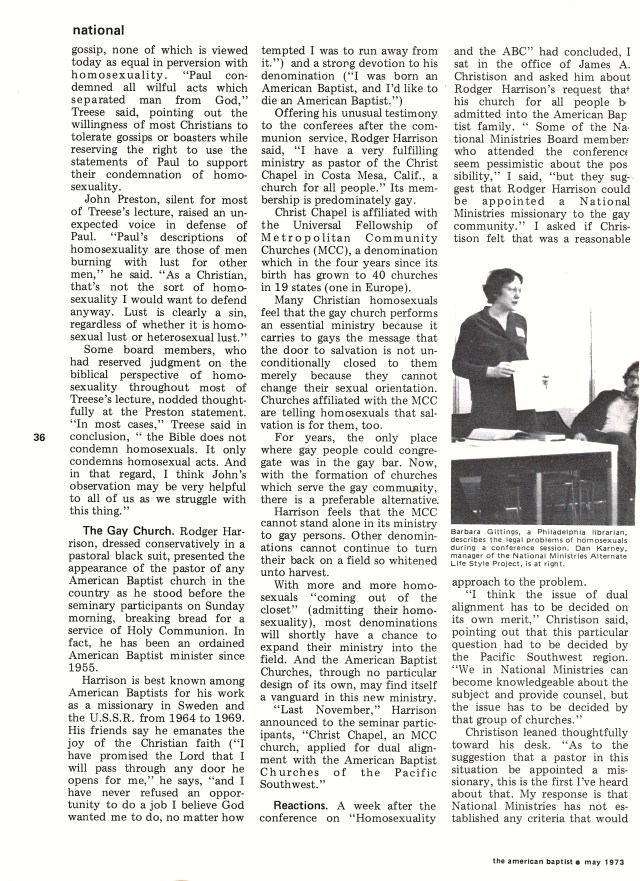
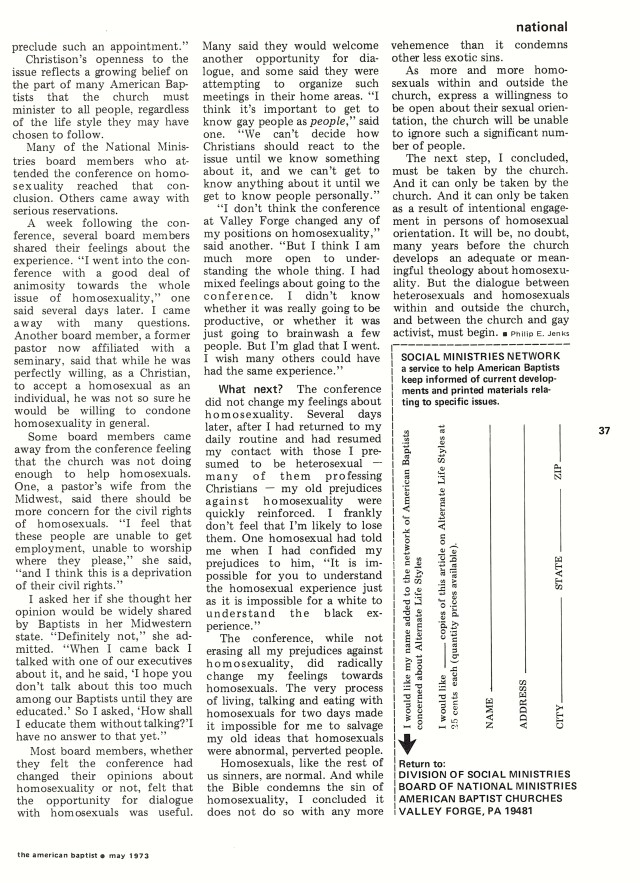
But I knew full well the pain that lies beneath the surface of that declaration in 1974 because the issue of LGBTQ equality in society and the church tore apart my former denomination, American Baptist Churches USA. The conflict among American Baptists rose to the surface in 1973 with the publication of an article in The American Baptist magazine, entitled, “Alternate Life Style.” The title was selected in an effort to mute the intensity of the main topic, which was about a conference on homosexuality in American Baptist life.

I was 27 when I was assigned to report on the seminar. The four-page article (scanned here) provoked dozens of angry letters. “The kind of permissiveness which allowed you to print the article, and Mr. Jenks to attend the meeting, allows the Devil to get his foot in the door,” wrote a woman from Crawfordsville, Ind. Others wrote, “Your article left me in a state of shock,” “I was truly grieved,” and, “I was appalled, disgusted, and saddened.”

On re-reading the article this week, I am not entirely satisfied myself about the way it reads. I remember thinking it might encourage readers to read it with open minds if I expressed my own ambivalence about the issue, but this was largely feigned as an editorial conceit. As a matter of fact I was never hesitant about it.

I believed, then and now, that God creates human beings with a large range of diverse and wonderful gifts over which we have no control but which God invites us to use as fully as we can. These gifts include our race, our ethnicity, our athletic ability or lack of it, our capacity to write or draw or carry a tune, our Myers-Briggs personality range, and – certainly – our sexual orientation and sense of gender identity. These are God’s sacred gifts, and we sin if we don’t strive to use them to the fullest. Moreover, institutions sin if they prevent anyone from living full, productive, and happy lives on the basis of any of these attributes.

There is no way I could have written that so explicitly in 1973 and, if I had, I’m sure my editor – whose courage permitted the article – would have judiciously deleted it. Now, when I am retired and have nothing to lose, I can write what I believe.

In 1973 – and in 1974 when the ELCA’S Reconciling Works was formed – most LGBTQ people were often forced to hide amid the institutional ignorance that surrounded them. Many persons of faith – then and now – accepted ancient scripture texts as proof of God’s condemnation of homosexuality. I knew and loved many colleagues during my 20 years on the American Baptist staff who hid their orientation in order to keep working in the ministries to which they had been called. In what may have been the darkest hour of American Baptist life, an ad hoc group of evangelicals formed an Internet group in the 1990s and began to “out” members of the staff. They did this purportedly because they believed they were called by the Holy Spirit to assure the sexual purity of the staff, but one must wonder if their actions were a blasphemy against the Spirit for which there is no forgiveness. (Besides, the American Baptist staff, as in any other grouping of humans, was never sexually pure. See my commentary written at the beginning of the #MeToo movement in 2017.)

Of course, it is not just my ecclesiastical colleagues who suffered the suffocation of the closet in order to keep working. Looking back in my high school years, I wince at the bullying experienced by boys deemed to be effeminate. Many others kept their proclivities private. Years later, some attended class reunions with same-gender partners, but others are still trapped in society’s sexual ignorance.

Looking back on the article I wrote in 1973, it’s long passed time to pay tribute to some of the heroes of the movement. To the best of my knowledge, Rodger Harrison still lives in Palm Desert, Calif. I meant him several times during my early years with the Baptists and found him to be extremely pastoral with a self-effacing sense of humor. I once sat with Rodger and Ralph Abernathy, the former lieutenant to Martin Luther King, Jr., during a Baptist meeting in San Diego. Rodger said, “Someday, Dr. Abernathy, I hope our movement will receive the same volume of moral support as yours.” I studied Abernathy’s face but couldn’t detect a reaction.

I tried do locate some of the persons mentioned in the article. I couldn’t find John Preston, although he left the Minnesota Council for the Church and the Homophile after the article was published. Dr. Robert L. Treese, Barbara Gittings, and James A. Christison, Jr., have died.

So has Norman R. De Puy, the editor who assigned me to cover the seminar on Homosexuality and the ABC. Norman’s theology was always profound, and I quoted him in the article: “All Christians are sinners, therefore a homosexual is a sinner,” Norman said. “So let’s call the homosexual a sinner and get on with it.”

Forty-six years after the article was published in The American Baptist magazine, it’s heartbreaking how much more progress needs to be made to help many persons of faith reach that conclusion. It’s worth celebrating that LGBTQ persons now have the Constitutional right to choose whom they will marry. At the same time, thousands of people still cling to a shallow interpretation of brass-age scripture to justify discriminating against their fellow human beings.

I do hope Lutherans will deluge Jennifer Younker, the editor of LivingLutheran, Pastor Meghan Johnston Aelebouni, writer of the article, with letters supporting “Grace and God’s Welcome.”

I know the readers’ response will not be unanimous, and there will be plenty of people who still don’t understand God’s grace is for all people.

But God’s grace is an irresistible force in the moral universe.

And I am grateful for the courage of the journalists at LivingLutheran to remind their readers of that reality.

Posted in Uncategorized | 1 Comment

Alternate Life Style 1973

jesus72

This article appeared in The American Baptist magazine in May 1973 to report a seminar on “Homosexuality and the ABC.”

ALS1

ALS2

ALS3

ALS4

ALS5

Posted in Uncategorized | Leave a comment

Entering the UK as Sir Winston Departs

wandp[final
January 24, 2019 – Winston Churchill’s death 54 years ago today marks a week of vivid personal memories.

Sir Winston died as I was preparing to leave home for a three-year Air Force posting at RAF Stations Bentwaters and Woodbridge in England’s bucolic Suffolk. I was already homesick when I climbed aboard a Boeing 707 at New York’s John F. Kennedy airport en route to London’s Heathrow.

My orders called for me to check in at Douglas House, a military hostel in the heart of London, where I would receive instructions for travel to the bases. I climbed into a luxurious London cab and gave the driver the directions recorded on my mimeographed orders.

The driver, wearing a wool cap and a frayed tweed jacket with shirt and tie, said, “Right-O, Mate.” He took me past Buckingham Palace, where the Union Jack was lowered in Churchill’s honor but the royal standard was at full staff. The driver was apologetic. “The Queen ain’t no better than you nor me, but she can’t lower her flag for Winnie, he warnt a peer.” Later I was told the royal standard is only lowered for the death of the sovereign.

I made my way to RAF Bentwaters on Saturday, the day of Churchill’s funeral. Ray Williams, the NCO in charge of the chapel where I would work, invited me to his family quarters on Woodbridge base, where we watched the funeral procession on a black-and-white telly. We listened respectfully as the BBC broadcast the voice of former U.S. President Dwight D. Eisenhower, who referred to my “old friend Winston.”

I was 18 and let it all flow over me. As time went on I began to wonder if Ike and Winston were really friends or did they constantly annoy each other by their differing views on the conduct of the war?

But on the day of Churchill’s funeral, my first full day so far away from home, I found comfort in Ike’s homely Kansas resonance.

Fifty-four years ago this week, Harold Wilson’s Labour government gave Sir Winston a funeral worthy of the savior of the nation.

But I wonder if some Brits also looked back upon him with mixed feelings. There is no question Sir Winston’s indomitable courage and soaring eloquence galvanized his people in their finest hour. Still, nothing was said during his funeral about his fierce imperialism and stunningly racist views, or his glorification of violence and war.

Even so, I found it an honor to be present in England as the Commonwealth said farewell to this towering figure Time magazine dubbed the Man of the Half Century.

And today I adapt an old admonition from Britain’s days of war: Keep Calm and marvel that you can remember 54-year-old events as if they are frozen in time.

Posted in Uncategorized | Leave a comment

Cana

suddenlyjoash72

staugue3x

Posted in Uncategorized | Leave a comment