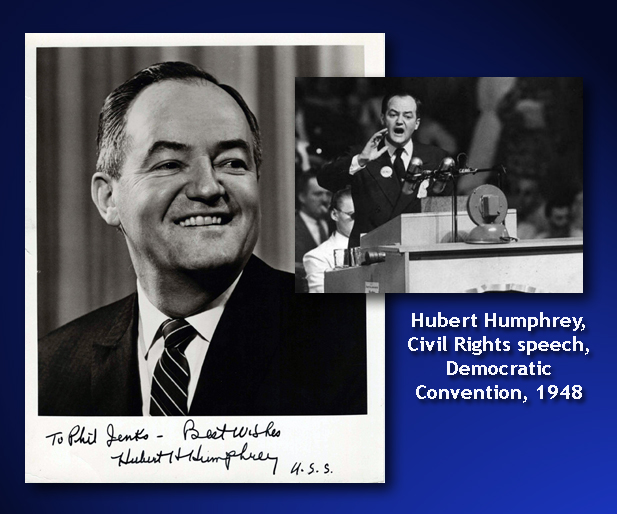
Hubert Humphrey and the Moral Test of Government

ImageIn politics, location is as important as it is in real estate. Hubert Humphrey was one of the great political and moral leaders of his generation. Unfortunately, he was located too closely to politicians who had more charisma and more power than he, but less vision.

No candidate for president in 1960 has a better record on civil and human rights than Hubert Humphrey, but he couldn’t match the magnetism or pocketbook of John F. Kennedy. In 1968, his presidential campaign was overshadowed by his closeness to Lyndon Johnson and Vietnam. Richard Nixon eked out a narrow victory that year, though skeptics believe that was because Nixon deviously convinced North Vietnam to ignore LBJ’s peace overtures until after the election.

Looking back, one suspects it was tragic that Hubert Humphrey was never President of the United States. His philosophy of government was not always embraced by actual Oval Office occupants:

“It was once said that the moral test of government is how that government treats those who are in the dawn of life, the children; those who are in the twilight of life, the elderly; and those who are in the shadows of life, the sick, the needy and the handicapped.”

If that sounds like ordinary political rhetoric, the difference is that Humphrey meant it. He was a profile in courage from the beginning of his career. When he was Mayor of Minneapolis in 1948, he pushed his fellow Democrats to strengthen their commitment to labor, welfare, and civil rights. He burst upon the national scene in 1948 with a firey address to the Democratic Convention in Philadelphia, calling for a stronger civil rights plank:

I do not believe that there can be any compromise of the guarantees of civil rights which I have mentioned. In spite of my desire for unanimous agreement on the platform there are some matters which I think must be stated without qualification. There can be no hedging – no watering down. There are those who say to you – we are rushing this issue of civil rights. I say we are 172 years late.

The speech helped precipitate the walk-out of southern delegates, who formed the Dixiecrat Party and rallied behind Strom Thurman’s presidential candidacy. The party split seemed to doom President Truman’s chances for re-election.

Humphrey’s speech may have annoyed Truman, who did win the 1948 election, but it propelled him into the U.S. Senate. His progressive record commanded national attention and in 1960 he ran unsuccessfully for president in primaries that were dominated by John Kennedy.

ImageHumphrey continued in the Senate during the Kennedy years and I wrote to him on several occasions, usually eliciting a thoughtful response from him.

In 1964, Humphrey spearheaded support for Lyndon Johnson’s Great Society legislation, including the Civil Rights Act of 1964.

Both Humphrey and the president realized the bill would not be supported by southern Democrats. LBJ recruited Republican leader Everett Dirksen to bring moderate Republicans into the fold, and Humphrey played a pivotal role in bringing the bill to the president’s desk for signing.

LBJ rewarded Humphrey by naming him vice president inn the 1964 election. For the most part, Humphrey was treated badly by Johnson — who, as a former vice president himself, should have known better. But Humphrey was a loyal supporter of the president and his Great Society.

Humphrey’s loyalty included support for Johnson’s Vietnam policy. There is a sad footnote to his vice presidency in which Humphrey was invited to address the general assembly of the National Council of Churches, a long-time progressive ally. He may have been expecting a friendly reception, but the faith leaders lambasted the administration’s “immoral war.”

Humphrey was re-elected to the senate after his difficult turn as vice president and he continued to serve with distinction. After the election of 1976, when Jimmy Carter defeated Gerald Ford, Humphrey paid a friendly visit to the outgoing president.

“I only wish I had had more time,” Ford told him.

“Aw, Mr. President, don’t complain,” Humphrey said. “I would have given anything for a day in this office.”

Looking back, I have no doubt this country would have been much better off if Hubert Humphrey had indeed been our president, if only for a day.
Posted in Uncategorized | Leave a comment

Lincoln and Dirksen

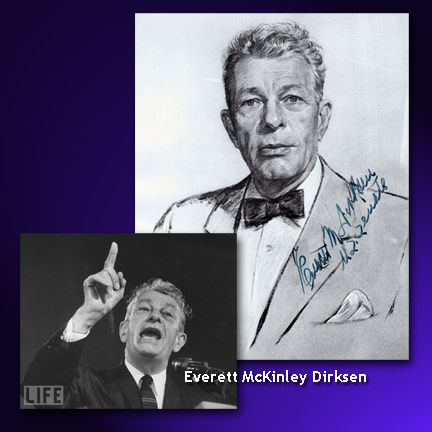
ImageFifty years after the passage of the Civil Rights Act of 1964, I wonder how many people remember Everett McKinley Dirksen.

If you watched television news in the sixties, you knew exactly who he was. He was an Illinois Republican, the Minority Leader of the United States Senate, a man with deep crevices in his face, a mop of tousled hair, and a deep and mellifluous voice. Historian Michael Beschloss, who grew up in Dirksen’s home state of Illinois, said he and his brother thought Dirksen sounded like Mr. Ed. (Of course you remember Mr. Ed was a talking horse with his own TV program, 1961 to 1966.)

I loved listening to Dirksen speechify, and that was one of there reasons I sought to add his autograph to my collection. The picture he sent was a somewhat idealized artist’s sketch, but his elegantly old-fashioned fountain pen signature was impressive. Each letter of his name was carefully crafted and it must have taken several seconds to complete the task. I wondered how long it took him to sign his constituent mail each day.

In addition to his stentorian voice, Dirksen played a significant role in U.S. history.

In a college lecture, Beschloss put it this way:

Spring of ’64 Johnson calls up Dirksen and essentially says, “Ev, I need your help on this Civil Rights Bill because the southern Democrats are going to be against it and I need Republican votes.” And he essentially says, not verbatim, but the essence of it is, he says, “Ev, I know you’ve got some doubts, but look at it this way, if this bill passes it’s going to change the country and make history, and if all that happens everyone will give credit to you. And if it happens a 100 years from now the school children of America will know exactly two names, Abraham Lincoln and Everett Dirksen.”

And Dirksen heard that and he liked what he heard, and I think it was not the only reason, but he supported the Civil Rights Bill and it passed, and history was changed.

Fifty years on, Lincoln’s name is still better known than Dirksen’s, at least in Illinois school rooms.

Perhaps Dirksen allowed himself to succumb to the famous Johnson Treatment when he should have been wiser. But surely it’s a good thing he didn’t.  Almost certainly, the Civil Rights Act of 1964 could not have been passed without his nonpartisan effort.

Posted in Uncategorized | 7 Comments

Nehru

ImageIn addition to U.S. politicians, I began writing to world statesmen (the gender exclusion is deliberate  because I didn’t know any world stateswomen except Eleanor Roosevelt and, if you will, Jacqueline Kennedy).

I wrote to the Pope (as reported earlier), Charles DeGaulle, and Winston Churchill. Aside from a note from the pontiff’s secretary I heard from none of them. Later I learned that Churchill was fragile with advanced age and had retired from routine correspondence.

I wrote to Pakistan President Ayub Kahn and India Prime Minister Jawaharlal Nehru, in part because they were visible in the U.S. media as President Kennedy sought to align their nations with the so-called free world.

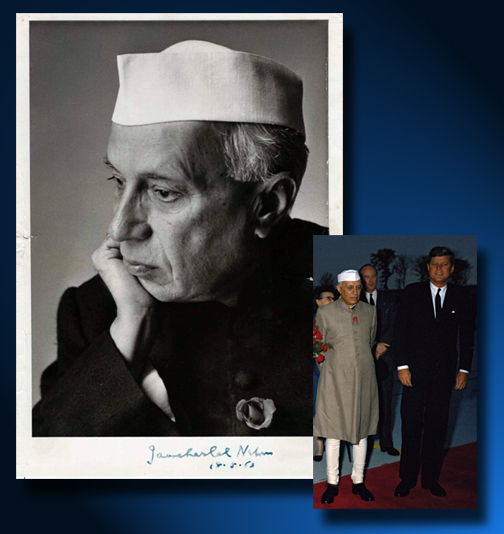
I never heard from Ayub Kahn, but many months after I wrote to Nehru I received a tattered brown envelope from India. The letter had traveled by surface mail, suggesting it had been on a boat for several weeks. Inside was a small card engraved, “With Compliments,” and a photograph autographed by Nehru.

At 16, I knew little about Nehru beyond the fact that President Kennedy treated him with great respect. In the book Odyssey of a President by Merriman Smith, a report of President Eisenhower’s 1959 visit to several friendly nations, a memorable passage described the Prime Minister standing next to Eisenhower in an open car that was slowed by welcoming crowds in its path. Nehru, Smith reported, jumped out of the car and began pushing people out of the way. That alone would have earned respect from any U.S. president.

Many years later, when I worked for the U.S. National Council of Churches, a colleague from India made a reference to “the first prime minister of India,” omitting his name because he assumed no American would know who he was.

But perhaps my friend was wrong. I think a lot of Americans know Nehru was Mahatma Gandhi’s primary lieutenant, and the architect of modern India. I have few possessions I value more than the photo on which he scrawled his name and the date, 18-5-63.

Nehru’s health was in decline by then, and he died a year later on May 27, 1964. Even so, he was evidently managing both the impossibly large and incredibly small duties of his office — including writing his name for an American teenager he never met.

Posted in Uncategorized | Leave a comment

The Pope and the Patriarch

ImageIn October 1967, when I was an Air Force chaplain’s assistant in England, I helped organize a pilgrimage of Catholic airmen to Rome. The itinerary included visits to major statuary, crumbling ruins, and St. Peter’s Basilica.

As it turned out, only a handful other airman joined me in the tours, including my fellow chaplain’s assistant, Doug Greene, and a six-and-a-half foot tall Minnesota Lutheran named Moose. The other 30 guys disappeared on Fernandina Beach, and we didn’t see them until they showed up at the airport on the last day, sunburned and sated.

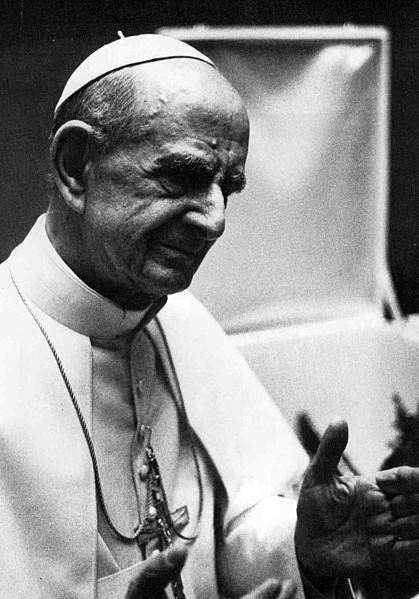
I didn’t skip a single opportunity on the itinerary. The day after our arrival, a Sunday, we stood in Saint Peter’s Square to watch Pope Paul VI bless the crowd. It was an exotic moment for sheltered young Americans.

We stood next to a huge speaker when the Pope spoke, so his nasally voice sounded like an air horn. He addressed the crowd in Italian for several minutes as we held our hands over our ears.

An woman in the crowd told us to find something to lift up when the Pope started speaking in Latin.

“That’s the blessing,” she said. “It covers anything you want.” As an example, she showed us a small golden crucifix.

She held the crucifix in air and closed her eyes prayerfully when the Pope began the blessing. We reached into our shirts and pulled out our dog tags, lifting them as high as the chain would allow. It probably looked like we were sniffing them.

The next day,we found our way to a Vatican courtyard where the pope was receiving a smaller crowd. The tour agent told us the courtyard would fill up quickly, so we got there early and waited beneath a small balcony.

It was difficult for people to slip ahead of Moose, who stood tall and implacable, unwilling to give up his space to see the pope close-up. But a short, stout nun, followed by a half dozen school girls, pressed her large bosom against Moose’s arm and he flushed and jumped aside. The nun did the same thing to others in front of Moose and soon she and the school girls were in the front row.

Even so, Moose and I were fairly close to the window and when the pope emerged we could see the crinkles around his eyes.

The Pontiff, a fair linguist, began to address the crowd in different languages. “Français,” he announced, and when the French speakers applauded, the pope lifted his right hand to his ear and made a giggling sound. “Português,” and when persons from Portugal applauded he giggled again. Soon, he announced, “English,” and after his giggle he offered a thickly accented greeting to the English speakers.

“That was neat,” Moose said as the crowd dispersed. “We got closer to the pope than we ever get to the chaplain.” That was true, because when the chaplain mounted the pulpit, the airmen retired to their desks to drink coffee.

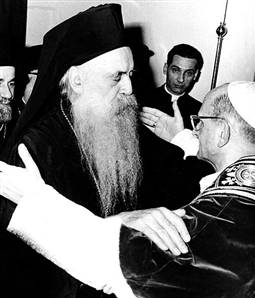
We saw Pope Paul one more time that week, on October 28, when he stood at the main altar of St. Peters next to the Ecumenical Patriarch Athenagoras I.

The Pope and the Patriarch had already met in 1964, ending a centuries old rift between the western and eastern churches. The October visit was a follow-up, an auspicious occasion when the two church leaders were to join in a concelebrated mass.

For us uninformed boys, the pair looked mismatched at the altar. The Patriarch with his long beard towered over the petite pope.

ImageBut we I knew it was a major historic event because the basilica was filled with ecclesiastical celebrities. Included in the procession was Bishop Fulton J. Sheen, known to Moose and me as the “Uncle Fultie” of 1950s television fame. Sheen, like the American politician he was, kept straying from the procession to shake hands, repeating, “How are ya, how are ya …” For years, shaking Bishop Sheen’s hand was my most vivid memory of the day.

Years later I began to realize what an important day that had been, when a historic split in the Christian church began to mend. At the end of Athenagoras’ visit to Rome, the Patriarch and the Pope issued a joint statement, thanking God “for enabling them to meet once again in the holy city of Rome in order to pray together with the Bishops of the Synod of the Roman Catholic Church and with the faithful people of this city, to greet one another with a kiss of peace, and to converse together in a spirit of charity and brotherly frankness.” (See http://bit.ly/1i5m2c7)

And years after that, when I was on the staff of the National Council of Churches, I reminisced about this day in October 1967, and said it was probably the most historic event I had ever attended. “It was,” I told colleagues who might have missed it, “a concelebrated mass by the pope and the Patriarch.”

But my friend Father Leonid Kishkovsky, ecumenical officer of the Orthodox Church in America, raised his hand.

“It was not a concelebrated mass,” he said quietly. “Where did you get that?”
“That was what they told us,” I said. “I was a 21-year-old Baptist. There’s no way I could have made the word up.”

Leonid shook his head gently. “It was not,” he repeated. “It couldn’t have been.”

There is no one on earth better informed about interreligious relations than Leonid Kishkovsky, so I will take him at his word.

But I will never forget that in October 1967, Doug and Moose and I saw Pope Paul VI and Patriarch Athenagoras I stand side by side at the central altar in St. Peters Basilica.

And what ever they were doing together that day, it was for us an incomparably historic event.

Posted in Uncategorized | Leave a comment

Dear Pope

ImageWhen I sent Eleanor Roosevelt a list of questions in 1962, her prompt response inspired me to write to other luminaries.

Almost immediately after he became pontiff in June 1963 I sent Pope Paul VI a list of questions and asked that he respond to them for Smoke Signals, the student newspaper of Morrisville-Eaton Central School in New York State.

God knows what questions I thought appropriate to send the pope. I never kept carbon copies of my correspondence so they are lost forever.  I was also oblivious, at 16, of the administrative chaos that must have prevailed in the Curia in the transition between John XXIII and Paul.

After a year, when I had completely forgotten my letter to the pope, an ordinary looking envelope arrived in the mail.

Inside was a note from Father Pasquale Macchi, the pope’s private secretary. This note is also lost, but I recall its friendly tone and Father Macchi’s assurance that the Holy Father, as the son of a journalist, was always glad to hear from journalists, even if he couldn’t respond to every letter. I think Father Macchi also assured me of a papal blessing.

The blessing was nice but it was even nicer that a priest in Rome was willing to play along with me as I posed as a genuine journalist.

I didn’t think about this correspondence for decades until April 1999 when my father, Elmore Jenks, died and the family gathered for his funeral in Morrisville, N.Y. The Rev. Walt Ketcham, an old family friend presided at the funeral. Walt added this anecdote to his eulogy:

“When I was Elmore’s pastor in Morrisville, I was contacted by a prominent and very alarmed Catholic layman who complained that Elmore’s son, Phil, was writing to the pope. I had no idea what Phil would be writing to the pope about, so I contacted Elmore to see if he had any idea. Elmore rolled his eyes and smiled. ‘Phil does stuff like that,’ he said. ‘He doesn’t mean anything by it.’”

I had no idea, in my teenage naiveté, that it was such an alarming thing to write a letter to the pope. As a Baptist, I also had no clue about apostolic succession, though I’m pretty sure I would have written to Saint Peter, too, if I had had the chance. But it was a startling revelation years later that my letter to Paul VI had been so distressing to old-fashioned Catholics who must have been reeling from the potential of Vatican II.

Looking back, I’m pleased that at least two persons were not alarmed by my effrontery. My father never told me that he had brushed aside an ecclesial complaint about me.

And Father Macchi, clearly unoffended by my letter, sent warm words and a blessing.

Posted in Uncategorized | Leave a comment

Dick Nixon, Soda Shark

Dick Nixon, Soda Shark

DIck Nixon was attorney for Pepsi Cola when I wrote to him to request an autographed picture. His generous response was probably accompanied by a cover letter from his secretary, Rose Mary Woods. If so, I discarded her letter because I didn’t know she would be famous in a dozen years. When I wrote to RN in 1964 to request an interview, I inadvertently preserved Woods’ reply by using it as a book marker. (See http://bit.ly/1mGSgxb)

In 1961, I saw no reason to dislike Nixon. My Weekly Reader had bolstered his image during his vice presidential years, and he was no longer campaigning against JFK, so I set ill feelings aside. My views toward Nixon soured during the Watergate period. When I left American Baptist Churches in 1993, the human resources officer pulled out my 20-year-old application form which had a space for “Miscellaneous Comments.” I had written, “Nixon Sucks.”

Suffice it to say he was a complicated man. When I was growing up, my household held him in fairly high esteem, and my mother was fond of pointing out that, in some poses, my father looked like Nixon. When it came out years later that she was a closet Democrat, I suspected passive-aggressive motives.

Be that as it may, Richard Nixon — possibly underwhelmed by his duties at PepsiCo — took time to scrawl his name for a stranger not old enough to vote. Did it belie a spark of optimism for his future career?

For the record, when I came of age to cast my first vote in 1968, it was for Nixon’s rival, Hubert Humphrey.

Posted in Uncategorized | Leave a comment

Mister We Could Use a Man Like Hoibert Hoover Again …

Mister We Could Use a Man Like Hoibert Hoover Again ...

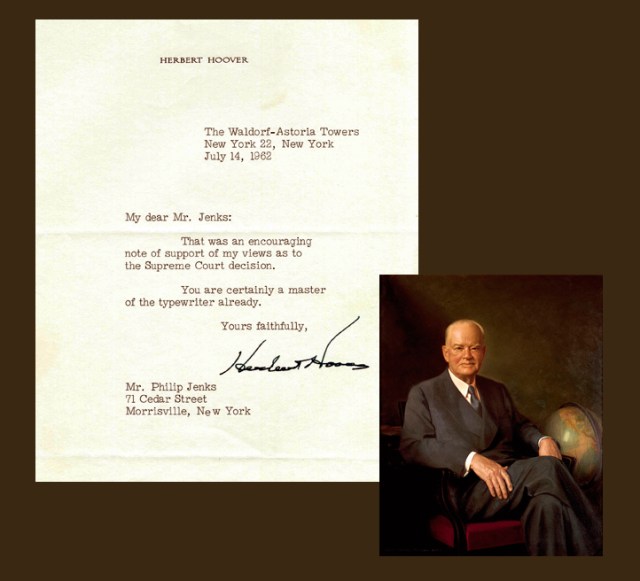
In 1962 I read an article about Herbert Hoover in Parade magazine. The article described his austere life in the Waldorf-Astoria towers, and noted the ex-president still received a half dozen letters each day. He would write his responses on a yellow tablet and sign the responses after they had been typed by his staff.

Knowing that my grandparents would place great value on a letter from Mr. Hoover, I typed a letter to him immediately, citing a Supreme Court decision long since forgotten. When I examined the letter I was chagrined by the strike-overs and added an apology for my typing. His response that I was a “master of the typewriter already” was not only gracious, it was a useful affidavit to show my typing teacher father when he complained about my eccentric two-fingered style.

Posted in Uncategorized | Leave a comment

Sadly with Adlai

Sadly with Adlai

Adlai Stevenson would have been 114 this month. I once took a girl I admired on a “date” to see him speak at Colgate University, circa February 1963. The effort did not sweep her off her feet, and I began to realize what it meant to go sadly for Adlai. He did send me a signed photograph, although the signature — appropriately enough — is fading.

Posted in Uncategorized | Leave a comment

Smokin’ Joe and Typin’ Phil

Smokin' Joe and Typin' Phil

With one exception, I haven’t solicited a celebrity’s or politician’s autograph since 1964. That exception was Heavyweight Champion Joe Frazier. In retirement, Joe represented a furniture company that happened to have a display room beneath my apartment on Charlotte Street in Pottstown, Pa.

When it was announced Joe was making a public appearance at the store in 1994, I was the logical member of the Pottstown Mercury staff to cover the event. Don Seeley of the Mercury sports staff told me, “He’s kind of hard to understand but he’ll be happy if you make him sound good.”

On the morning of Joe’s arrival, my friend photographer Kevin Hoffman and I followed the champ around the store. He was genial and friendly, but — as Don predicted — difficult to understand. I asked the champ about his relationship with Muhammad Ali, and he was clearly expecting the question. Puffing himself up almost comically, he said, “Ali say he got the Parkinsons, but I’ll tell you what he got.” He shook his large fist in front of my face. “THAT what he got,” he said, laughing. I reached out my hand to feel his biceps, which were like steel, and Kevin snapped the picture (below, right).

Later, I received an autographed picture of Joe from the furniture company. Kevin printed the picture of Joe and me and gave me a copy. I sent the picture to Joe and asked for an autograph, which he quickly provided — in exchange for a $50 donation to his favorite charity.

Years later, when I hung the picture in my National Council of Churches office in New York, an occasional passerby would look at the picture and say, “Ooo, you knew Dr. King?” As if Martin was six feet tall and would bend his arm in people’s faces and say, “Hey, Bud, feel that.” But I’d politely respond, “well, they were both Baptist.”

Posted in Uncategorized | Leave a comment

JFK Campaign Pin

JFK Campaign Pin

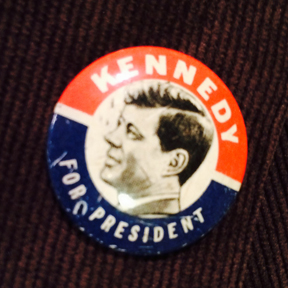
I can’t remember where I got this pin because Democratic campaign items were not plentiful in Morrisville, N.Y., in 1960. I remember that I wore it throughout the 1960 Kennedy-Nixon campaign, wore it throughout the Kennedy years, and was wearing it on November 22, 1963 when JFK was killed. It has rattled around in sock drawers and jewelry boxes for 50 years, and for a few days it has returned to my lapel. The pin, like a tinny portrait of Dorian Grey, has long outlived its honoree.

Posted in Uncategorized | Leave a comment