When Kennedys Meet Out Yonder

kennedyconclave

August 1, 2018 – Senator Edward M. Kennedy died nine years ago this month. At the time I fantasized what it might have been like when Teddy crossed over. Would he have been greeted by his long-dead brothers? And what would the conversation have been like?

The fantasy unfolds:

Somewhere laughter erupted, as if someone had just told a joke.

It was raucous, frat house laughter, exploding loudly and then fading into Boston-accented commentaries on whatever the hell was so funny.

It was familiar laughter. Ted opened his eyes to see where it was coming from.

The mist in the room began to lift and Ted saw three shadowy figures. Two were over six feet tall and one was shorter, and their foreheads nearly touched as they leaned toward each other. One of them – Ted wasn’t sure which – was about to tell another joke.

“Huh,” Ted said.

The three straightened and turned to face him. “Huh, yourself,” said Jack, flashing his teeth. Joe and Bobby smiled, too. Ted blinked his eyes and stared at the three grinners.

“Where – what -?” Ted said. “Am I -?”

“What’s wrong, hot shot, don’t you read the Globe any more?” asked Joe, whose starched white Navy officer’s uniform glowed as if he was being transfigured.

Kennedy Dead at 77,” said Bobby, reading from a paper that suddenly materialized in his hands.

Liberal Lion of the Senate, symbol of family dynasty, succumbs to brain cancer,” Jack recited.

“Brain cancer,” Joe said. “Jesus, Mary and Joseph.”

Ted began to catch on.

“I knew when the priest came and they took away my ice cream that it was getting close,” he said. “Am I -?”

“A ‘malignant glioma’ for God’s sake,” said Jack. “Christ, you always did do things the hard way.”

“Us, we never saw it coming,” said Joe. “A bomber explodes …”

“A couple bullets in Dallas,” said Jack.

“A .22 round to the head in Los Angeles,” Bobby shrugged.

“Couldn’t have been easier, old man,” Joe said. “But a ‘malignant glioma’? Jesus.”

Ted looked around but he couldn’t see clearly through the thick mist.

“Is this heaven? Where’s Dad?”

The three older brothers exchanged glances. Jack shifted his weight at an invisible podium, as if it was a press conference and he was searching for a misleading answer.

“This isn’t heaven,” Bobby said. “More like the narthex.”

“And we haven’t seen Dad,” said Joe.

“Remember, we all predeceased him,” added Jack. “But if he came through here, we didn’t see him.”

“Mother is up ahead of us,”clarified Bobby. “And Eunice and Jackie and John Jr. – all of them.”

“But we haven’t seen Dad,” repeated Joe.

“We don’t know about Dad,” said Jack.

Ted stared at his brothers, and they stared back at him.

“You all -” Ted started. “You all look good.”

Bobby snorted impatiently, the way he did when he read convoluted Justice Department memos.

“Of course,” he said. “So do you.”

A shimmering mirror appeared in front of Ted. He did look good. The gut was gone, the jawline was firm, the hair was dark brown.

“Damn,” he said.

“It’s a fringe benefit,” said Joe, stepping along side Ted to share the mirror. Joe examined his teeth and smoothed his hair with his palm.

Ted turned away from the mirror and extended his hands toward his brothers. “So what’s next?” he asked. “Why are you here?”

Jack placed his hands in the side pockets of his sports jacket. “We are here,” he said – the familiar starchy he-ah – “to honor you.”

“Welcome me to the other side?”

“More than that,” said Bobby.

“We’re here to pay our respects,” Jack said. “Dad had big ideas for all us boys, and you transcended us all.”

“Me?”

“Yes, you. Joe was relieved of the burden early, but I was president and Bobby became a civil rights icon. But you went so much further.”

“So we’re here as your honor guard,” said Joe. “You were the greatest among us.”

Ted snorted. “Shit,” he said. “I could have used this respect when you were pummeling me in touch football.”

“You hadn’t earned it then,” said Bobby, frowning. “That was then,” said Joe. “This is now.”

“And, look, you weren’t perfect,” said Jack. “Chappaquiddick. Shit.”

Joe and Bobby shook their heads.

“No way you are Saint Teddy,” Jack said. “You’ll be reminded of that every day here in the Narthex. All four of us were horny bastards and we thought we were entitled.”

Joe stepped in front of Jack.

“Not me. I was Mom’s altar boy,” he said. “But Teddy, this is no canonization. It’s just us boys getting together to acknowledge who you are in the Kennedy firmament.”

“Firmament?” Ted asked

“Look,” Bobby said. And he began to sum it up in lawyerly fashion. “Because of you, this country has a fighting chance for universal health care,” Bobby said. “You were responsible for more legislation that became law than any of us: in civil rights, voting rights, education, labor justice, immigration reform. You pushed George W. Bush to implement ‘No Child Left Behind.'”

Jack added, “You pushed this country to oppose apartheid in South Africa. You pushed for peace in Northern Ireland. You forced the U.S. to stop sending arms to the Pinochet dictatorship in Chile. You opposed this country’s entry into the Iraq War.” Jack looked down at his feet. “I wish you had pushed me a little harder to get out of Vietnam,” he said in a low whisper.

“But you were the man,” Joe said. “You may well be the Kennedy future generations will remember.”

“If they mention us at all,” Bobby said quietly, “Who knows? Maybe Joe and Jack and I will be remembered as Teddy’s brothers.”

Jack and Bobby and Joe exchanged dubious smirks.

“I can live with that,” Ted said.

The four were silent for a moment. Teddy cleared his throat. “What’s next?” he asked.

“Time to move on, old man,” Joe said.

“We’ll follow you,” said Jack. “Let’s go,” said Bobby. The three older brothers stepped aside and pointed the way to a shaft of light.

“What’s that”

The older brothers shrugged.

“Okay,” said Ted. “Let’s go, then.”

“Any last minute instructions before we go?” asked Joe, a bit sardonically.

Ted scratched his head and smoothed his dark brown hair.

“Yes,” he said, stepping forward. “The work goes on, the cause endures, the hope still lives …”

Ted stepped in front of his brothers and began walking toward the light.

“And the dreams shall never die.”

Posted in Uncategorized | 1 Comment

Grandpa, What Was Print Media?

Mercury Building copy

July 29, 2018 – A few years ago my oldest grandson asked what I had done in the Air Force and his father told him I had used a typewriter. “What’s a typewriter?” he asked.

Now before my youngest grandson asks me what a newspaper was, I thought I’d better record some thoughts before I forget the answer.

Earlier this month the New York Daily News announced it was firing half of its newsroom staff, a draconian move by publisher tronc Inc. and only the latest development in the decline of daily newspapers around the country,

The decline has also affected my favorite local rag, the Pottstown Mercury, where I worked as a staff writer for three years in the early 1990s. Editor Evan Brandt’s recent post about the closing of a building that housed The Mercury is the latest rasp of the death rattle of small-town newspapers.

According to Brandt, The Mercury will continue to publish and staff will be asked to work from home or at the paper’s Exton, Pa., printing plant. But it’s not a good sign, and clouds of doom hang over all print media. Earlier this year New York Times CEO Mark Thompson estimated that the newsprint Times would disappear in ten years.

“We’ll decide that simply on the economics,” Thompson told Kellie Ell on CNBC’s web page. “There may come a point when the economics of [the print paper] no longer make sense for us.”

The tear I shed over this development is, I confess, slightly hypocritical because I already read the digital Times on my iPad. I also read the Merc on line because I live a hundred miles from the paper’s closest coin box.

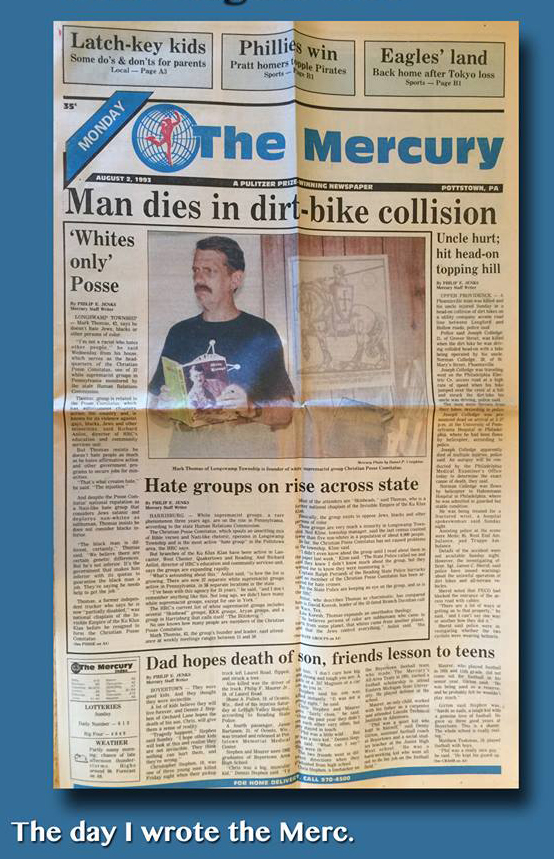
I was a cops and politics reporter for the Merc from June 14, 1992 to June 21, 1995. It was an intense and generally enjoyable experience although, looking back, it was only a brief interlude in my 40-year career as a church communicator. The Merc’s editorial and advertising offices were on the second floor of the now redundant building. Even 25-years ago the building seemed old and reporters once filed an OSHA complaint that the stale air gave them headaches. There was no evidence that the air was bad but I suspect the real purpose of the complaint was to call attention to the fact that the publisher was hermetically sealed away from the reporters in a freshly painted air-conditioned office.

I was not party to the complaint. In fact, I found little to dislike about the Merc. Unlike church workers, who think their tasks are so godly they must take work home at night and on weekends, the Mercury didn’t like paying reporters overtime and refused to allow it. If I had to cover an evening school board meeting I’d come in at noon. If there was no evening meeting I’d come in at 10 a.m. and leave before 7. I’d interview sources, write two or three stories, and when I filed them with the editor my day was done.

On Tuesday nights, if my day was over by 7, I’d kick off my shoes and watch ABC’s NYPD Blue, a police procedural about a detective squad with a management style very much like the one in our newsroom. On television, Lieutenant Fancy would get a call about a crime occurring somewhere in Manhattan South; in the newsroom, Editor Walt Herring would get a call about an accident, robbery, fire, or other news event in the Pottstown coverage area. On television, Fancy would call out the names of two detectives and order them to the scene of the crime; in the newsroom, Herring would call out the names of a reporter and photographer and send them to the news event. On television, detectives Sipowicz and Simone would arrive at the scene where they would always find a place to park and use their fists or pistols to subdue the malefactors and haul them into justice; in the newsroom, the reporter and photographer would double park, take pictures, interview sources, and return perspiring to the newsroom to process the story for the next day’s edition.

I have to admit that I loved it. Sometimes the news we covered was not pleasant. The first story I covered for the paper was a fire that cost the lives of three young children. Photographer Kevin Hoffman and I were occasionally first to the scene of grisly automobile accidents where the smell of blood wafted with the odor of gasoline fumes. Sometimes a driver’s mangled body sat strapped akimbo in the seat until the coroner arrived to officially declare what first responders could already see. One January, Kevin and I covered the crash of a small two-engine commuter aircraft that failed to take off from the Limerick, Pa., airfield in a snow squall. The bodies of two young businessmen showing no signs of trauma were strapped in the back seats, but the body of the pilot had been torn apart by the impact. Limerick Police Chief Doug Weaver called me over to look. “Here’s something you don’t see every day,” he said, pointing to the pilot’s heart which was exposed on the outside of his chest cavity.

dayiwrote

Most other news events were more prosaic, including school board or township meetings or preliminary hearings in district court. Most meetings were too boring to make for interesting reading, and when something exciting did happen – as when a school superintendent called one of his board members a “little shit” – it had to be reported obliquely because the Mercury was a family newspaper. But I loved writing the stories, filing them, going home to bed, and – best of all – coming in the next day to see my byline on the front page. The very last story I wrote for the Mercury, was in June 1995, when two elderly men in a trailer park got into an argument and shot each other with .22 rifles. They were both bad shots and both lived, but I had to leave it to other reporters to do the folo. That month I was on my way to New York to join the staff of the World Council of Churches.

The Mercury continues to publish a print version and I hope it continues for many years. But the future of print journalism is not bright. After 579 years Gutenberg has been succeeded by Zuckerberg. A digital mirage on our smart phones is replacing the tactile comfort and smell of newsprint and ink.

Granted, reading a newspaper online is convenient (so long as your power source lasts) and news updates are instantaneous. Nor can I see myself patiently waiting for the bulky Times to be tossed on my front lawn when I want to read Charles Blow NOW.

When the final paper Times rolls off the press, I’ll miss it terribly. And now when I pick up my iPhone to read the instant headlines, I’ll try not to remind myself that my need for instant news gratification – and yours – was ultimately responsible for the end of print.

Posted in Uncategorized | Leave a comment

An Unplanned Conversation with Julian Bond

BondandKingAmong the decaying newsprint clippings I discovered in the attic this weekend was a February 20, 1970 issue of The Spotlight, the student newspaper of Eastern Baptist College.

Headlining the issue was an exclusive interview with Georgia legislator Julian Bond who, despite having just turned 30 that year, was a political superstar on campuses around the country. Bond was one of eleven African Americans elected to the Georgia House of Representatives after the passage of the Voting Rights Act of 1965 opened registration to Black voters, and – as noted in The Spotlight’s introduction – he became a national media figure at the Democratic Convention in 1968. He was a founder of the Student Nonviolent Coordinating Committee and chair of the NAACP from 1998 to 2010 when he compared the GOP’s Tea Party movement as “the Taliban wing of the Republican Party.” Bond was 75 when he died in August 2015.

It was a cold night in January 1970 that the Spotlight staff gathered in its elegant office in Walton Hall to do some brain storming about the next edition. Top issues that year were the demonstrations of the Resistance Movement against the Vietnam War, and the (ultimately unsuccessful) campaign of Democratic upstart Norval Reece to unseat Senate Minority Leader Hugh Scott. Editor Judson Childs had already interviewed Reece and staff members began suggesting names for other interviewees. I think it was Jane Thompson who said, “How about Julian Bond?”

We all admired Bond and thought that was an excellent idea.

“He’ll never do it,” someone said, but by then I was already on the old rotary phone in the office calling information for the number of the Georgia House. I was quickly connected with Bond’s office where an adolescent-sounding male said, “He’s not here, he’s on the floor,” meaning the floor of the house. Trying to make “Eastern Baptist College” sound as august as Bond’s alma mater Morehouse College, I left my name and number and asked if Mr. Bond would please call me for a brief telephone interview.

I put the phone down and the staff conversation turned to other matters. Within the hour, however, the phone rang and one of the women picked it up and her eyes widened.

“It’s Julian Bond!” she shouted, muffling the phone with her palm.“Who is going to talk to him?”

I reached for the phone just as I was handed the microphone of a barely functioning cassette recorder. I pressed the microphone against the mouthpiece and began talking.

We must have been on deadline because I remember staying up late to transcribe the interview, carefully omitting my nervous banter and futile efforts to make the serious Bond laugh. Once typed, I quickly measured the copy for layout, clipped a picture of Bond out of TIME magazine and dropped it in without a credit line. The interview – for whatever minor contribution it makes now to the history of small school journalism – is posted below before the actual newsprint deteriorates into meaningless yellow flakes.

JB172

JulianBondConc


Posted in Uncategorized | 4 Comments

Odyssey of a Would-Be Cartoonist, Part 6

Eastern Baptist College, Part 4

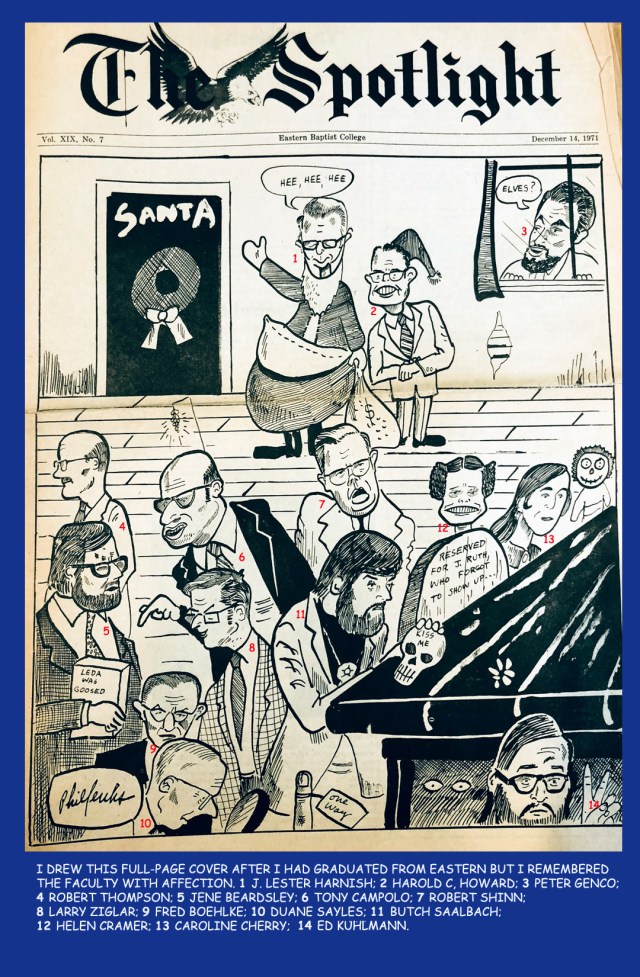
As is the case with most institutions, the faculty is the heart and core of the student experience.

CORRECTEDFACULTYXMASPARTY

Posted in Uncategorized | 2 Comments

Odyssey of a Would-Be Cartoonist, Part 5

Eastern Baptist College, Part 3

Either despite or because of the tenor of the times, the spiritual dimension of life at Eastern was never lost.


newgeeting

And the theological discourse was rarely tame.

EARNESTANDBUTCH


Posted in Uncategorized | Leave a comment

Odyssey of a Would-Be Cartoonist, Part 4

Eastern Baptist College, Part 2

MISCVIEWS

CLIMATECHANGEVIEWSIN1970

Posted in Uncategorized | Leave a comment

Odyssey of a Would-Be Cartoonist, Part 3

Eastern Baptist College

July 23, 2018 – I spent barely six months at McConnell AFB, Kansas, from February to August 1968. It was the briefest and, in some ways, the most educational period of my Air Force experience.

As a sergeant in the base chapel, one of my responsibilities was to greet airmen who had been newly assigned to the base and to make sure they were aware of all the base chapel had to offer them. The majority of the new assignees were returning from their year in Vietnam.

I had signed an agreement to enlist in the Air Force in July 1964, more than a month before the Gulf of Tonkin resolution that granted Lyndon Johnson authority to dramatically increase the number of troops in Vietnam. We didn’t know then that the resolution was based on a lie but one of its side-effects was that many people with my date of enlistment were sent to Europe and North Africa, and thousands who enlisted a month later were sent to Southeast Asia.

By 1968, many of the returning Air Force veterans had concluded that the Vietnam War was a hideous mistake and morally bankrupt as U.S. policy. The troops who came through McConnell AFB chapel, reeking of sweat and marijuana, couldn’t stop talking about it. It was largely because of their testimony that I became an anti-war veteran and when I was separated from the Air Force in August 1968 I knew I would seek ways in college to express my views.

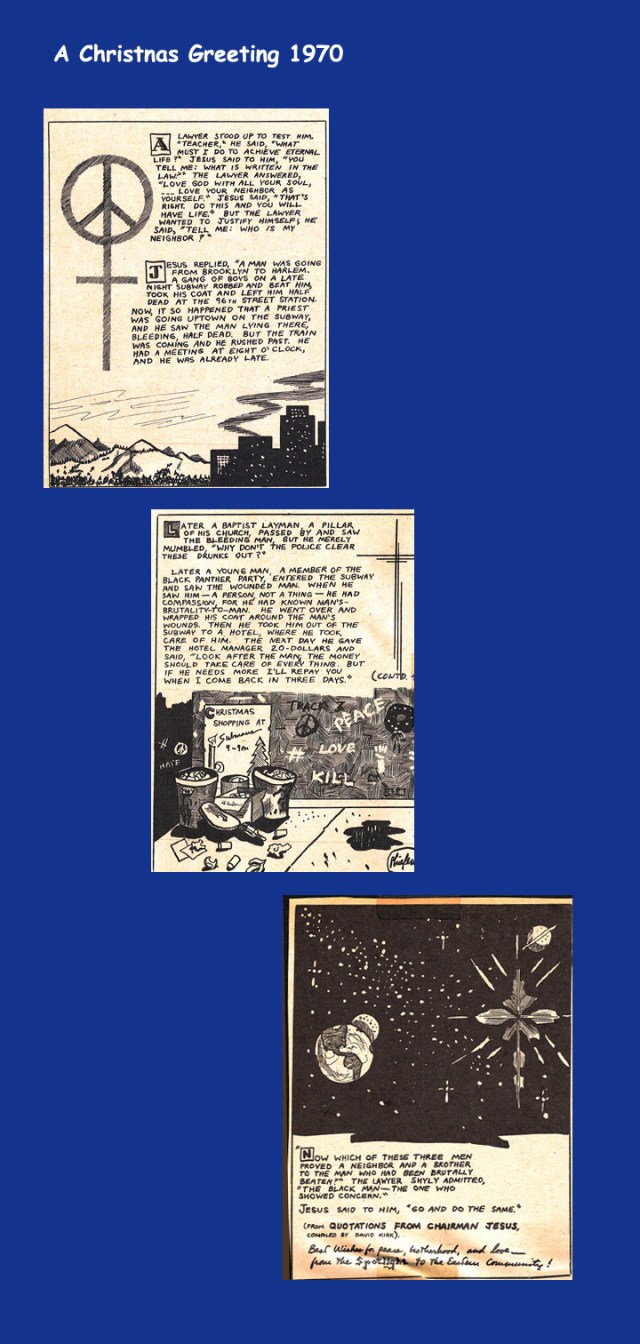
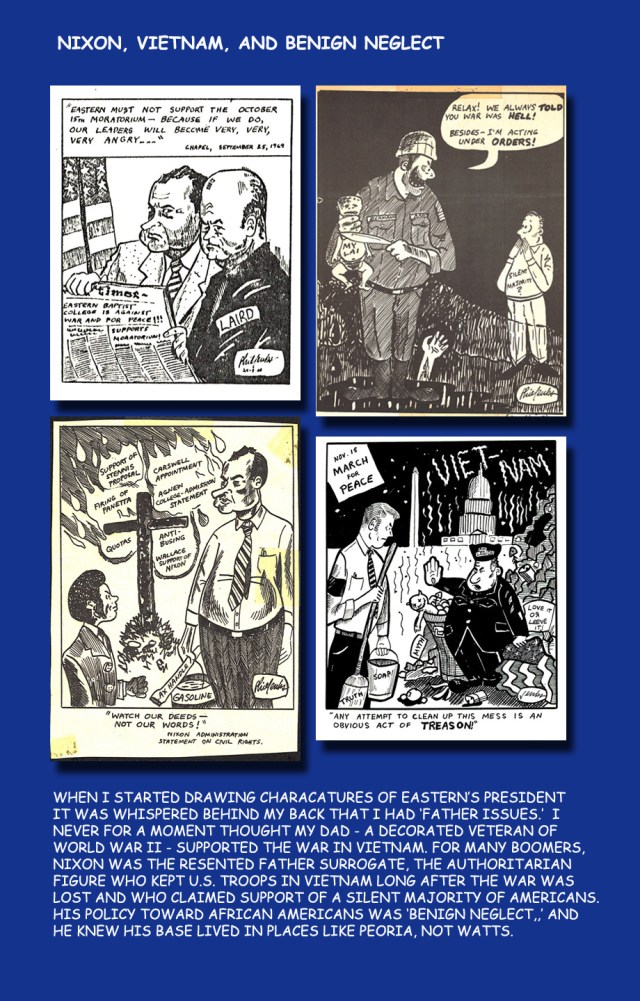
After a year to get adjusted to the academic routine, I joined with other anti-war vets in my class and began submitting articles and cartoons to The Spotlight, the college newspaper.

NIXON

Actually, my first cartoons for the student newspaper were anything but hostile.

WRYNOTANGRY

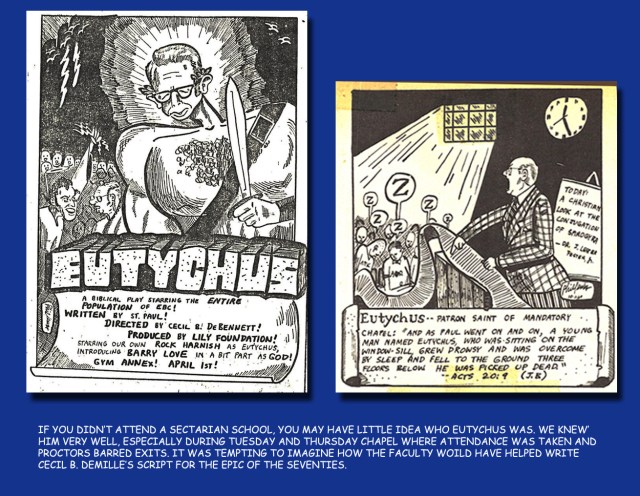
And there was certainly enough on a Christian college campus to distract and amuse. Certainly a sense of humor was useful in dealing with the restrictions of a conservative, moralistic culture, including twice-weekly mandatory chapel.

EUTYCHUSDUO

Posted in Uncategorized | Leave a comment

The Lutheran Peacemaker

SaintFrederickNoldedofPhiladelphia

July 4, 2018 – Independence Day need not be devoted entirely to martial marches and soldierly invocations. Even our founding parents envisioned it as a day that should be celebrated in peace.

In 1971, as an ex-GI engaged in the anti-Vietnam War movement, I was invited to address a 4th of July picnic gathering of Mennonites. “We celebrate peaceful resistance to war,” explained my friend John L. Ruth, a Mennonite historian and professor of English literature at Eastern Baptist College. As I recall, I addressed the large crowd hoarsely without a microphone and told of many returning veterans who opposed the War in Vietnam as a moral travesty and were raising their voices in the cause of peace.

I was a Baptist back then and I remember lamenting the fact that the number of Baptist pacifists could be counted on the fingers of one hand, including Walter Rauschenbusch, Edwin Dahlberg, and Martin Luther King, Jr. It appeared to me that peacemakers in other mainline denominations were virtually absent.

But I was wrong. One peace activist who rose above us all was Otto Frederick Nolde, a Lutheran academician, whose influence on international diplomacy was incalculable in the post-World War II world.

Otto Frederick Nolde died June 17, 1972, just as my career in ecumenism was beginning at the American Baptist offices in Valley Forge, Pa. I realized quickly that he was a towering figure not only in Philadelphia church circles but across the globe.

A Philadelphia Lutheran, Fred Nolde was a leader in the vanguard of human rights activists who sought to build pillars of justice amid the ashes of World War II. Nolde and other activists, including future Secretary of State John Foster Dulles, a Presbyterian lay leader, helped form “The Six Pillars of Peace” to prevent future wars. Among their proposals – incredibly – was a universal monetary system and currency for all nations, open borders through which all persons could freely pass, and automatic citizenship for immigrants and refugees wherever they decided to settle.

Needless to say, these idealistic and thoroughly Christian proposals were never accepted. But Dulles – who is remembered for his “brinksmanship diplomacy” that seemed to bring the U.S. close to war with the Soviet Union – spoke highly of Nolde’s contributions. According to The New York Times, Dulles wrote that Nolde was “outstanding” among the consultants, his suggestions “always sound” and many of them “bore important practical results.”

Nolde’s influence on the post-World War II world was significant. He was the author of the religious freedom section of the United Nation’s Universal Declaration on Human Rights and contributed to the human rights language in the United Nations charter.

KN-C20169Nolde was the World Council of Churches’ first director of the Commission of the Churches on International Affairs (CCIA), where he became known as an “ecumenical diplomat.” He knew and influenced post-war secretaries of state, not only his friend John Foster Dulles but his successors. There is a picture of World Council of Churches leaders from the U.S. meeting with President John F. Kennedy in the White House in 1962. Nolde, typically, is shown turning away from the President to engage in an apparently intense conversation with Secretary of State Dean Rusk.
The Times also reported that Nolde urged President Lyndon B. Johnson to bring the Vietnam War to a swift conclusion in 1966, recommending that the United States be prepared to leave South Vietnam if asked to do so by a government “as freely elected as conditions in South Vietnam permit.”

Otto Frederick Nolde was professor of Christian Education and Dean of the Graduate School at the Lutheran Theological Seminary in Philadelphia.

He was a major leader in urging nations to seek peace and justice. I was privileged to know his widow, Nancy, an ecumenical journalist, when I was a communicator for American Baptists, and I sensed the deep respect of colleagues for her advocacy of Fred’s legacy of peace.

I wish I had known Fred Nolde. He lived his life as a powerful witness for peace and I wish his name was better known within the current generation of persons of faith.

But his message still resonates mightily for all who listen. And if Lutherans were wont to honor their saints with icons and feast days, I would nominate Otto Frederick Nolde for recognition of the sainthood he has clearly attained.

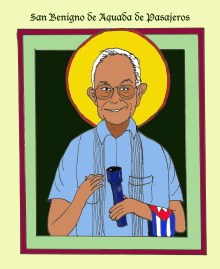
sanbenignoA note about the Saint Fredrerick icon. Lutherans do not honor their leaders as saints with icons and feast days, but of course many Christian (and non-christian) activists are unmistakably saintly. Brother Robert Lentz has created icons of hundreds of notable leaders including Dorothy Day, Martin Luther King Jr., César Chávez, and Harvey Milk. Although I am not an artist as skilled as Brother Robert, I was inspired by his reminder that saints walk among us every day. I started drawing some saints particularly close to me – including my sainted father-in-law, San Benigno – as a project in a Lutheran Diakonia class. Once the class was over, I realized there are many more among us who deserve a loving recognition from all of us, and I’ve kept drawing.

Posted in Uncategorized | Tagged , , , | 2 Comments

Shining Light on Luther by Standing in his shadow

Melanchton

June 25, 2018, Feast Day of Philip Melanchthon, 1497-1560

Martin Luther’s friend and supporter, Melanchthon honed and refined Lutheranism as we know it today.

With Luther he joined in the denunciation of indulgences, excessive saint worship, the sacrament of penance, and the notion that Jesus is physically present in the bread and wine of communion. His Augsburg Confession is widely regarded as the most significant document of the Reformation.

Had he persuaded Lutherans to think more highly of the veneration of saints, he might be known today as Saint Philip of Augsburg.

Had he been less devoted to preserving Luther’s memory, we might have actually have heard of him.

Posted in Uncategorized | Leave a comment

John and John

saintjohncropped

I knew I understood Blackie Ryan, a fictional priest who appears in 17 novels by Father Andrew Greeley, because he esteemed three great Johns in his youth: John Unitas, John Kennedy, and John XXIII.

I was never much into Unitas, quarterback for the Baltimore Colts, both because I never followed football and because Syracuse alum Jim Brown was the gridiron hero in my family.

But I revered President Kennedy and Pope John. Blackie Ryan – had he been a real boy – would have been a year older than I, and we both struggled through adolescence at a time of Cold War terrors and church upheavals. These two Johns towered over both events and were heroes to millions of Baby Boomers.

I grew up Protestant in a tiny Central New York community so I had little understanding of the New Frontier oligarchy or the Vatican’s archaic governance. Popes were far removed from my experience until about 1957 when my father and a neighbor took four of us boys from the neighborhood to New York to see a Yankees game. We peeked inside St. Patrick’s Cathedral and saw a life-sized wax figure of Pope Pius XII encased in a glass box. It was a macabre sight. He looked – well, waxen, and cadaverous, like an immobilized vampire. I did not regard his figure as something religious people would venerate. He gave me the creeps.

Pius died in October 1958 when I was 12. His passing stirred little interest within our confederated Protestant church but it launched the first papal transition of the television age. The election of Angelo Roncalli as Pope John XXIII was well covered and to my youthful eyes he looked more far more appealing than his predecessor. In contrast to Pius, who looked like a disapproving embalming teacher, John was a round, smiling grandfather type. At 76 he was not expected to last long and was widely touted as a transitional pope.

Of course John famously overturned that expectation in 1962 by calling the historic Second Vatican Council to reform the church. He also extended the church’s reach to all people when he declared, “We were all made in God’s image, and thus, we are all Godly alike.”

It would be years before I understood what Vatican II was all about but John from the beginning of his reign fascinated me. In art class one year I attempted to draw an India ink portrait of the pope. I used a LIFE magazine photograph as a model and I remember struggling to get his nose right. “Nobody has a nose that big,” I thought. A half century later, when Martha and I took two of our daughters on a Roman holiday, we viewed the perfectly preserved remains of John XXIII in St. Peter’s Basilica. His nose was indeed that big. The India ink drawing is one of the few artifacts of my youth that survives. The look of concentration I drew on his face led some of my high school classmates to wonder if I captured him in his morning ablutions. They immediately dubbed it, “John on the John.”

johnandjohn

President Kennedy, the other John of my youth, never met Pope John. Perhaps their closest connection was during the Cuban Missile Crisis of October 1962, eight months before the Pope died. As the world teetered on the edge of nuclear winter, John offered to mediate between Kennedy and Soviet Premier Nikita Khrushchev. Both leaders praised the Pope for his commitment to peace, but neither heard his urgent prayer on Vatican radio: “May they hear the anguished cry which rises to heaven from every corner of the earth, from innocent children to old men, from persons and communities: peace, peace!”

The resolution of the missile crisis has been attributed to Kennedy and Khrushchev, who each backed away from hardened positions that could have led to nuclear war. At the time I remember a condescending comment from a journalist who referred to “Pope John, who thought he played a role in making peace.”

Thought he played?

Fifty-six years after the world stepped back from the abyss, it seems clearer to me that it might not have happened without divine intervention. I have no doubt that Pope John XXIII played a pivotal role in making the peace. And he will always remain, for me, one of the two big Johns of my life.

Posted in Uncategorized | 2 Comments