Here’s hoping the excellent biopic “Harriet” will focus more attention on what can reasonably be regarded as a racist decision.


Here’s hoping the excellent biopic “Harriet” will focus more attention on what can reasonably be regarded as a racist decision.
November 11, 2019 – Looking back on my Air Force years this Veteran’s Day (1964-1968), I don’t detect a whole lot of sacrificial heroism. When I wear my Veteran hat in town, people – usually fellow Boomers – reach for my hand and say, “Thank you for your service.” I thank them politely, but I know what I should say is, “I drew cartoons and I typed.”
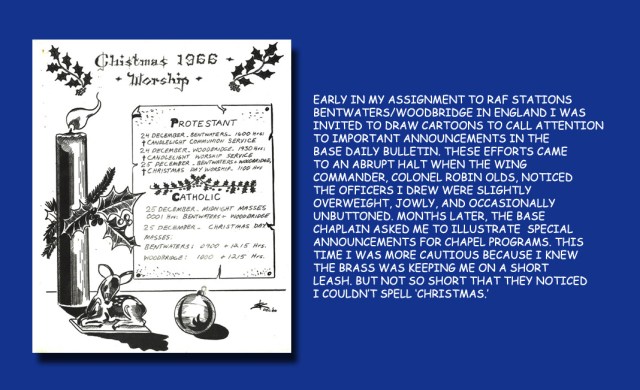
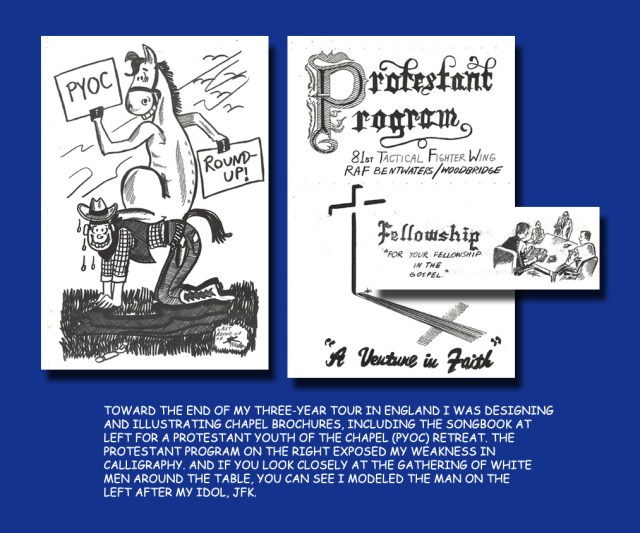
When I was reassigned to McConnell Air Force Base in February 1968, cartooning became a major part of my military portfolio. Chaplain Clay Rohrer, the senior chaplain, and Chaplain Allen Kolmer, allowed me a free range.
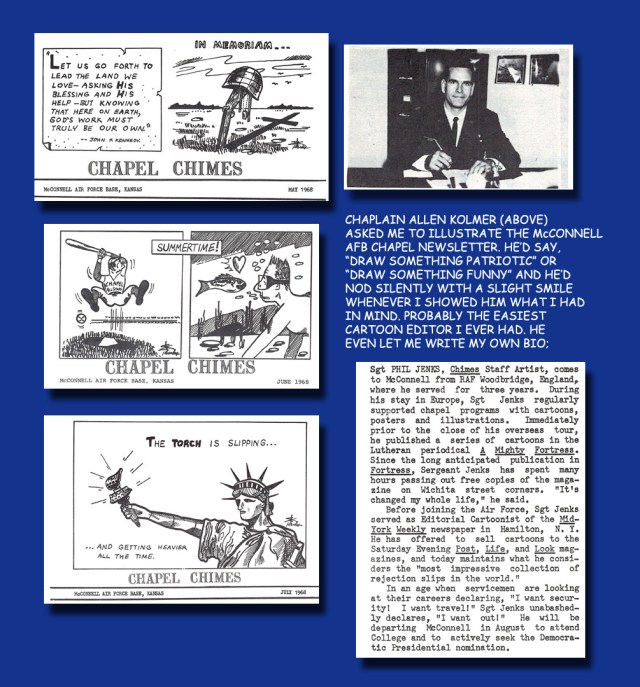
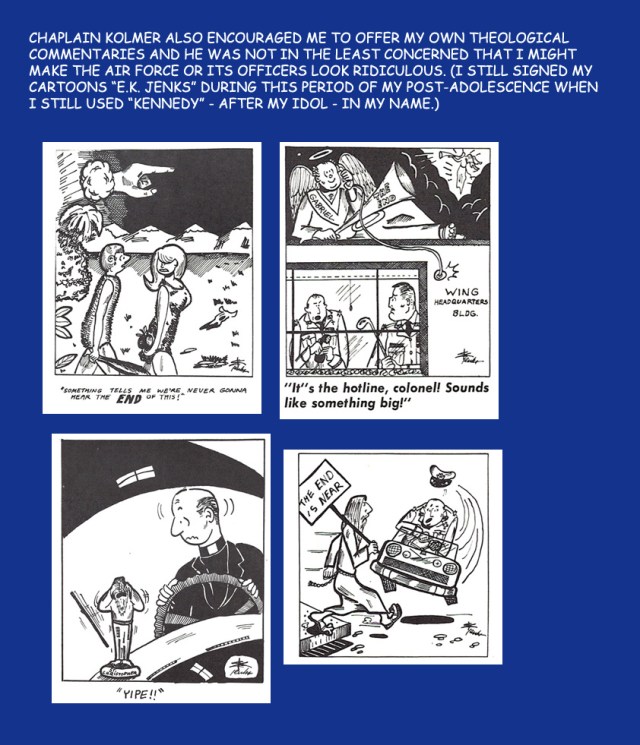
Naturally, my Air Force years included a standard amount of marching, KP, guard duty, and latrine queening. So it was for millions of us who served in Air Force blue.
But the next time one of my grandchildren asks me what I did in the Air Force, I’ll keep my answer simple.
I drew cartoons and I typed.
 Veteran’s Day 2019. – I joined the U.S. Air Force 55 years ago last September. My experience was shared by millions of women and men who joined the Aerospace Team since it was founded in 1948. I salute them all.
My memories are not unique. On September 10, 1964, nine of us adolescents were sworn in at an induction center in Syracuse, N.Y. It was a hot day in Central New York and I remember the soothing hum of the air conditioning as we raised our right hands. We were so overcome by the weight of the occasion that it was hard not to snicker.
I do solemnly swear that I will support and defend the Constitution of the United States against all enemies, foreign and domestic; that I will bear true faith and allegiance to the same, and that I will obey the orders of the President of the United States and the orders of officers appointed over me, according to regulations and the Uniform Code of Military Justice. So help me God.
I wondered who domestic enemies were and what I was supposed to do about them, but as I lowered my hand I felt a huge weight of responsibility on my shoulders. I was no longer just a recent high school graduate; I was now in the United States Air Force. My carefree summer had come to an end.
The recruiting sergeant handed us mimeographed orders. I noticed my name was misspelled: two l’s in Philip. Still feeling the new burden of responsibility, I figured there was no sense arguing minor details with the Air Force. I kept the redundant l all four years. (Later I confused the orderly room by arbitrarily adding “Kennedy” to my name in honor of my idol, the late president, so my name began appearing in orders as Phillip E.K. Jenks. I dropped the K in college, but in the current clownish political climate, I’m considering adding it again.)
“There’s a bus outside waiting to take you to the Hancock Field for the flight to San Antonio,” the recruiter said. “I’m going to give you your first order: look at your serial number and memorize it by the time you get to Lackland.” Immediately the nine of us stared at our orders and began reciting the numerals silently.
The aircraft from Syracuse to San Antonio, Tex., was a sleek jet tossed around by heavy turbulence as it skirted the fringes of a southern hurricane. I had never flown before so I assumed the severe bumps were normal. An attractive young flight attendant was thrown off her feet and fell into the uncomplaining lap of one of my fellow recruits, her shapely legs kicking in the air. The recruit tried to help her up, but she scowled and jabbed her elbow into his ribs.
It had been a humid pre-Autumn day when we left New York, but the steamy humidity of San Antonio was suffocating. We arrived in darkness at 0430 and were quickly collected by a civilian bus driver to be transported to the training center. Several of the recruits, oozing white New York entitlement, ordered the Latino driver to move his ass so we could get to the base and go to bed. The driver smiled and said, “When we get there, you will wish you were back here.”
The sun was rising as we filed sleepily off the bus and were met by training instructors Tech Sergeant Saxon and Airman First Class Ellefson. Several more young recruits who had just arrived from Chicago gathered with us. If we had any expectation of getting sleep that day, it vanished when the two TI’s – training instructors – roughly grabbed us by the arms and forced us into marching formation.
The TI’s began berating us loudly, using obscenities that were unfamiliar to most of us. We weren’t used to this kind of verbal abuse, but the stream of sexual and excretory invective, uttered in crude iambic meter, seemed almost poetic. In a comparatively gentle gibe, Ellefson shouted into the face of a large, lumbering recruit, “Jesus, you walk like a girl.”
For some reason the boy, who had been a running back in local high school, thought he was expected to challenge the sergeant.
“I don’t care for your attitude,” the boy said with a look that must have been intimidating on the line of scrimmage.
“What?” Ellefson said.
The boy didn’t get a chance to repeat his challenge.
“Sarge,” Ellefson screamed to his colleague. “We gotta wise ass here!”
Sergeant Saxon, a muscular man with a flattop haircut and barrel chest, stepped over and quietly pulled the boy out of line. He escorted him several feet away. I couldn’t hear what the sergeant was saying but he seemed to be quietly menacing the boy, questioning his manhood and emphasizing each threat with a poke in the chest. Whatever the sergeant said. it was effective. The boy returned to the line in a more docile mood.
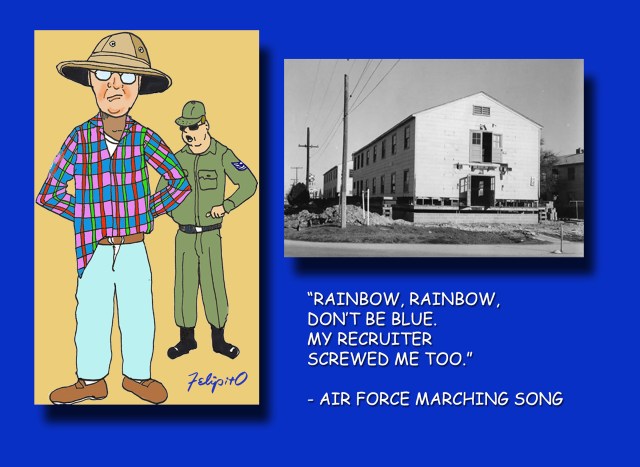
Somehow the two sergeants managed to get us into a formation suitable for marching. Nearby, training flights marched past us on the way to morning mess. They had had been on base long enough to be outfitted with green fatigue uniforms, which made them vastly superior to us. In our civilian clothes, we felt like teenagers playing war, which wasn’t far from the truth. Military discipline forbade the senior uniformed troops from laughing at us, but their drill sergeant led them in a taunting marching song,
“Rainbow, Rainbow, Don’t Be Blue, My Recruiter Screwed Me, too!”
The song derided us for our multi-colored mufti. We would wear the clothes we arrived in for the next several days until the sergeants arranged for us to receive our uniforms. The only concession to uniformity was a large pith helmet that was designed to protect us from the searing Texas sun. The helmets wobbled on our heads as we marched clumsily to a GI barbershop where our civilian locks would be buzzed away. In 1964, none of the young men had long locks so the sheering was not an Elvis moment,
My memory is hazy, but I think we spent most of our first day at Lackland Air Force Base learning rudimentary marching skills. Boys who had been in high school marching bands had a distinct advantage over the rest of us.
Late that night when we finally got to the barracks – a World War II vintage building– I was so sleep-deprived I was hallucinating. Earlier I had sighted a recruit with a vivid port wine stain on his face and I wondered for days if I had dreamed it.
It was hot in the barracks, but we were ordered to hang our clothes on hangers and slide beneath the heavy wool GI blanket on the bed. Despite the heat, most of us fell asleep immediately.
At 0500, Airman Ellefson walked between the rows of bunks.
“You people get up and make yours beds.”
Several recruits slid out of bed and began to head for the latrine, but Ellefson blocked their way.
“I said make your fucking beds,” he said. “I know the first thing the human body has to do when you get up is take a piss. But now the first thing you do is make your bed.”
Compared to the initial shock of arriving on base, the rest of Basic Training was easy. We marched in the Texas heat, ran around a quarter-mile track in heavy brogans, polished our low-quarter shoes, ran the obstacle course, learned to salute, sat many hours in air conditioned class rooms learning military customs, and generally learned how to absorb illogical orders and homophobic taunts from the sergeants. Most of us got through it.
Our open bay barracks had rows of GI bunk beds lined up in precisely measured formation. The beds were covered with olive green GI blankets pulled tightly into hospital corners. The blankets were hardly necessary in the stifling summer heat of San Antonio, but, as I said, we were required to sleep beneath them anyway.
Most of our earthly possessions were neatly organized in footlockers at the foot of the bed. By neatly, I mean in military fashion. Boxer shorts, T-shirts, and black socks were tightly rolled into rows. Shoe polishing rags were also rolled, and toiletries – safety razor, toothbrush, toothpaste, and a can of shaving cream – were fastidiously cleaned after each use. We were instructed to dismantle the shaving cream nozzle to remove excess lather so it wouldn’t dribble out.
But sometimes the cans dribbled.
Each morning the TI’s conducted a full inspection of our personal areas. The beds had to be firmly made, shoes shined, uniforms clean and hung precisely on a rack, and foot lockers immaculate.
Dressed in white baggy boxers and T-shirts, we’d stand nervously at parade rest while the TI, scowling disapprovingly, moved stiffly among the beds.
Elihu Ellefson, a tall, blond, foul-mouthed TI, opened my footlocker and peered in. It looked perfect to me.
But Ellefson reached in, rudely dislodging rows of socks and underwear, and pulled out my shaving cream can. A tiny blob of cream was attempting to escape from the spout.
“What the fuck is this?” he asked shrilly, pushing the can onto my nose.
I was silent.
Ellefson glared at me censoriously. He up-ended my footlocker and poured the contents onto the floor. Boxers unraveled among socks and rolled away. My toothbrush clattered on the linoleum, and my safety raiser made a snapping sound. Ellefson picked up the offending can and, staring at me, spewed shaving cream onto the remaining contents of my locker.
“Jenks,” he said, “The only thing I hate more than a lazy fucker is a filthy fucker.”
I was silent. After Ellefson left, I picked up my locker and its contents and went into the latrine to remove the foam and put everything back into GI order. One of other trainees followed me in to commiserate.
“Geez, too bad,” he kept saying. “What a dick.”
Of course, Ellefson was not supposed to be popular with the trainees, and most of us hated him. In 1964, he used racial and ethnic slurs freely, including the N word, and he seemed particularly punitive with Jews. I’m not sure why that was, unless he was angry with his parents for naming him Elihu.
No other GI in our training flight had his footlocker tossed. No doubt Ellefson felt the point had been made.
And, looking back, having one’s footlocker tossed is not a big deal. It probably pretty much of a universal experience for basic trainees in all branches of the service.
Even so, I’m curious about whatever happened to Ellefson. I don’t hold any grudges against him, beyond the fact that he was a racist, homophobic, anti-Semite.
But it was clearly Ellefson who made me mildly obsessive with my personal hygiene habits over five ensuing decades, a habit I may have passed along to some of my children. And I’d like to thank the son of a bitch.
I stayed in the Air Force for four years after basic training, and they were good years. With each succeeding Veteran’s Day I reflect back on basic training at Lackland Air Force Base and marvel how an event so far removed in time and space has never faded from the memories of my life.
Fifty-five years on, I no longer worry about spit-polishing my shoes. But I notice when my shaving cream leaks and I still won’t leave the house without checking to make sure my gig line is straight.
As time goes on, I hope my fly will be zipped, too.
Not enough is known about Neanderthals except we are related to them. Somewhere 40,000 years ago there was a Neanderthal nana who passed on the two to three percent Neanderthal genes you have in your genome.
Herewith is a meticulously researched and carefully drawn guide to Neanderthals, based on a single course in anthropology I took in college and on the fact that I was labeled a science major in high school (unless the Yearbook editor was messing with me).


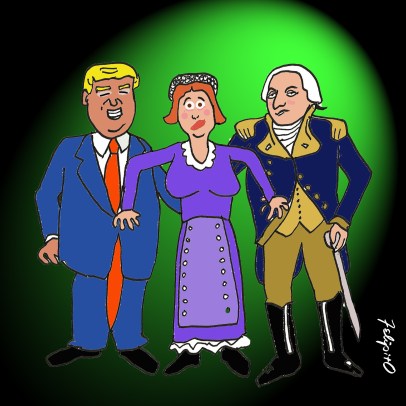 The debauchery arc of the universe is long, and it bends toward boys.
Even Jimmy Carter lusted in his heart. The only surprise is that Fox News never found out with whom.
And, look, fellas. None of us are innocent. Back in the seventies and eighties, free-wheeling jokes and sexual innuendos were rife among the guys in the American Baptist Office of Communication. We thought the women were laughing with us, but now I doubt it. Once I quoted a Benny Hill lyric to one of my female colleagues:
Oh it’s an older woman for me;
They don’t yell and they don’t tell
And they’re grateful as hell;
Yes it’s an older woman for me.
My colleague laughed. But did she? Really?
And guys are still getting away with this shit. I watched uneasily as Representative Katie Hill, a victim of revenge porn by her abusive husband, announced her resignation from Congress.
“The forces of revenge by a bitter jealous man, cyber exploitation and sexual shaming that target our gender and a large segment of society that fears and hates powerful women have combined to push a young woman out of power and say that she doesn’t belong here,” she said.
“Yet a man who brags about his sexual predation, who has had dozens of women come forward to accuse him of sexual assault, who pushes policies that are uniquely harmful to women and who has filled the courts with judges who proudly rule to deprive women of the most fundamental right to control their own bodies, sits in the highest office in the land.”
Fittingly, her last vote on the floor of the house was to endorse the Trump impeachment inquiry.
Wicked temptation is particularly rife in adolescence when hormones blaze like bonfires and fantasies of sex recycle every five minutes like Liberty Insurance commercials. But the embers of lust never completely cool and most of us boys learn early that it’s important to keep our carnal urges under control. My mother’s social code, imparted early to my three brothers and me, was be nice and keep your hands to yourself. As we grew older and left the confines of the United Church of Morrisville, N.Y., we wrote our own codicils to the code. I like the way New York Times columnist Charles Blow puts it: “Consenting adults should feel free to express their attractions as they please without shame or guilt. Just play safe.”
Blow wrote these words some time ago amid a deluge of news stories about men who never learned to keep their hands and penises to themselves. “This is a Man Problem,” Blow wrote, adding his own codicil: “But, there is no ‘sex’ without consent. To believe that is a twisting of terminology . . . Rape is not sex; it’s rape. Unwanted touching is not sexy; it’s assault. Sexual advances in a professional environment, particularly from a position of power, are highly inappropriate and could be illegal.”
For weeks following reports that film mogul Harvey Weinstein is an abuser and rapist, thousands of courageous women decided they have had enough. Inspired in part by the #MeToo social media movement, women no longer hesitate to confront their abuser(s) for fear of losing their jobs or not being believed.
To be sure, the movement has led men to examine their own past to count the number of times their rushing hands and roaming fingers crossed consensual lines. In an interview on NPR’s Fresh Air, comedian Patton Oswalt spoke for a lot of us guys:
I’ve had to sit down these last few weeks and I’m going through my head – and I hope every other guy is doing this, of not even, like, physical acts — but, “Was there a remark that I made? Was there a way that I put things?” You’re just constantly now thinking of that. I see a lot of people saying, “Oh what, men are now supposed to triple-, quadruple-, quintuple-think everything that they say and do?” And you go, “Well, clearly women have had to double-, triple-, quintuple- think and say everything that they do, and look at all that they can achieve and do with that load on them! Can we maybe take a little bit of the slack? Will that be OK, Mr. Alpha Male?
Brother Patton makes a good point because confession is good for the soul, not because God is unaware of our bad behavior but because it makes ourselves aware of how far we have strayed. The Psalmist explains it this way: (Psalm 119:26-29)
When I told of my ways, you answered me;
teach me your statutes.
Make me understand the way of your precepts,
and I will meditate on your wondrous works.
My soul melts away for sorrow;
strengthen me according to your word.
Put false ways far from me;
and graciously teach me your law.
Indeed many of the men accused of predatory behavior have confessed their sins and apologized to their victims.
But the nation’s president continues to dismiss his several accusers as liars. Mr. Trump blithely denies a long string of abuse accusations by different women and so far the issue of his moral turpitude has not dismayed his small but loyal Republican base. Mr. Trump’s confidence in his small but potent base led him in 2017 to support Alabama Judge Roy Moore, an accused serial pedophile, for the U.S. Senate. When supporters of Trump and Moore were asked why they continue to support the two accused sexual malefactors, the common reply is, “What about Bill Clinton?” President Clinton, who has confessed and begged forgiveness for his sins, was impeached for lying under oath but not removed from office.
Most logicians will dismiss as nonsense the idea that it’s okay for Trump to be a sexual predator because Clinton was one, too.
But perhaps it’s understandable that Trump supporters in the deploratude think like that because the history of presidential sexual misconduct goes way back.
According to historian James Thomas Flexner, it began with the youthful flings of our first president.
“Although (George Washington) drank and gambled and (we gather) wenched as did his officers, he was known as a stern disciplinarian in military matters,” Flexner wrote in 1965 in the first of his six volume biography.
The use of “wenched” as an intransitive verb is an effort to shift the onus from the great wencher to the irrelevant woman with whom he went wenching.
If we accept the second dictionary definition of “wench” as “prostitute,” it’s a case of boys being boys.
If, however, we accept the dictionary’s first definition of “wench” as “servant girl,” to use her as a means of wenching sounds more like boys raping.
No one knows whether young George’s women were willing partners, but it doesn’t really matter. Even as a young officer, he was a white aristocrat who probably considered farm and pub girls as his inferiors. He knew he had power over them whether they liked it or not.
George Washington, as Flexner points out, created many precedents as the nation’s first president. Some of those precedents paved the way for powerful men to seek sex from powerless women anytime they got an itch. Jefferson impregnated at least one of his slave women. Cleveland conceived a child out of wedlock. Harding explored hidden spaces in the White House to have sex with a young woman. FDR and Ike were unfaithful to their wives and LBJ had several mistresses. John Kennedy’s sexual appetite was dizzying; he once told British Prime Minister Harold McMillan that if he didn’t have a different woman every three days he got terrible head aches.
Because bedrooms of yore were private places, we will never really know how many other presidents took advantage of powerless women. No doubt most of the men who occupied the White House were upright men who were faithful to their wives and treated women with respect. I’m going to go out on a limb here, but I think that list includes Jimmy Carter, George W. Bush, and Barack Obama.
But the aggressive disrespect Mr. Trump has shown for women is migraine inducing. Clearly he is not going to sit down and reassess his life and the harm he has done to his fellow human beings, as Patton Oswalt urges all us guys to do.
That’s too bad. Because as thousands of women are letting it be known that they will no longer tolerate crude and abusive behavior by men, we could use a little male moral leadership to speak on behalf of us guys: sisters, you are right, and we have been deplorable. We vow hereinafter to show you the respect you deserve.
But Mr. Trump, now ferociously tweeting falsehoods to curtail his own impeachment investigation, punctiliously denies his well-documented sexual misconduct. And there are no signs that his obtuse base cares about it.
But history has a long memory. And there is little he can say to erase the words that will be carved in granite on the walls of his presidential library:
“Grab ‘em by the pussy. You can do anything.”
 [Revised and Reposted from January 2017.]
I was a very young and very low-ranking airman when I first arrived at RAF Bentwaters/Woodbridge in Suffolk, England, in January 1965. I couldn’t help but think of John S.D. Eisenhower’s arrival in Europe in 1945 after he graduated from West Point. Meeting with his father, the Supreme Allied Commander, John asked, “If we meet an officer senior to me but junior to you, who should salute first?” Ike replied, “Everyone in this theater is senior to you and junior to me.”
The convenient thing about the Air Force was that you always knew who was more senior than you: their status was clearly marked on the shoulders or sleeves of the uniforms. One thing was clear to me: Everyone was far superior to me in rank.
And there were giants on base who didn’t need the eagles on their shoulders to look important.
The wing commander was Colonel (later Brigadier General) Robin Olds, West Point football lineman of the year in 1942, a fighter ace in World War II, and future Vietnam War hero. By the time he commanded the 81st Tactical Fighter Wing in England from 1963 to 1965, Olds was a mythic figure.
And so was his spouse, Hollywood doyenne Ella Raines, a cinema star of the forties and fifties. I had not heard of Raines in 1965, though my mother assured me the Lady was famous. Ella Raines was 45 and no ingénue when I met her. She was three years older than my mother.
Raines’ residual Hollywood influence was such that Jimmy Stewart, a reserve Air Force brigadier general, frequently donned his blues to visit Bentwaters. Stewart, who was also clear about his exalted place at the banquet table, schmoozed with Robin and Ella and other brass at the officers club while we GIs were assigned to clean-up details around the base.
Looking back, I realize Ella Raines was bored by life in bucolic Suffolk. There was no First Lady role required of the wing commander’s spouse but she found ways to keep busy. On occasion she would visit the airmen’s mess hall, an oversized Quonset Hut, and appear to check the quality of the food and the morale of the troops. The mess hall was the lowest place at the Air Force banquet so it could be stipulated that the quality of the food was not great. And the GI’s who didn’t eat and run were on KP for the day, so their morale was not great.
I was on KP one day when the Lady walked in on one of her peculiar inspection tours. I had just finished scrubbing a score of pots and pans larger than me and was standing beside a rack of bananas to catch my breath. Raines was immaculately coifed and dressed and (as I think back on it) quite beautiful. I was dressed in a wet, baggy, garbage-stained fatigue uniform, and I smelled of adolescent sweat.
The Lady caught my eye and smiled. “Where are you from?”
I cleared my throat and muttered a half-truth. She would not have heard of Morrisville. “New York,” I said.
She nodded thoughtfully and pulled a banana from the bunch. She peeled it and tested it aggressively with her tongue.
“Are these bananas fresh?”
I might have explained that we KP’s weren’t allowed to eat the bananas, and that she must have a better idea than I because she was pushing one into her mouth. But I just nodded.
She massaged the banana with her tongue and smiled. “Well,” she said (disengenuously, I realized years later), “I shall think of you the next time I’m on Broadway.”
I nodded again, and watched the Lady saunter out of the hall. I wrote to my mother to give her a highly embellished account of the incident. Later Mom told her bridge club, “Well, Phil knows Ella Raines.”
Today what this dim memory invokes for me more than anything else is the realization that there are high places and low places at the banquet table of life, and it can be awkward to find yourself in the wrong place.
I had one other Air Force encounter involving Colonel Olds that confirms this even more clearly.
I was a chaplain’s assistant, an enlisted position akin to being the chaplain’s valet.
Chaplain Joseph McCausland was a Catholic priest from Cleveland. Father Mac was tall and slightly bent-over, with prematurely white hair. I remember him sitting at his desk squinting through the smoke of a Camel cigarette while he used his elegant fountain pen to add items to his growing to-do list. One to-do item he never did in the two-and-a-half years I knew him was, “Get your shots.”
Father Mac had two hobbies: shortwave radio, which he used to keep in touch with friends all over the world; and flying.
He was an amateur pilot of small, propeller driven airplanes. That must have taken guts and, perhaps, a fair amount of humility when you consider that most of the men who sat at the bar with him in the officer’s club were jet jockeys. On occasion, one of the fighter pilots would invite Father Mac to come along on a stomach-wrenching F-101 sortie to the Isle of Man, and the priest would glow happily for days. But on most afternoons, when he wasn’t counseling Catholic families or hearing confessions, Father Mac would jump into his Piper club and climb into the breezy skies of East Anglia. He always flew alone. None of us dared go with him.
One particularly windy afternoon, Father Mac brought the Piper club in too low and too fast and, amid a shower of metallic sparks, tipped the aircraft up on its nose. He was unhurt but when he rolled out of the plane to inspect the damage, he could see the prop was mangled and the nose was shattered.
Colonel Olds happened to be driving his staff car on the flight line that day and he rushed over to the accident sight to make sure Father Mac was okay. The chaplain shook his head in embarrassment. “I’m fine,” he said. “Misjudged the wind sheer.”
Colonel Olds called out to one of the airmen who had also rushed to the scene. “Quick,” he said. “Get a picture of the fuselage. In case we need it for insurance purposes.”
I don’t know what kind of insurance covers Air Force accidents, but the picture was snapped.
That night, a poster-sized blow-up of the picture was delivered to my barracks. There in crisp black-and-white was the small plane balanced on its nose amid pieces of broken propeller, its tail pointed ignominiously at the sky.
Accompanying the picture was a note from the Colonel: “Jenks, do some calligraphy for me. Some kind of Old English script. Ta, R.O.” The Colonel wrote out in block capital letters the message he wanted imprinted on the picture.
I had drawn cartoons for chapel and base publications, and Colonel Olds must have concluded – erroneously – that I was some kind of artist. I was not, and I was certainly no calligrapher. But orders are orders, and I stayed up most of the night, painstakingly inking letters onto the photograph.
The next morning the Colonel’s driver pulled up in front of the barracks to retrieve the picture.
“What’s this about?” I asked.
“The old man wants it for Officer’s Call,” the driver said. He grabbed the picture and sped away.
Later that day, senior Chaplain John Donnelly returned from Officer’s call with the story.
After the Colonel called the meeting to order, he asked Chaplain McCausland to come forward. Warily, Father Mac stood beside the Colonel.
“Father,” Colonel Olds began sternly. Then he flashed a smile, and said, “Actually, he’s not my father.”
The officers roared in laughter (as they do when Colonels tell jokes). “I guess I can get away with that because I’m Episcopalian,” Olds said.
Then Olds took the photograph, freshly framed, and put it on the podium. The officers stared at the vivid picture of the mangled plane and tried to read the laboriously inscribed Latin message:
“Qui se exaltat, humiliabitur.”
Father Mac turned red and smiled through his teeth.
“I wanted you to have this, Father,” Olds said.
Turning to the officers in the room, he added, “Actually, he’s not my father.” The officers roared with laughter, and Olds said, “I guess I can get away with that because I’m Episcopalian.”
He continued to address the officers. “If you don’t know your Latin as well as Father,” Olds said into the microphone, “the inscription means, ‘he who exalts himself will be humbled.’” The officers in the room, mostly experienced fighter pilots, laughed again. Then they stood and applauded. (The phrase is from Matthew 23:12.)
“I don’t think they were laughing at Joe,” Chaplain Donnelly said. “All these pilots, from Olds on down, knew it could happen to them, too. It was the Colonel’s way of reminding all of us: don’t get cocky.”
There are many lessons in life that I’ve learned through age and harsh experience. Now that I’m in my 70th year, I confess most of these lessons are the result of miscalculations and misjudgments, including the always hazardous assumptions that I knew more than others or was better than others.
But when I was 18 on an Air Force base inhabited by giants, I was certainly not prone to making those kinds of assumptions. Colonel Olds’ message to Father Mac contains words of wisdom that are not always easy to follow – and as those who knew him will remember, the old man was not always able to refrain from cockiness himself.
But the wisdom of the words endures: those who exalt themselves will be humbled.

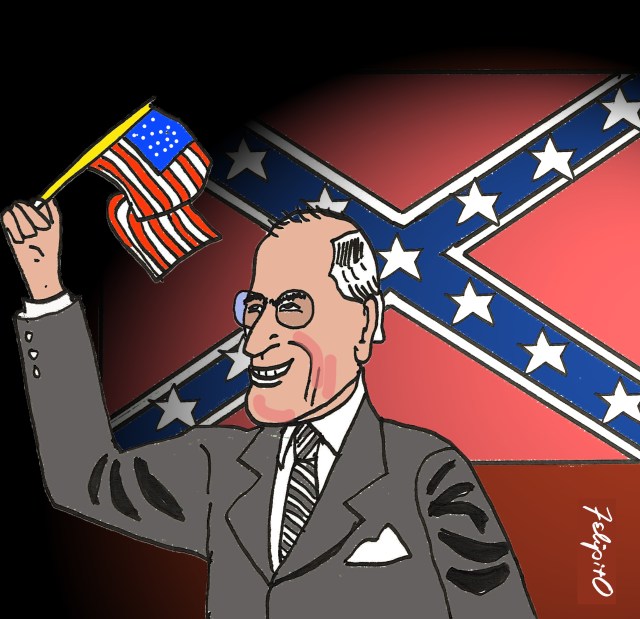 In 2015 some Princeton University students uncovered one of the worst kept secrets in American history: Woodrow Wilson, the 28th president of the United States, was a racist.
If these students had grown up reading Howard Zinn or Richard Shenkman, this wouldn’t have been a surprise. Unlike the historians who wrote our high school text books, these guys tried to tell the truth about U.S. history. The truth – and we didn’t read it in the thick history texts collecting dust in our school desks – included the genocide of native Americans, the horrors of slavery, the bloody imperialism of American expansion, the peccadillos of pious politicians, or the sexual predation of our greatest presidents.
No wonder history is so boring in the 11th grade.
One of my last interviews as a reporter for the Pottstown, Pa., Mercury, was with James W. Loewen, author of Lies My Teacher Taught Me, Everything Your American History Textbook Got Wrong.
On the phone, Loewen came across as a passionate man who never made his peace with the texts that lied to him, especially about some of our most beloved icons.
He was particularly incensed about the mistreatment of Helen Keller, known to most of us baby boomers as the woman who overcame blindness and deafness as dramatized in The Miracle Worker, and who was featured in My Weekly Reader as she stroked President Eisenhower’s beaming face.
But what the history books left out was the fact that Keller was a far-left radical who campaigned for socialist candidates for U.S. president and openly supported the Soviet Union.
Loewen was also displeased about the incomplete depiction of President Wilson, described in most texts as a progressive leader whose vision of the League of Nations was squashed by short-sighted isolationists.
But, Loewen pointed out, Wilson, whose youth was spent in Confederate Virginia, was also a white supremacist. He told “darky” stories in cabinet meetings and ordered the segregation of government offices. The proper Presbyterian president also denigrated any American who was not of white Northern European heritage.
In addition, Wilson – who posed as a man of peace – was chronic interventionist in foreign countries. Loewen wrote:
Under Wilson, the United States intervened in Latin America more often than at any other time in our history … In 1917 Woodrow Wilson … started sending secret monetary aid to the ‘White’ side of the Russian civil war … This aggression fueled the suspicions that motivated the Soviets during the Cold War …Wilson’s interventions in Cuba, the Dominican Republic, Haiti, and Nicaragua set the stage for the dictators Batista, Trujillo, the Duvaliers, and the Somozas.
John Milton Cooper Jr, writing in the Princeton Alumni News in 2o15, offered an assessment of Wilson’s attitudes toward race.
Soon after he got to Washington, (Wilson) allowed members of his cabinet to mount efforts to segregate facilities in their departments and he condoned reductions in the categories of federal jobs open to African Americans. Protests by the newly formed National Association for the Advancement of Colored People (NAACP) brought a halt to formal segregation in the federal workplace, although it informally prevailed in practice. The employment reductions continued unabated, and the return of the Republicans to power in the 1920s did not reverse this trend. Most famously, Wilson permitted D.W. Griffith’s cinematically brilliant but scurrilously racist film The Birth of a Nation to be screened at the White House.
But Cooper also noted that “The correct way to assess Wilson’s racial attitudes is as a fairly typical white Northerner of his time. This means that he shared their near blindness toward racial injustice and impatience with efforts to arouse concern about what was happening along the color line. Such attitudes epitomized the views of the vast majority of whites outside the former Confederate and Border States.”
It’s no wonder that the Black Justice League called upon Princeton, where Wilson was also president, to remove his name from buildings and institutions where he has been honored. However, given what has always been known about Wilson, the move seems belated.
And, given the truths Zinn, Shenkman, and Loewen have been eager to uncover, one must wonder how many other great figures are undeserving of the laurels we have bestowed on them.
Beginning with George Washington, a slave owner who was conflicted about the efficacy of the peculiar institution, especially after he calculated that the overhead costs of maintaining a slave population often cancelled out the benefits of free labor.
In his Pulitzer Prize winning biography, Washington: A Life, Gene Chernow reminds us of some disturbing facts about the Father of Our Country that were never highlighted in high school texts. As a general and later as president, Washington was attended by a large retinue of slaves dressed in uniforms bearing his family crest. When the U.S. capital was temporarily lodged in Philadelphia, President Washington brought a large number of his slaves along to run his household. He circumvented a Pennsylvania law that automatically freed slaves who resided in the commonwealth for more than six months by returning them temporarily to Mount Vernon every five months.
Washington freed all his slaves in his will (effective upon the death of his wife Martha, which surrounded her with people who looked forward to her passing). And few historians believe Washington’s enormous contributions to U.S. history should be lost in the reality that he was a slave-owning Southern aristocrat who acted like one.
There are other great figures of U.S. history who don’t deserve all the nice things high school texts say about them. President Jefferson had a slave mistress who carried several of his children. President Jackson’s relocation of Native American communities was genocidal and brutal. Even the Great Emancipator, President Lincoln, did not believe African Americans were his biological or intellectual equal.
And in a seemier side of history, which may or may not call into question their political performance, Presidents Cleveland, Harding, Franklin Roosevelt, Eisenhower, Kennedy, and Johnson were all purported to have extra marital affairs.
But given that much we think we know about American History is not true, including the assumed purity of the greats, the question remains what we should do about it.
Should we tear down their statues and name plates and cleanse their sordid memories from our public and private institutions?
Personally, I would hope not.
But I think it is time that we look more carefully at the history that has preceded us and acknowledge that it is rarely as simple and as benign as we thought it was.
I hope President Wilson’s name will not be expunged from the institutions he led. But I hope we will also be less naive about who he was, where he came from, and the human frailties that demeaned him.
And if an unreconstructed racist and vigorous imperialist was chosen as our leader for eight years, what does that say about the darkness of the times and the ignorance of those who put him in power?
Those are the questions we need to answer. And the question will never come up if we simply erase the names of the icons whose feet of clay offend us.
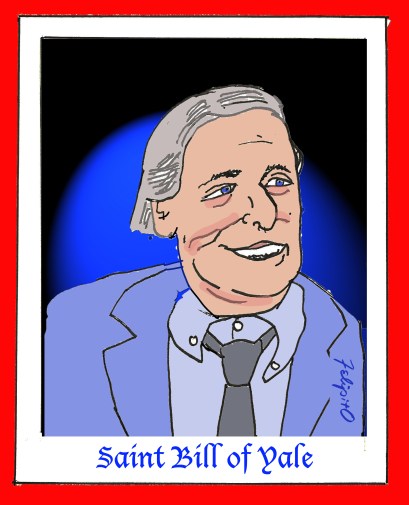 There was a time when liberals and conservatives could have conversations that were not only enlightening but also entertaining.
All that began to fade when the Newt Gingrich crafted his GOP Contract with America, which essentially declared Republicans had no further interest in bipartisan dialogue or, for that matter, in fighting fair to achieve their far-right goals.
Fair-minded conversation between liberals and conservatives was soon blocked by the formation of the TEA Party, which was described by NAACP President Julian Bond as “the Taliban wing of the Republican Party.”
And sane discourse became really quite sincerely dead with the advent of the Trump Circus. Trump, of course, is not really a conservative; he’s a self-obsessed narcissist whose views are so far right he cannot escape being compared to white supremacists and neo-Nazis. And most Republicans in Congress are so intimidated by his bullying that they swim blindly in his turbulent wake.
The only comfort I can find these days is that most of my truly conservative friends are as appalled by Trump’s blundering and amoral presence as I am.
Dear God, how I miss the days when ideological dialogue was pleasant and edifying. In particular I miss William F. Buckley, Jr., whose views were far to the right of mind but whose editorials in National Review were always worth reading. Under his editorship, the philosophical slant of the National Review was conservative, intelligent, open-minded, and frequently humorous. Back in the days when I was editor of The American Baptist magazine, I never missed an issue of the Review.
One thing I learned from Bill Buckley is that he never shied away from a challenge to his views and, apparently, that he always answered his mail. He answered his mail even in those long-gone days when letters had to be typed and envelopes stamped.
Somewhere in the American Baptist communications archives of the seventies and eighties are two letters from Buckley, one-line comments typed on plain bond paper.
The first was in response to my first boss, the Rev. Dr. Frank A. Sharp, director of American Baptist News Service, who wrote a weekly column on religion and culture for a local daily newspaper. Frank, a liberal in theology and politics, wrote to Buckley in 1974 to announce he was going to send him copies of the column. Buckley, who could easily have ignored the warning, replied, “Thank you, Doctor, but you really needn’t bother.”
In the summer of 1982 I read an editorial by Buckley that annoyed me. He opined that the nation’s seminaries were hotbeds of liberalism.
I used my own editorial to respond that Mr. Buckley – a famous Catholic – had lost sight of the fact that “the most conservative possible interpretation of the Sermon on the Mount” and other utterances of Jesus are “fundamental aspects of the faith.” I cited Jesus’ teachings about violence and hatred (Matthew 5:38-44), the nature of riches (Matthew 19:16-23), and Christian concerns for those on the fringes of society (Matthew 25:31-45) and concluded, “No Christian who seeks to conserve God’s word would dare seek to explain these teachings away, or water them down.”
I suggested somewhat condescendingly that Mr. Buckley might be excused for regarding God’s word as “too idealistic and impractical … He does, after all, live in the real world, and his philosophy for life in that reality is always wise and well stated in his (writing).”
“But he goes too far, “ I concluded, “when he insinuates that Christians who seek to live their faith in the manner Jesus commanded are ‘liberal.’ Those Christians are, in fact, the last true conservatives” those who believe Jesus’ words enough to apply them to the real world.”
With youthful chutzpah (I was in my mid-thirties in 1982), I sent Buckley a copy of my editorial, thinking I might have made some point he would consider valid.
Within days he replied, again on plain bond paper with a single typewritten sentence centered on the page. “Thank you, Mr. Jenks, it would seem the differences between us are quite comprehensive.”
Looking back, I realize what a significant response that was.
Like his response to Frank Sharp, it was polite, succinct, and showed Bill Buckley’s willingness to read any idea that crossed his desk however comprehensively different it was from his own thinking.
That kind of interaction is sorely missed today.
I hope the rational conservative spirit of a bygone era will soundly reject the Trump take-over of the GOP and restore sanity and civility to our political dialogue.
Even when our differences are quite comprehensive.
 | Frank Vee on … |
| Frank Vee on Mayflower |
| Frank Vee on All We Are Saying is |
| Frank Vee on Bulletin art for September… |
| Frank Vee on Bulletin art for September… |