Is Seeing Believing?

The Twilight Zone encounter on the Road to Emmaus is one of three appearances of the resurrected Jesus in Luke’s gospel. 

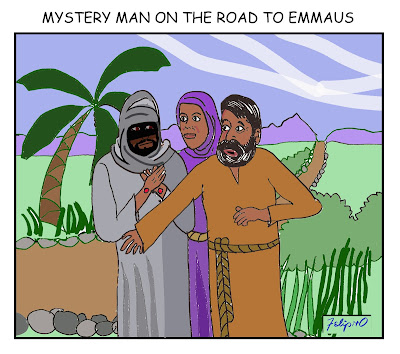
Two travelers are walking together when a mysterious stranger appears.

Only one of the walkers – Cleopas – is named. The other walker is the second mystery in the story. Some scholars think  Luke either had a lousy copy editor or that the unnamed person was a woman and, by first century standards, not worth identifying.

What we do know is that both travelers had known Jesus for years and knew what he looked like. But when a stranger approached them they had no clue who he was.

That’s understandable. For one thing, Jesus probably looked a lot better than he did the last time they saw him, when he was scourged raw, his face twisted in the agony of crucifixion. The stranger may also have been wearing a keffiyeh, the traditional Arab covering that would hide his face. Many artists and cartoonists have drawn a keffiyeh into the picture when they portray this scene on the road to Emmaus.

But I think the traumatic events of the past several days also played a role. Death is disorienting. When I was 15, my mother’s 32-year-old brother, my Uncle Maurice, died after a painful bout with cancer. At his funeral, I noticed my mother and other family members watched me intently as I approached the open casket to pay my respects. I learned later that everyone thought Uncle Maurice in the casket looked exactly like me – straight brown hair, high forehead, black horn rimmed glasses, pursed lips, a proper double chin. They thought I was going to see myself in the box and freak. But under circumstances like these, people may not see what others expect them to see. I looked at my uncle sadly and thought, “He was a good looking guy.”

We can only speculate why the two travelers – Cleopas and what’s-her-name – didn’t recognize Jesus. Not only did they not recognize him, they actually seemed to feel superior to this obtuse stranger.

“What’s up?” Jesus asked, all friendly-like, and they snap at him. “You don’t know, man? Or, as the New Revised Standard bible puts it, “Are you the only stranger in Jerusalem who does not know the things that have taken place there in these days?”

And Jesus – who could resist many temptations but not the urge to bait his friends – said, “What things?” So Cleopas and what’s-her-name immediately begin to proclaim Jesus’ resurrection, which is ironic when you think about it, because their first efforts at evangelical witness were to grab Jesus by the robe and tell him about Jesus.

At the end of the story, Luke reports that “their eyes were opened” and they recognized Jesus. As soon as they did, Jesus, apparently still playing them, abruptly disappeared.

As our friends on the Emmaus road demonstrated, it’s not easy to recognize Jesus in our midst at any time in history, whether we know what he looks like or not. But one thing is sure: if we’re going to pick out Jesus in a crowd, we’ll have to ditch the blonde image of Sallman’s Head of Christ, and we’ll have to ditch our own presuppositions, the “my Jesus” that limits him to our personal biases and makes him hard to spot.

A pastor friend of mine once told the story of having a late-night visitor at the Manse. The visitor was a homeless woman who obviously hadn’t bathed in weeks. “Please, Reverend,” she said. “I hate to bother you but I’m living in my car and I haven’t eaten in days. I’m not a druggy, Reverend. I need food.”

Pastors hear stories like this all the time. But it was late at night and my friend was tired, so he went to a box in his office where he kept The Deacon’s Fund, ready cash for emergencies. The only cash in the box was a $50 bill – far too much for a meal. But he sighed, and handed it to the woman.

The woman gasped at his unanticipated generosity and grabbed my friend’s hands.

“The hands of Jesus,” she said. “The hands of Jesus.”

Embarrassed, my friend freed his hands and sent the woman on her way. But as he lay awake in bed, he had a sudden thought. “Was she talking about my hands?” he wondered. “Or were my hands grasped by a stranger I didn’t recognize as Jesus?”

In that same church there was a regular worshipper named Dick Jalopy. He started drinking as a teenager and in high school his friends called him Sloppy Jalopy. By the time I knew him, Dick was a recovering addict and more than a little eccentric. He believed too much of the national budget was being spent on the Vietnam War and too little on services to the poor, and he carried his protest to political meetings dressed in a false white beard, red cap, red jacket, Bermuda shorts and decaying high tops. He called himself “Santa Cause.” And even without the costume, he looked creepy with his pock-marked skin, long snarly hair and bandy legs. He also smoked constantly, explaining with a cough, “A lot of addicts beat the drugs but never the cancer sticks.”

I used to watch Dick come into church on Sunday mornings. He had his preferred pew (as most Baptists do) and members of the congregation tried to sit far away from him. But he was tolerated because that’s what Baptist do, or try to do. I don’t think he ever joined the church but he never missed a Sunday.

One Sunday during the organ prelude, I stared at the back of Dick’s head. What’s up with you, Dick? I mused to myself. Sure, you love God and you love people and your faith keeps you clean. But you’re strange, man, smelly, and you make people uncomfortable. And no one knows where you live.

Suddenly the organ swelled with the strains of, “Stand Up, Stand Up for Jesus,” and in the process of standing I was so surprised I lost my balance.

My God, Dick, I thought. Are you Jesus, man?

Sloppy Jalopy? Jesus?

It’s the kind of thought one has when one misses the morning coffee, and I quickly dismissed it. But for years, every time I saw Dick, I’d think: that’s exactly what Jesus might look like to us. Strange. Eccentric. And he would make us uncomfortable.

Okay, probably Dick Jalopy was not Jesus. But that’s also true of the Jesi we carry in our hearts, white and blonde and holy like Sallman’s head, or glowing and red-bearded like the Holman Hunt figure standing at our door and knocking.

These images don’t make us think of the Jesus who violated religious traditions by healing the sick on the Sabbath, or by declaring to his followers that none of this is about you, but about the poor, the imprisoned, the disabled, the oppressed and those drowning in economic injustice.

No wonder Cleopas and what’s-her-name didn’t quite grasp who Jesus was when they fixed their gaze upon him.

“Oh, how foolish you are, and how slow of heart to believe all that the prophets declared,” Jesus told the couple, and they still didn’t recognize him. “Was it not necessary that the Messiah should suffer these things and then enter into his glory?”

In a strange way, Jesus was more Santa Cause than Sallman’s head. His defiance of tradition and convention made people uncomfortable, and they turned away from him.

That’s why the Emmaus Road story can be disturbing. If I’m honest, I’ve got to wonder. Would I recognize Jesus if he joined me on a stroll through Times Square? Or would I dismiss him as a strange and eccentric figure who failed to meet my expectations. Would my heart burn within me as he talked? Or would my mind wander because he was saying things I didn’t understand?

And when this stranger went on his way, would I go with him to the judgment?

Or would I put him out of my mind as soon as possible, thinking to myself:

That was a weird dude.

And walk on alone.

Posted in Uncategorized | 1 Comment

Earth Day 2023

Posted in Uncategorized | Leave a comment

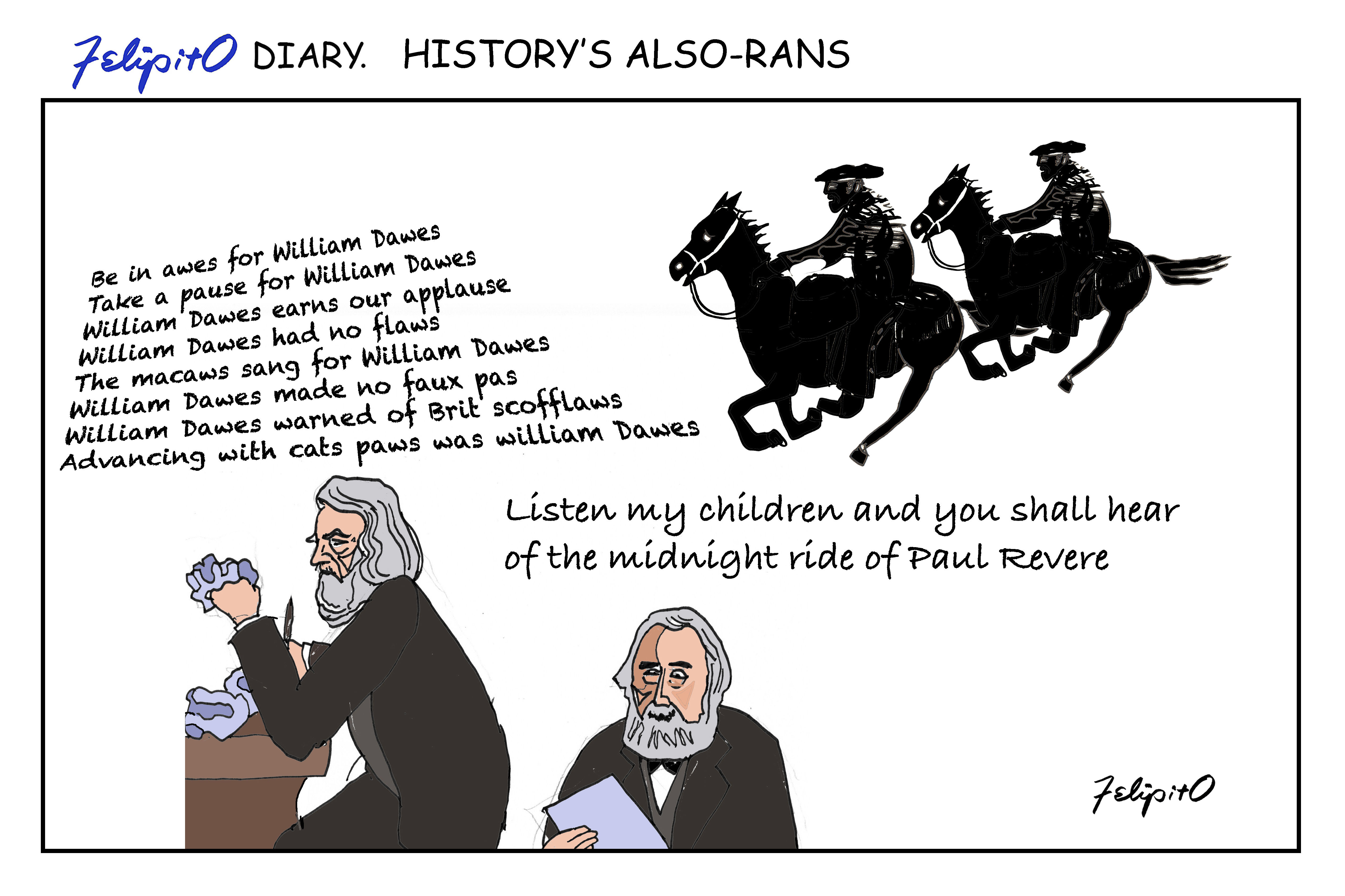
William Who?

Posted in Uncategorized | Leave a comment

Bulletin Art for April 23

Posted in Uncategorized | Leave a comment

Boomer Memories

Posted in Uncategorized | Leave a comment

#TransgenderRights

Posted in Uncategorized | Leave a comment

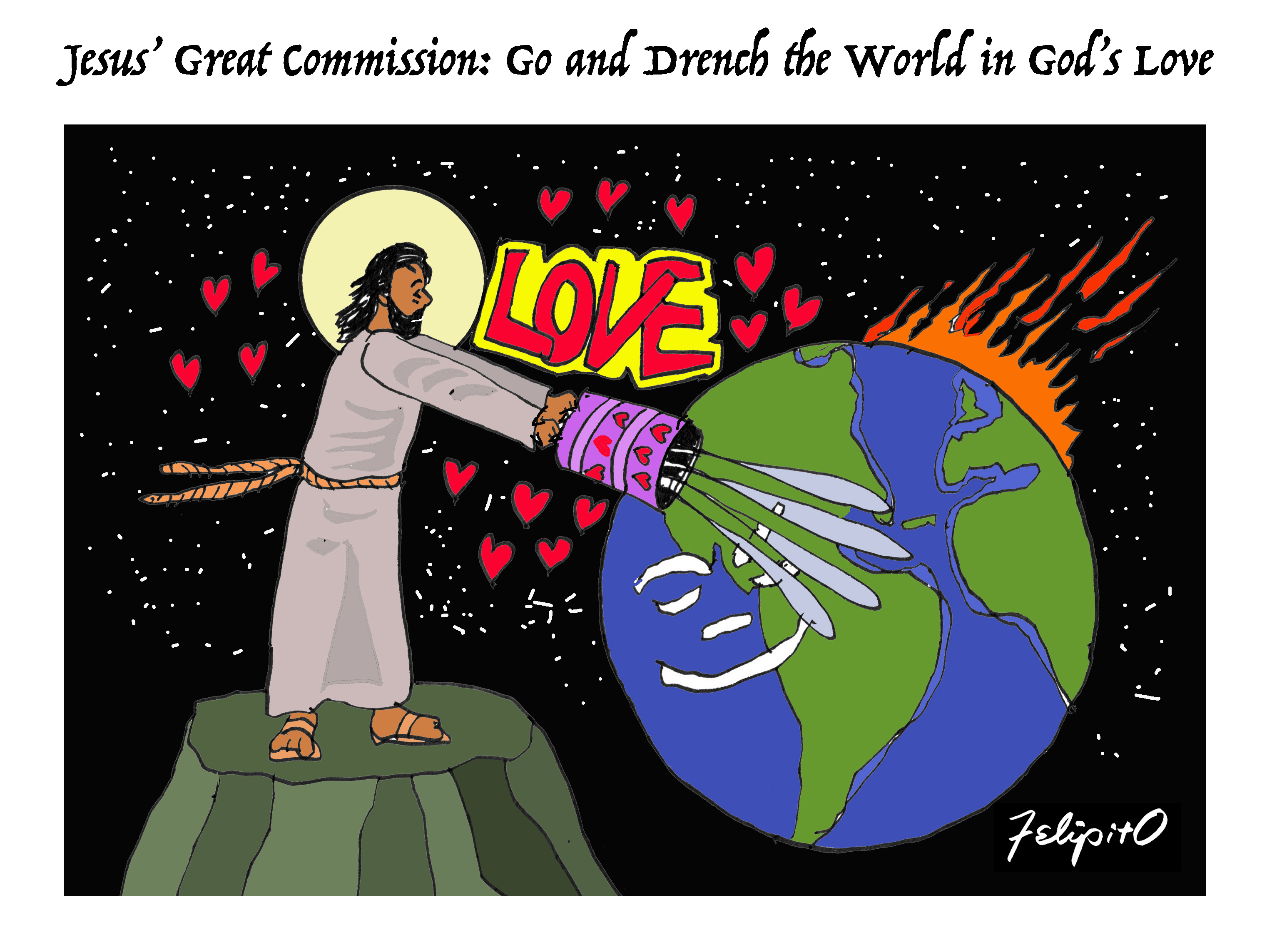
Go and Drench the World in God’s Love

April 16, 2023

The Lord is Risen! Hallelujah! The Lord is risen indeed.

Today is Easter Sunday for millions of Orthodox Christians around the world.
Orthodox Easter takes place between April 4 and May 8, following the first full moon after Passover. Orthodox Easter always falls after the celebration of Passover because the biblical accounts say the crucifixion and resurrection of Jesus took place after he entered Jerusalem to celebrate Passover.

For Roman Catholics, Lutherans, and other western Christians, Easter is determined by the Gregorian calendar established in 1582 by edict of Pope Gregory XIII. Orthodox Christians use the Julian calendar which means we celebrate the same holidays on different days.

The last time western and eastern Easters were on the same day was in 2017, and the next time will be 2025.

As you might suspect, many people think it is a bad witness to the non-Christian world that Christians cannot agree on the day to celebrate the most important event in the Christian year.

When I was on the staff of the World Council of Churches there were occasional quixotic efforts to get both traditions to celebrate Easter on the same date every year. But I’m not going out on a limb to predict this will never happen. Orthodox Christians are convinced that their formula of placing Easter on the first full moon after Passover is the correct one. And who is to say they aren’t right?

So today, on Orthodox Easter, we read of Jesus’ great commission to all the church – and note the repetition of the word “all:”

All authority in heaven and on earth has been given to me. Go therefore and make disciples of all nations, baptizing them in the name of the Father and of the Son and of the Holy Spirit, and teaching them to obey everything” – all – “that I have commanded you. And remember, I am with you always, to the end of the age.”

There’s no room for misunderstanding these orders.

And yet here we are on an Easter Sunday that exposes the divisions that exist among all the disciples of all the nations.

Ain’t that a shame?
You broke my heart
When you said we’re apart
Ain’t that a shame?

Given that Jesus gave us all the same commission, it’s a shame we are all apart.
There’s not enough time to trace the history of the early church to see how we ended up this way.

But perhaps we should take a closer look at how all of us Christians lost track of Jesus’ real message in his great commission.

And perhaps the first question to ask, is, who and where are the nations we are seeking to make disciples?

In the very early years of the church, Saint Paul interpreted the Great Commission as a call make disciples of all outposts of the Roman Empire, including Rome itself.

Simeon Bachos the Eunuch, who was baptized by Saint Philip in Acts 8, is thought to have carried the message of the resurrected Lord to Ethiopia.

Saint Thomas, who we call “Doubter,” traveled to India and established churches. Today the Mar Thoma and Malankara Orthodox churches trace their origins to his missionary efforts.

All of these churches are different from one another because of cultural differences, but all of them and many more were faithful baptizers and teachers of Christ’s commandments.

But as the shadow of medievalism darkened across Europe, the idea of disciple-making took a sinister turn.

Alarmed by the presence of Islam in Jerusalem, Christian popes and monarchs sent eight murderous crusades to the Holy Land between 1096 and 1291. Thousands of Muslims were slaughtered in the name of Christ.

In 1597, Martin Luther’s Ninety-five theses led to badly needed reforms in the church. But they also led to violent divisions between Catholics and Protestants that erupted into holy wars. For decades, Catholics burned Protestants at the stake, and Protestants burned Catholics. It was a far cry from creating disciples who would follow Christ’s commandments.

In the late fifteenth century, when Europeans discovered other lands across the sea, the scramble to accumulate fruitful real estate began. To simplify matters for European Christian sailors who found themselves in strange lands, the Doctrine of Discovery had been proclaimed by Pope Nicholas V in 1452.

The doctrine allowed sovereigns to claim territories that were uninhabited by Christians. The doctrine proclaimed that indigenous peoples in the Americas were not human so any land conquered by Europeans was considered uninhabited.

When Columbus arrived in 1492, it is estimated that the Americas were inhabited by 100 million people, about one-fifth of all humans on the planet. (www.ictinc.ca) These human beings were slaughtered, conscripted into slavery, exposed to fatal European diseases, and forced to witness the purging of their ancient cultures.

A mere eighteen days ago, on March 30, 2023, the Vatican press office announced “in no uncertain terms” the repudiation of the doctrine of discovery.

But of course the damage had been done. And you and I no doubt know individuals who continue to be affected by the fall-out of the doctrine.

I have a friend, a professor of theology at Northern Baptist Theological Seminary in Chicago, who is a member of the Kiowa nation in Oklahoma. Tom is also a drummer in his own band, and he handles those sticks with rhythm and an energy that makes your heart pump faster.

“It’s kind of a revenge,” Tom once told me. “The missionaries who came to us thought drums were of the devil and they took them away from us.”

Missionaries also discouraged their charges from holding on to their customs, speaking their languages, and expressing their beliefs in a God the missionaries didn’t recognize.

Too often, it seems, we have responded to the Great Commission by going forth to teach peoples we think of as “other” – people who we think are different from us. Years ago, Martha and I were stunned at a commissioning ceremony at a local Baptist church to send a young man into the mission field. The field? Ireland. He was being sent to convert Christians to
Christianity.

For years the foreign mission arm of the United Methodist Church sent missionaries to Russia, no doubt with the aim of bringing Jesus to godless communists. But these good intentions raised the ire of Christians who remained active, namely the Russian Orthodox Church. Life in the Soviet Union was difficult enough, the Patriarch said, without Christians sending missionaries to convert Christians to Christianity.

“Go therefore and make disciples of all nations, baptizing them in the name of the Father and of the Son and of the Holy Spirit, and teaching them to obey everything that I have commanded you.”

What is the essence of Jesus’ message to us?

It is this:

“I give you a new commandment, that you love one another. Just as I have loved you, you also should love one another. By this everyone will know that you are my disciples, if you have love for one another.” (John 13:33-36)

The Great Commission of Jesus is to go throughout the world to proclaim the message that God’s love is for all people.

And let the Holy Spirit take it from there.

In the late 1990’s, I received a powerful lesson on what trust in the Holy Spirit can do.

The World Council of Churches organized in San José, Costa Rica, a gathering of Orthodox Christians and Latin American Pentecostal Christians. The theological and cultural differences between these groups could not be more vast, but Orthodox and Pentecostal Christians place great reliance on the Holy Spirit. The gathering was called to explore their similarities.
Somewhat to my surprise, Nicaraguan Pentecostals said they do not re-baptize the Roman Catholics they have converted.

“We know the Holy Spirit was present during their Catholic baptism,” they explained, “and we respect the Holy Spirit.”

But more than that.

The Pentecostals said they also reject the notion that their non-Christian neighbors, as well as their indigenous ancestors going back thousands of years, are irredeemably lost souls because they never accepted Christ as their Lord and Savior.

“God’s love is for all God’s creation,” the Pentecostal pastor said. “God was present in the lives of our pagan ancestors, and the Holy Spirit dwelled within them. Their religious practices were different, but the Holy Spirit led them to an understanding that a great and loving power presides over the world.”

Today we have the full story of Who that power is, and the love the Father has for God’s creation.

God’s love is the message we are commissioned to spread throughout the world.

And the Holy Spirit will bring that love to fruition in God’s own time.

Posted in Uncategorized | 2 Comments

Go and Spread Love

Posted in Uncategorized | 1 Comment

13

Posted in Uncategorized | Leave a comment

Easter

Posted in Uncategorized | 2 Comments