Colson: Walking Over His Grandmother for Jesus?

NIXONCOLSONLEWISLooking through some old blog posts, I came across a reference to Charles Colson’s death eight years ago this April 21. He was 80.

Boomers and other chronologically gifted persons may recognize the name but I suspect most will not. I’m willing to bet none of my six adult children know who he was. In the 1970s and 1980s he was nationally famous, mostly because of his connection with political scandal and, later, because of his religious fervor.

Toward the end of his life he had faded into the obscurity of right-wing political and evangelical extremism that was not as powerful as it is today. Indeed, had Colson lived beyond his 80th birthday, I wonder: would he have become a leader of the Trump pack of theologically dim zealots? Or would he have warned the nation about the disastrous consequences of following an uneducated, amoral, racist, self-obsessed, biblically ignorant political leader”?

Colson, as many will recall, was a high-ranking advisor to President Richard M. Nixon, best known for a crack about his campaign strategy, “I’d walk over my grandmother to assure Nixon’s re-election.” He was the dean of the dirty tricks school of politics which, though not invented by Nixon, was employed with singular creativity during his era.

Some of Colson’s tricks turned out to be illegal and he pleaded guilty to obstructing the investigation of a break-in at the office of Dr. Daniel Ellsberg, leaker of the Pentagon Papers and a Nixon critic. Charges that Colson had orchestrated the break-in were dismissed for lack of concrete evidence, but he was ordered to prison in 1974 and served seven months of a three-year sentence.

When I interviewed Colson in 1977, I discovered the fastest way to witness his famous red-faced sneer was to suggest the Alan Wood Prison was a country club for white collar criminals. “It wasn’t,” he hissed, glaring at me. Whatever jail had been like for him, some may also remember that it inspired Colson – by then famously re-born as a Christian – to found Prison Fellowship, an evangelical organization to lead prisoners to Jesus.

I met Colson in his small Prison Fellowship office in the late fall of 1977. Sitting in the waiting room with me was Ken Clawson, another Watergate figure (best known for his plea for mercy to Bob Woodward, “I have a wife and a family and a dog and a cat!”) Clawson’s presence made me wonder if all Watergate figures hung out together, or if he was seeking spiritual guidance from Colson. But Colson, in a starched button-down shirt and paisley tie, emerged before I could talk to Clawson and escorted me to a chair in front of his desk.

Except for his reaction to my country club reference, Colson was charming and soft spoken during out hour-long conversation. He was disarmingly likable; I was so disarmed, in fact, that the article I wrote about him in the January 1978 issue of The American Baptist magazine outraged most of my liberal friends who doubted the sincerity of his conversion. American Baptist prison chaplains were incensed that I gave attention to Colson rather than to them. Bill Cober, head of the American Baptist Home Mission Society, was furious that Colson had been quoted as saying Walter Rauschenbusch – a Baptist social activist, pacifist and saint – was not Christ centered. Colson was flat wrong on that point and I argued with him about it but elected not to include my own views in the article. Colson listened politely to my insistence that Rauschenbusch was devoutly Christ centered and shrugged non-committally.

I stayed in touch with Colson for several years, giving rise to rumors among my Baptist colleagues that he and I were buds. He once asked me if I’d like a job writing articles under his byline, which was flattering but the conversation never developed into a bonafide offer. Later, when I asked Colson to write something for The American Baptist, I got a glimpse of what the job might have been like. He quickly accepted my invitation and told me to contact his chief of staff. I called and began telling this obviously beleaguered staffer what I needed. He was silent for several moments before he drew an exasperated breath. “Shit,” he said. “Does Chuck think he doesn’t give us enough to do?”

Over the years Charles Colson drifted away from the mere Christianity of his idol, C.S. Lewis, and became associated with the Christian right-wing. His evangelical tactics also hardened to the extent that some of his critics suggested “Colson would walk over his grandmother for Jesus.”

But for a brief period years ago, I had nothing but the friendliest of feelings for the guy. My admiration – for better or for worse – is all too detectable in my editorial of January 1978:

Chuck Colson and the Social Gospel

A secretary had just told me that Mr. Colson would be delayed, and I settled in my chair to relax a few more minutes.

This is really strange, I told myself, listening to my friend Fred Rhodes as he bantered reassuringly. It wasn’t so long ago that I was a student protesting the Vietnam War, and casting helpless glances at the Nixon White House. I had been told about the men inside, about their callous indifference to the suffering in Vietnam. Sometimes I had nearly wept with frustration because the men in the White House wouldn’t even listen to our pleas – had, in fact, called us bums.

One of those men had been Charles W. Colson, special counsel to the President. White House tough guy. The archfiend. One of the most powerful men in the world.

Unexpectedly, he came through the door. The face I used to imagine twisted into a perpetual snarl was smiling warmly. His hair was slightly longer than it had been in the White House days, but it was carefully groomed. His blue shirt was neatly pressed and I was surprised to discover that he is about six inches taller than he looks on television. “Chuck Colson,” he said evenly, extending his hand. Soon I was sitting at his side, sticking a microphone in his face.

I had to get it off my chest. I told Chuck Colson about my errant youth on the field of protest, and admitted that I still felt pretty much the same way I did then.  “Is there a ground of reconciliation between us?”

He laughed. “Sure,” he said without hesitation. “Jesus Christ.” And the strangeness began to melt away. Reconciliation.

People who have read Chuck Colson’s best-selling book, Born Again, are familiar with that theme of reconciliation. It is one of the remarkable distinctives of his testimony.

Here was the White House “hatchet man,” the Nixon functionary who was supposed to have said (he never did) that he would run over his grandmother to assure Nixon’s re-election. The story has now been told time and again how Colson, sensing the emptiness of his life, invited Jesus Christ to take it over, how that new life in Christ had led Colson to deep fellowship with former Senator Harold Hughes and Federal Reserve Chairman Arthur Burns – men who had been his enemies.

The story includes countless occasions when men and women who had been in opposite political poles from Colson had rallied to his side when he needed to be “Christ’s Man” and accept a prison sentence for his Watergate misdeeds.

Few people in public life have symbolized God’s power of redemption and reconciliation more than Chuck Colson. And I would have to confess that I was slightly moved to be sitting in Colson’s office. The former student protestor who Had been immobilized by a sense of powerlessness and insignificance; the former White House aide who had been intoxicated by his sense of power and position. And we were easily exploring a common, familiar ground against which all other differences fade: Jesus Christ.

In fact, I found it a bit disquieting to find myself in such agreement with Colson. I had gone to Washington at the invitation of Fred Rhodes, former government official and former vice president of the Southern Baptist Convention, in order to do a story on the Prison Fellowship founded by Colson and of which Fred is president.

As I was asking Chuck Colson about the Prison Fellowship and its services to society, it occurred to me that he was beginning to sound a bit non-Nixonian. I pointed out that the Prison Fellowship and its efforts at reform sounded like the Rauschenbusch Social Gospel. “Will somebody someday accuse you of being a political liberal?” I asked? “Rauschenbusch believed man could do good in his own right,” he said slowly. “He did not have Christ as the center of his life. And I think the disciples of  Rauschenbusch down through the years  have … largely been consumed by their own social concerns, but believed they were doing it by themselves, not Christ.”

He noted the other side of the spectrum, the church’s conservative wing, people who emphasize life style, soul saving, salvation. “I come out somewhere in the middle,” he mused. “So long as He lives in me and leads me, it is Christ and not Chuck Colson. But I believe that Jesus Christ calls us to a social concern … We are commanded to love the world, and it seems to me that we are being called to a lot more than sitting in a pew, praying one hour a week, and being happy that we are saved and going to heaven. I believe that Christianity hasn’t failed, it just hasn’t been tried.”

As our interview ended, I sheepishly shoved toward him my copy of Born Again for an autograph.

As he scribbled on the flyleaf, he chuckled, and asked, “Well? Am I a liberal?” I stammered something noncommittally.

But it was clear to me that there weren’t many differences on things that really mattered between the former liberal student and the former conservative presidential aide.

That may have been a small, even routine miracle for those who trust Jesus Christ.

But it continues to astonish me.
Posted in Uncategorized | Leave a comment

Air Force Latrine Queen

OOPS

April 1, 2020

It was a day like all days, filled with those events that alter and illuminate our times.

And in the best interest of the historical record, I feel compelled to retell the story each April First.

It all began in October 1964. I was in basic training at Lackland Air Force Base, Texas, struggling to find my niche in the military hegemony.

I got a nearly perfect score in the Air Force aptitude test in mechanics, achieved by guessing my way through several pages of multiple choice questions, and I tested high in typing. Early on, it looked like I’d be spending four years repairing jets or typing supply requisitions. Neither possibility seemed heroic (although as I think about, it’s improbable that jets maintained by me would stay in the air long enough to liberate the Mekong Delta). I began to question whether volunteering for military service had been such a good idea.

Then one morning Sergeant Ellefson, our barracks chief, said he detected stubble on my face. This was likely a ruse because, at 18, I had never shaved a day in my life, but sergeants had a highly personalized view of reality and it was rarely a good idea to challenge it. So I checked an impulse to stroke my fuzz-free cheeks and said, “Yes, Sergeant.”

“And this is what I’m gonna do about it,” Ellefson said. He led me into the barracks latrine – a room equipped with an open-bay shower, 12 sinks and two rows of redolent commodes facing each other – and said the words that would change my life.

“You’re gonna be my Latrine Queen,” Ellefson said. “And every morning I wanna see these commodes so clean General LeMay can eat breakfast out of ’em.”

Ellefson didn’t seem like the kind of guy who used hyperbole, so I said, “How does he like his eggs?”

“You’ll find out,” he said, and left me alone in the Latrine.

It is now almost forgotten that Curtis E. LeMay was the Air Force chief of staff. He was a hard-nosed S.O.B., the father of the Strategic Air Command, and the World War II commander who oversaw the destruction of Japan from the air. Later, he applied the same strategy to North Vietnam.

I was stunned when Sgt. Ellefson strode out of the latrine, leaving me alone with so much stained porcelain.

But I had grown up in a household where clean toilets and godliness were theologically fused and I knew exactly what to do. I armed myself with sponges, scowering powder and cans of pungent disinfectant and set to work. By the end of the day, my nose smarted with lingering fumes of ammonia. More to the point, the harsh glare of white porcelain that glowed like our transfigured Lord, brought tears to my eyes.

The next morning, Sgt. Ellefson’s mouth dropped open when he came into the latrine.

“God DAMN,” he said. “God DAMN.”

He stroked the silvery faucet of one of the sinks, and admired his unblemished reflection in one of the mirrors. He stepped back to view the full pristine panorama and he began to smile. “God DAMN.”

Sergeant Ellefson placed me on full-time latrine duty. That was fine with me because it replaced the more onerous trials of boot camp, like precision drilling and olfactory comparison drills to prove you could tell the difference between tear gas and human pheromones.

And politically, Latrine Queen proved to be an extremely powerful position. It gave me the authority to impose such time-saving measures as requiring my barracks mates to use the latrines in the mess hall and shower in the rain.

But as the eleven weeks of basic training neared at end, I began to worry what the next four years might hold. There were no medals for exceptional commode cleansing, nor did a four year career of urinal polishing seem likely to generate diverting tales to spin in American Legion bars.

Then one day as I was using a cotton swab to clear calcium deposits from the shower heads, I heard a commotion in the barracks. A high-pitched voice yelled, “Ten HUT,” followed by a thunderous rumble as fifty guys leaped off their bunks and slammed their brogues on the linoleum floor.

“Where’s the latrine?” a gravely voice shouted with urgency. “Gotta crap.” This was not an unusual occurrence in San Antonio where northeastern stomachs were introduced to green sausa and burritos. After lunch, stricken officers often found it necessary to pop into the first barracks they passed.

“This way, Sir.” Ellefson’s muffled voice sounded uncharacteristically polite.

“Outa my way, goddam it.”

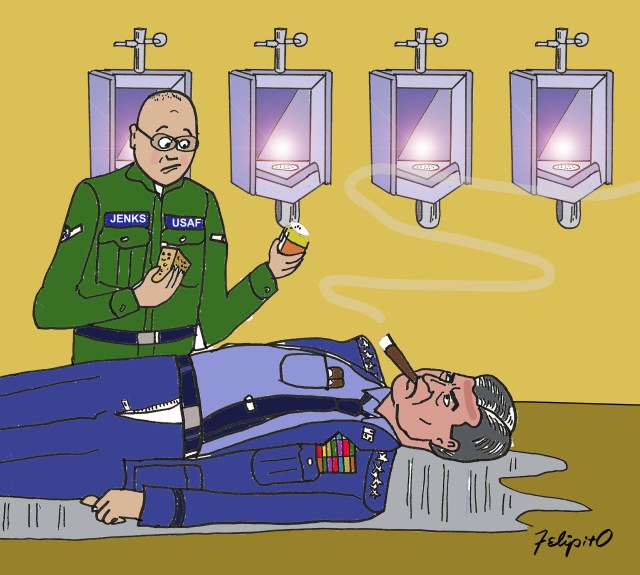
The latrine door sprung open and in marched a scowling officer clenching a huge Cuban Cohiba in his teeth – unusual even in the earliest days of the Cuban economic boycott. The officer was barrel-chested with thick steel-gray hair. There were four twinkling silver stars on each of his shoulders.

Before I could stammer, “General LeMay, Sir,” he pushed me out of his way and moved earnestly toward the bank of sparkling commodes. But the unblemished souls of his spit-shined low-quarter shoes were too new to resist the polished tiles of the cleanest latrine in the Air Force.

Down went the general.

I watched transfixed as the general’s feet rose and his posterior descended in a fluidly graceful motion, while his arms shot out like a uniformed cruciform.

Abruptly, he was on his back with his limbs fully extended like DaVinci’s Vitruvian man. His wide body spun in a clockwise motion on the shiny floor.

The general’s gabardine uniform offered little resistance to the polished tiles, but when he stopped revolving he surrendered the back of his head to the hard floor. He appeared to be carefully assessing his situation, like the great tactician he was.

I could think of no chapter in the USAF Customs and Courtesies manual that addressed this particular situation. I stood cautiously over the general and leaned forward to make eye contact with him. He scowled upwards at me, furiously chewing the Cohiba.

“General LeMay,” I ventured.

The general narrowed his eyes menacingly. I think he said, “Grempf,” but he might have been swallowing a piece of tobacco.

“How do you like your eggs?”

He appeared to think about it briefly, but then he spat the wetly chewed cigar out of his mouth so forcefully that it smacked against a urinal on the far side of the room.

“Help me up, goddam it. Gotta crap.”

I placed my hands under his arms and pulled him to his feet. As soon as he was erect, he shoved me aside and skidded toward the commodes. He dropped his gabardine drawers and plopped down on the seat. I had gotten used to seeing young basic-trainees seated in the humiliating ritual of collective crapping, but the Air Force chief of staff seemed out of place.

The general carried it off with dignity but never stopped scowling at me. I wasn’t sure what the rules called for, but I assumed they had something to do with standing at strict attention. I refrained from saluting.

Soon (and I spare the reader the auditory and olfactory details of the scene) the general was finished. He stood and tightened his belt.

General LeMay walked to one of the sinks. As he washed his hands he looked around the cleanest latrine in the Air Force.

“Goddam,” he said. “This must be the cleanest latrine in the Air Force.”

Now seemed like an appropriate time to salute. I snapped my right hand rigidly to my forehead, and he responded with a more casual gesture that looked as if he were shooing a fly from his face.

Silently, the general pulled a neatly folded towel from the shelf and dried his hands. When he walked out, I picked up the reeking cigar butt and threw it away.

General LeMay retired from active duty early in my Air Force career, and I saw him rarely after that first latrine rendezvous. When I did see him, it was usually when the chief of staff was called to accompany President Lyndon B. Johnson on his visits to military installations. For the remainder of the general’s career, whenever word came down that LBJ was planning to visit a base, I got a call from a chief master sergeant in the chief’s Pentagon office.

“The old man wants the President to have access to the cleanest latrine in the Air Force,” the sergeant would say. “Get to work.”

On such occasions I would spend a week getting the presidential latrine in shape for presidential elimination, whichever form it might take. On occasion, General LeMay would invite me outside to shake hands with the president.

“Goddam,” LBJ would say. “That must be the cleanest latrine in the Air Force,” and General LeMay would nod happily. I would stand modestly between the two men, trying not to expose the pride that was swelling in my chest.

But pride was warranted. I was the best Latrine Queen in the Air Force.

And I have a letter from the commander-in-chief to prove it.

Image

Posted in Uncategorized | Leave a comment

Don Pablo Escape Clause

ANYTHINGYOUCANIMAGINEISREAL

Posted in Uncategorized | Leave a comment

The Dogs Are Lutheran

SAINTROCHSGOTTHIS

Posted in Uncategorized | Leave a comment

Covid-19 Binge Watching

WHENITCOMESTOTELEVISION

Posted in Uncategorized | Leave a comment

A Wift of Spring

GONNABESICK

Posted in Uncategorized | Leave a comment

That didn’t take long.

FILLINGOUTTHECENSUS

Posted in Uncategorized | Leave a comment

My Encounters with AFOSI

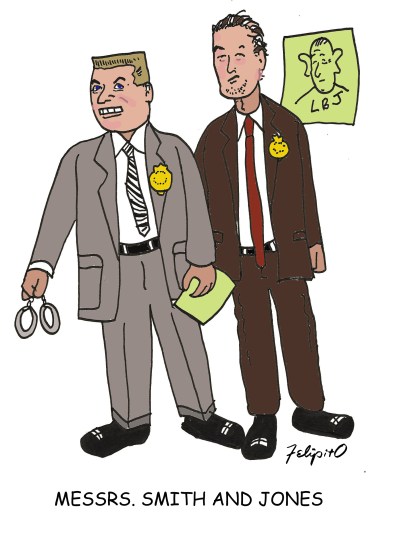
MESSRSSMITHANDJONESIn the Navy, as we have known through 17 seasons on CBS, it’s NCIS: Naval Criminal Investigation Service.

In the Air Force it’s AFOSI: Air Force Office of Special Investigations.

Air Force Secretary W. Stuart Symington, who envisioned it as an “independent, unbiased” agency to investigate criminal activity in the Air Force, created AFOSI in 1948.

During my four years in the Air Force (1964-1968) I had two encounters with OSI agents. That was not enough to develop a 17-season TV series but they were memorable experiences for me. So for the historical record:

There were two OSI agents who made periodic appearances on RAF Bentwaters/Woodbridge air stations in England. I don’t know if they were assigned to the twin bases or if they investigated all criminal activities on U.S. bases in England. Both of my encounters were with these two guys.

I have long since forgotten their names, so let’s go with Smith and Jones. Both wore civilian suits and were addressed as “Mister.” It was assumed one was an Air Force officer, possibly a captain, and the other was an NCO. Their actual ranks were secret, in part to maintain their independence from more senior officers.

Mr. Smith was of medium height, had a closely groomed flattop, and wore a freshly pressed gray suit. Mr. Jones was tall with a protruding chin highlighted by a five o’clock shadow, and his brown suit was slightly rumpled. Both wore spit-shined low-quarter shoes. Mr. Smith, clearly the senior partner, put people at ease with glib but friendly chatter. Mr. Jones stood slightly behind Mr. Smith and grunted.

i.

In the spring of 1965 I was in my first year as a chaplain’s assistant in the Bentwaters chapel. My duties involved making the coffee, typing chapel bulletins and chaplain’s sermons, arranging altars for worship services, counting and depositing chapel offerings, setting up chairs and tables for fellowship suppers, and general janitorial work. The chaplain’s assistants also served as receptionists when people visited the chapel. Every airman and officer assigned to the base was required to visit the chapel for a briefing on what services the chaplain could provide. These briefings took place each week, and most were routine.

I was sitting at my desk in the main office one drizzly morning when two African American airmen walked in. They were dressed in green Air Force fatigues and seemed happy to be out of the rain.

“We’re here to see the chaplain,” one said, smiling. I stood up and both airmen reached out to shake my hand.

“Have a seat,” I said. “Chaplain Donnelly has someone in his office.”

The two airmen sat down and I asked them where they were from.

“Just finished tech school training at Chanute,” one replied. The other added, “We’re from Newark. We knew each other before we enlisted.”

We continued talking amiably until Chaplain Donnelly emerged from his office. He smiled broadly at the two airmen and invited them in. The door was closed and I went to lunch. I never saw the two airmen from Newark again.

That afternoon I was sitting at my desk typing when Mr. Smith and Mr. Jones walked in. I was surprised to see two men wearing civilian suits on a weekday. Airmen usually dressed in suits when they attended Sunday services, but this was different.

“We’re OSI,” Mr. Smith said breezily. “Chaplain Donnelly called us.”

I had never heard of OSI but I buzzed the chaplain’s phone immediately. Chaplain Donnelly brought them both inside and closed the door.

Sergeant Bob Lincoln, one of my fellow chaplain assistants, came over to my desk. “What did you do?” he asked, wryly.

“Me? Nothing!”

“Those guys investigate crimes,” Bob said.

I swallowed nervously, remembering an uncomplimentary cartoon I had drawn of President Johnson. Bob had found it on my desk, “Get rid of that before Donnelly sees it,” he said. “Against regulations to make fun of the President.”

The two agents were in the chaplain’s office for several minutes. When the door opened, Donnelly walked over and affixed me with a serious expression.

“You were here this morning,” he said. I nodded silently and was about to say I really had no intention of insulting the president.

“Those guys who were here earlier,” Donnelly said. “What did they tell you?”

I thought I should be standing at attention so I slid away from my chair.

“Nothing, really.”

Mr. Smith stood beside Chaplain Donnelly.

“Did they tell you they were Black Muslim?”

Donnelly added a clarification: “Nation of Islam.”

Now I was thoroughly confused.

“No, Sir,” I said. They said they had just finished at Chanute and were both from Newark.”

I added: “They were nice guys.”

Mr. Smith and Chaplain Donnelly exchanged suspicious glances. Mr. Jones grunted.

“Well,” Mr. Smith said, “if you hear anything in the barracks about Black Muslims, you tell Chaplain Donnelly immediately.”

“Yessir.”

Again, everyone exchanged suspicious glances.

It is a mystery to me what happened to the two airmen after Messrs. Smith and Jones left that day.

I asked Chaplain Donnelly, “Can’t Muslims be in the Air Force?”

“Well, this type of Muslim could be a morale problem,” he said. “They hate white people.”

I was silent. These two guys had not appeared to be hateful. Chaplain Donnelly wouldn’t say what happened to them. Were they simply advised not to talk about their religion? Were they allowed to stay on base? Were they given general discharges and sent home? It’s frustrating that I will never know.

But it is reassuring that the Air Force has seen many changes in the 52 years since I left it. In 1968, the Air Force recognized only three major faith groups: P, C, and J. Today, scores of faith groups are recognized by the Department of Defense. And last year, Saleba Jabeen, wearing an Air Force blue hijab as part of her uniform, was commissioned as the first woman Muslim chaplain. It’s a development I’m glad I lived to see.

ii.

In the fall of 1965 I was transferred from the Bentwaters to the Woodbridge chapel. I put all my clothes in a blue duffle and dragged them to my new barracks on Woodbridge base.

The barracks were dormitory style and two airmen were assigned to each room. Looking at the tan brick building I thought my living arrangements would be greatly improved.

“We’ll have inspections about once a week,” said SMSgt Risley, the first sergeant, as he escorted me to my new room. But when he opened the door, his mouth dropped open.

It was a mess. The airman assigned to the room had torn the covers from his bed and his socks and underwear were strewn across the floor. Dust bunnies had gathered in each corner and the room had a foul, sweaty odor. Clearly it had been more than a week since the last inspection.

“Welp,” Risley said, blinking his eyes. “This is going to require some elbow grease.”

He walked over to the unused bed and thumped his fingers on the blue GI blanket. “I guess it’ll be safe for you to sleep on this,” he said. “But you’re going to have to get on your roomie to clean this mess up.”

I tossed my duffle in the corner and returned to my desk at the chapel. When I got back to the room that night, my roommate was there. He was sitting at the edge of his coverless bed, his skinny white legs protruding from baggy GI skivvies. I thought he looked old.

He looked up at me and then looked down again.

“You a chaplain?” he asked, staring at his lap.

“No. A chaplain’s assistant,” I said.

He thought about that for a moment.

“Listen,” he said, “I’m sorry about the room. Guess I let it get away from me a little.”

I thought about that for a moment.

“We’ll get on it,” I said. “First thing in the morning.”

I slipped between the covers of the other bed and slept fitfully. When I awoke the next morning, my roommate was buried beneath a clot of covers on his bed.

There was a note pinned to my pillow.

“Jenks I’m sorry please tell the chaplins pray for my sole.”

I jumped out of bed and poked my roommate.”

“Wake up,” I shouted. He did not respond.

Still dressed in my underwear, I ran into the hallway and picked up the barracks phone. I called Bill Dodge, the sergeant in charge of the chapel. “Call the medics,” Bill said.

I made the call and returned to the room to put on some pants. In fifteen minutes, a fatigue-wearing air policeman and white uniformed medic walked into the room.

Immediately behind them were Messrs. Smith and Jones.

The medic poked at my roommate and began pulling him from the bed. My roommate groaned. The air cop and the medic grabbed him by both arms and pulled him to his feet.

“Take him away,” Mr. Smith said. My roommate, dressed only in yellowing baggy skivvies, staggered slightly as he was dragged out the door. Messrs. Smith and Jones watched silently until he was gone.

Mr. Smith turned to me. “Okay,” he said, not unpleasantly. “Show me the note.” He took the crumpled paper and placed it in an evidence bag.

Messrs. Smith and Jones began going through my roommate’s clothes lying in open dresser drawers or on the floor of his closet. Mr. Jones removed a yellow tin from one of the pants pockets.

“Crab powder,” he said.

I had no idea what crab powder was. I was not pleased when Bill Dodge enlightened me at the end of the day. Mr. Jones placed the tin in an evidence bag.

Mr. Smith pulled a note pad from my roommate’s makeshift nightstand. On it was a draft of a letter my roommate had been writing to a woman.

“It says how much he loves her and misses her and can’t live without her,” Mr. Smith said.

“She’s a whore,” Mr. Jones said, with remarkable intuition.

“Wouldn’t be the first guy to fall in love with a whore,” Mr. Smith said.

Messrs. Smith and Jones kicked through clothing and papers until they were satisfied they had everything they needed.

“Okay,” Mr. Smith said, smiling at me. “You can go back to bed now.” Mr. Jones snorted a laugh.

It was 1100 hours and I was three hours late at the chapel. I showered quickly and walked to work.

This time, Bill Dodge was able to tell me what had happened to the subject of the OSI investigation.

“He was taken to the hospital at RAF Lakenheath for a psych eval,” Bill said. “He’ll be thrown out of the Air Force, probably a bad conduct discharge. You’ll never see him again.”

But Bill had been giving the incident some thought.

“Look,” he said. “You can’t go back to that room. Grab your stuff and bring it here.”

Across the street from the chapel were three Quonset huts, each divided into two rooms with four beds in each room. They were heated by foul-smelling diesel heaters and the latrine was a separate hut several yards from the others.

Bill called the first sergeant to arrange a bed for me in the hut that became my home for the next two-and-a-half years.

After a 24-hour stay in the brick barracks, the cold, diesel-reeking Quonset hut was a Godsend.

And I never saw Messrs. Smith and Jones again.


Posted in Uncategorized | Leave a comment

Whatever works.

HOMEWORKINGSTYLES

Posted in Uncategorized | Leave a comment

Okay, Boomers

MASKSPREFERRED

Posted in Uncategorized | Leave a comment