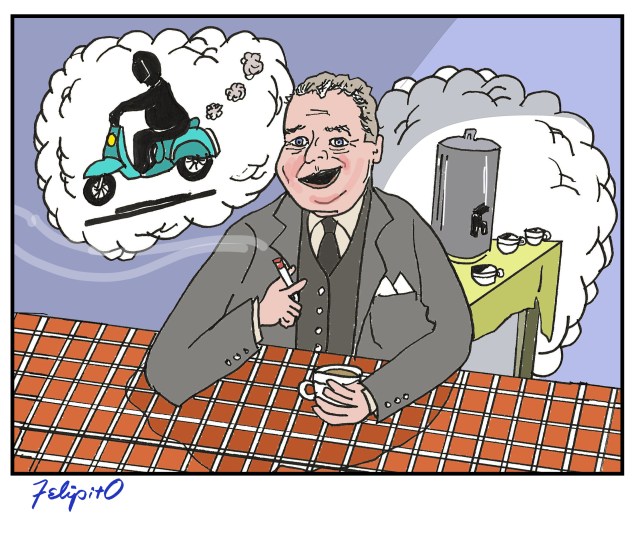
 A tall, slightly stooped figure dressed from head to toe in shiny black leather shuffled into the kitchen of the RAF Woodbridge chapel.
This was 1965, a quarter century before the Borg appeared on Star Trek: The Next Generation. But it was a Borg-like figure that startled me as I prepared coffee for chapel activities that night. I stared at the creature.
“Good evening,” he said, removing a black plastic helmet from his head. He was a middle-aged man who quickly ran his fingers through his graying tousled hair.
“I’m Teather,” he said. “The Catholic Children’s Choir director. Are you the new lad?”
I nodded, still silent.
Mr. Teather placed the helmet on the kitchen table and slowly unzipped his leather jacket. Underneath the black leather he was wearing an old gray tweed suit with a vest, an off-white shirt with a slightly frayed collar, and gray tie. Over the years I knew him I never saw Mr. Teather wearing anything different.
He carefully folded the black leather jacket and leggings under his arm.
“I must mind my minions,” he said pleasantly, referring to the children’s choir. “If you’re still hear when we’re done, I shall stop by for a chat.” I nodded.
Robert Teather was a history professor at the University of Suffolk in Ipswich, England. He was one of several British civilians contracted by the U.S. Air Force to lead choirs and provide musical support for the chapel. Every Wednesday night he would hop onto his petrol-powered scooter in Ipswich and make his way up the A-12 to Woodbridge base. On most Wednesdays, his leather outfit was barely adequate to protect him from the chill wind.
As an Air Force chaplain’s assistant, my job was to be present at evening chapel activities to keep an eye on the facilities and make sure everyone had tea or coffee – or Hawaiian Punch, which was a special favorite of the children of Air Force personnel. There were several activities including adult and children’s choir rehearsals throughout the week, most taking place after normal working hours. I would make myself scarce during the rehearsals, sitting in my office, smoking Pall-Mall cigarettes, and typing letters home. When everyone had left, I cleaned up the kitchen and retired to my Quonset hut across the street from the chapel.
I quickly learned that Mr. Teather liked to have a cup of coffee before slipping into his black leather and beginning the ordeal of his 15-mile scooter trip back to Ipswich. That made him and me the last persons to leave the chapel. At first I sat at the kitchen table with him and tried to conceal my impatience.
“One cannot get coffee as good as this at home,” he would say. “You Americans have a special talent for brewing coffee.” The “special way” involved guessing the quantity of grounds to load into a 30-cup GI coffee pot, but I had a knack for guessing right.
Both Mr. Teather and I smoked unfiltered cigarettes (he rolled his own) as we sat sipping heavily creamed and sugared coffee at the kitchen table. He quickly noticed I was interested in history.
“I’m sure you know Cardinal Wolsey was born in Ipswich,” he said.
I didn’t.
“He was Henry VIII’s closest advisor until he fell from grace over the issue of the King’s marriage,” Mr. Teather explained. He added some details and it was the first time I heard the school child’s rhyme for keeping the six queens straight: “Divorced, Beheaded, Died, Divorced, Beheaded, Survived.”
“You are just a few miles from Framlingham Castle,” Mr. Teather said. “Queen Mary hid there during a rebellion against her.”
“Bloody Mary?”
Mr. Teather, a good Catholic, scoffed good-naturedly. “They were all bloody back then.”
In June I traveled to London to watch the Queen preside over the Trooping of the Colour. Elizabeth II was 40 then, smiling and rosy cheeked, and I thought she was beautiful. I told Mr. Teather about it and he decided to tell me about the royal family.
“There are two types of Windsors,” he said. “One, typified by Her Majesty, is serious and dutiful. The other type is reckless and often irresponsible. In my lifetime, there has been King Edward VIII who fell in love with an American and abdicated the throne.”
I knew that story. My mother had listened to Edward’s abdication speech on the wireless in 1936 and found it so romantic.
“He was highly immature and foolish,” Mr. Teather said. “It was a national crisis.” He smiled, took a drag on his cigarette, and sang, “Hark the Herald Angels Sing, Missus Simpson’s pinched our king.”
George VI, who succeeded Edward, was an example of a serious and dutiful Windsor. “Princess Margaret is more the irresponsible type,” said Mr. Teather. “With Prince Charles, he’s too young to be sure which way he’ll go.”
I often thought of that conversation as the royals evolved over the next half century.
Mr. Teather had a sprightly sense of humor. As we poured our coffee one Wednesday evening he was laughing about something he had read about a movie that took place in Scotland.
“But it was not filmed in Scotland,” he said. “The director said they looked and looked and that if there is any place that does not look like Scotland it’s Scotland.” He found that hugely amusing.
On one occasion, he shared a profoundly sad experience with me.
“This would have been my son’s 20th birthday today,” he said. “We lost him at three. You know it is very difficult to lose a child at that age because they have developed a vivid personality and you are connecting with them emotionally and intellectually and there is so much promise.”
He said that matter-of-factly, as if he thought that was a life lesson I might be interested in keeping in mind.
One weekend I traveled to London to see a musical, The Barretts of Wimpole Street with Donald Wolfit, June Bronhill and Keith Michell,* and to sit in the visitor’s gallery of the House of Commons to watch a debate on Britain’s support of the Vietnam War. Prime Minister Harold Wilson and Tory leader Edward Heath sparred with each other, and I was exhilarated. Mr. Teather wanted to hear all about it.
“The war has become a serious issue,” I said.
“Oh,” Mr. Teather raised his hand as if I had said something significant. “Is that what Americans call it now? Just – the war?”
I hadn’t thought about it but it was true. The War in Vietnam had totally occupied American attention, at least on military installations. Mr. Teather the historian made a mental note.
The last time I saw Mr. Teather was in late 1967 when I was preparing to be reassigned to McConnell Air Force Base, Kansas. Two young Catholic seminarians had been ordained that day and were visiting the Catholic chaplain, Father McCausland, in his office. The chaplain invited Mr. Teather in to say hello.
My mouth dropped open when the distinguished Mr. Teather knelt humbly before these very callow youths. But the new priests were not surprised and they made gestures of blessing over his graying head.
Mr. Teather chatted with the young men for a while, and then we retired to the chapel kitchen.
“It is a very special blessing to be blessed by a priest who has just been ordained,” he explained to me as he lit a cigarette.
“Great,” I said.
I lost touch with Mr. Teather after I left England and became distracted by college and youthful pursuits. This week I tried to find him on the Internet – a dubious task because there are many Robert Teathers on social media and this one would be approaching his centennial now. I could find no mention of him on the Suffolk University webpage or Ipswich obituaries. He is one of scores of people I knew in the Air Force – Brit civilians and fellow airmen – who were important to me for a brief period in my life but have now disappeared.
But every now and then I find it amusing to read an article about the discovery of Richard III’s body beneath a parking lot in Leicester, or Harry and Meghan’s escape to Canada, or BREXIT, or Boris Johnson’s pregnant fiancee, and imagine what Mr. Teather would have to say.
__________
* In the seventies, Keith Michell had the title role in the television mini-series The Six Wives of Henry VIII, but I had no recollection of seeing him on stage.

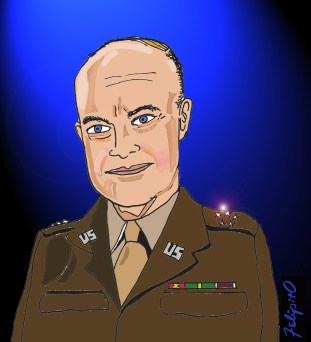 Friday marks the 75th anniversary of VE Day on May 8, 1945.



 Cakes and Ale