As an early Boomer, I have been a wary dweller in the nuclear age all my life.
That is an important fact that defines all us Boomers.
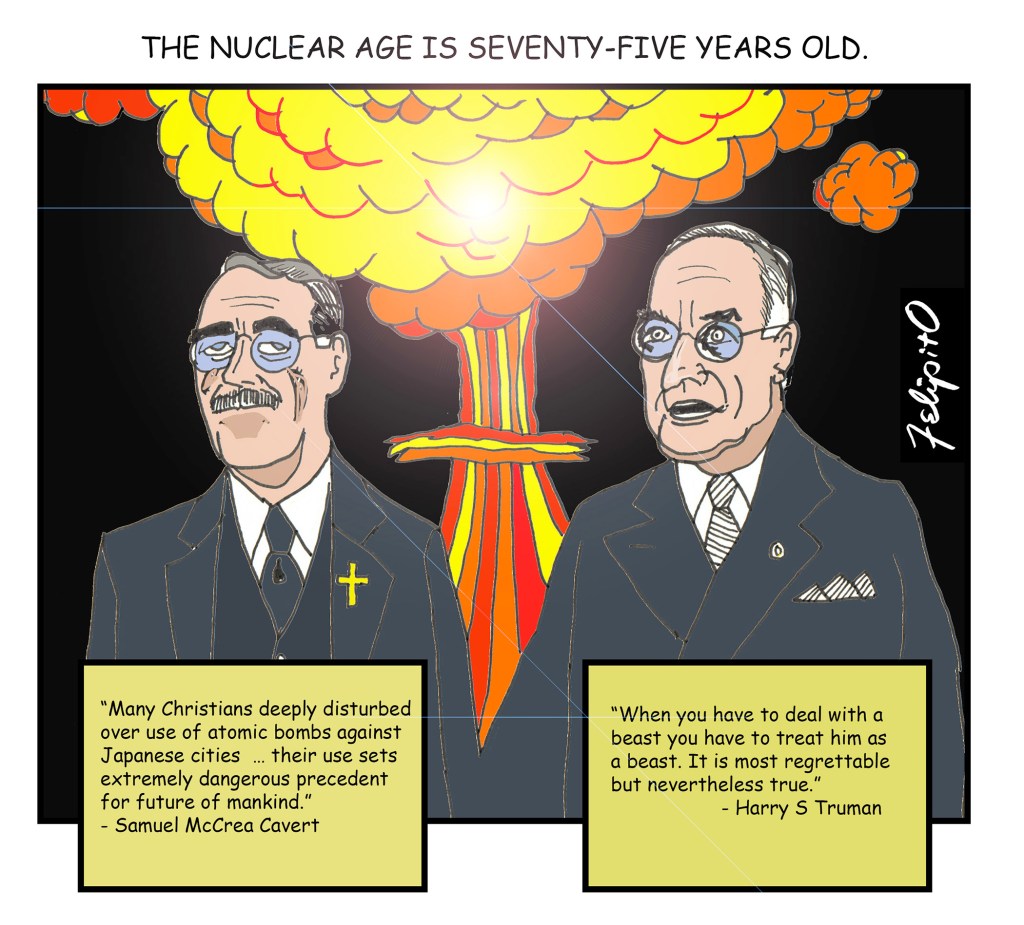
The nuclear age was born 75 years ago August 6 when an atomic bomb was dropped on Hiroshima, Japan, a densely populated city disingenuously described by President Harry S Truman as “a military base.”
Nearly eight thousand people died instantly in the blast, about 20 per cent of the population of Hiroshima. The horror was repeated August 9 on the city of Nagasaki.
“Now I am become death, the destroyer of worlds,” said Robert Oppenheimer, the principal developer of the bomb, when he realized what he had done.
“My God!” was the less poetic response of the pilot who dropped the bomb.
In 1946 John Hershey wrote a series of articles for The New Yorker that described the experiences of six persons who survived the Hiroshima fireball and lived through the devastation that followed. The articles were published that same year as a Pulitzer Prize winning book.
As seventh graders we were required to read Hiroshima. Our teacher said it was remarkable journalism. In calm, unemotional prose, Hershey simply described the facts. And the facts were devastating.
By that time in our lives the Soviet Union was developing a small cache of atomic weapons far inferior to the nuclear arsenal of the United States. But as far as we Boomers knew we were teetering on the precipice of fiery death. Every time Secretary of State John Foster Dulles strolled the diplomatic brink between peace and war, every time President Eisenhower warned that U.S. response to Soviet aggression “would not be a ground war,” there was a collective tightening of Boomer sphincters.
The nuclear age neared a denouement in October 1962 when the Soviet Union installed tactical nuclear weapons in Cuba and President Kennedy ordered them removed.
Boomers can quote from memory this line from JFK’s address to the nation on October 22: “It shall be the policy of this nation to regard any nuclear missile launched from Cuba against any nation in the Western Hemisphere as an attack by the Soviet Union on the United States requiring a full retaliatory response upon the Soviet Union.”
The next morning our parents stared blankly into their coffees as they sent us glumly to school. Our history teacher greeted us with red eyes. “We adults have had our lives,” he said eschatologically. “It would be too bad if your young lives were cut short.”
Thanks to the courageous restraint of both John Kennedy and Soviet leader Nikita Khrushchev, nuclear war was averted in 1962. But the missile rattling continued.
The closest I got to nuclear weapons was in the late 1960s when I served on an American Air Force base in England. It was U.S. policy to neither confirm nor deny whether any of its bases had nuclear weapons, but of course they did. And every time the base had a practice exercise I stood as a security guard and watched uneasily as my fellow airmen worked feverishly to upload tactical nukes to fighter jets. But it was only practice, and we all breathed easier when the nukes were put back into storage.
In 1992 the Soviet Union collapsed and the United States declared victory in the Cold War. But the nuclear age was not over. Both Russia and the United States still maintain their nukes. China, too. Even scarier, many other nations have the bomb. Israel, though it officially denies it, is generally assumed to be nuclear capable. The world’s two most vociferous antagonists, India and Pakistan, have the bomb, and both declare they would use it if provoked.
The nuclear age is alive and well at 75.
There was a time when the most eloquent advocates of nuclear disarmament were leaders of the world’s great faiths. These days faith leaders have a lot to be prophetic about: global warming, injustice, racism, poverty, terrorism, and the general inability of God’s children to get along with one another. I hope faith leaders will not forget to be prophetic about the urgent need to put the nuclear age to sleep.
Religious leaders spoke prophetically about the issue at the very birth of the age in 1945. The nuclear infernal in Hiroshima was still raging when U.S. churches told Harry Truman he had made a terrible mistake.
Harry couldn’t agree.
The way Truman saw it in August 1945, there was a sickening possibility that the Second World War would end in an unprecedented bloodbath.
The only alternative to a mutual massacre of American and Japanese troops, he believed, was the Atomic Bomb that his scientists told him was ready to use.
Months earlier, in land battles on Iwo Jima and Okinawa, U.S. forces suffered 75,000 casualties. On Iwo Jima, the president was informed, 21,000 Japanese troops fought fanatically to hold the island and 20,000 were killed.
Truman was also aware that Americans were getting harsh glimpses of the brutality of the Pacific war. In November 1942 through January 1943 the Allied losses in the battle of Buna-Gona in eastern Papua New Guinea were higher than that experienced at Guadalcanal. For the first time the American public was confronted with the images of dead American troops. My father’s personal account of that campaign can be read at www.bunadiary.com.
In July, as secret plans were underway for a U.S. invasion of Kyushu, the interception of Japanese messages indicated their military build-up on the island was four times larger than earlier estimates. In Truman’s estimation, the Japanese military government was prepared to fight on until every soldier was dead or wounded.
The atomic bomb, he said, was the only way to “end the agony of war.” On his orders on August 6, an American B-29 dropped a bomb on Hiroshima killing 80,000 people. The total swelled to 140,000 as people injured and suffering from radiation poisoning succumbed. An additional 80,000 died August 9 when a second bomb was dropped on Nagasaki.
Whether the numbers fell short of projected deaths in a theoretical invasion of Japan has been the subject of debate for three-quarters of a century.
When Truman went on the radio to announce the use of the bomb, many Americans regarded it as a hopeful sign the war was about to end. But even hopeful Americans were sobered by the number of people, including civilians, women and children, who died in Hiroshima and Nagasaki. It was immediately clear that the world had entered a dark and uncertain age.
Member churches of the Federal Council of Churches were appalled by the evils the new age had unleashed. Church spokespersons such as Presbyterian John Foster Dulles – known later for his policy of nuclear “brinksmanship” as President Eisenhower’s Secretary of State – urged a moratorium in further use of the bomb.
The Rev. Samuel McCrea Cavert, general secretary of the Federal Council, sent a telegram to the president on August 9, the day Nagasaki was bombed:
Honorable Harry S Truman, President of the United States, The White House
Many Christians deeply disturbed over use of atomic bombs against Japanese cities because of their necessarily indiscriminate destructive efforts and because their use sets extremely dangerous precedent for future of mankind. Bishop Oxnam president of the council and John Foster Dulles chairman of its Commission on a Just and Durable peace are preparing statement for probable release tomorrow urging that atomic bombs be regarded as trust for humanity and that Japanese nation be given genuine opportunity and time to verify facts about new bomb and to accept surrender terms. Respectfully urge that ample opportunity be given Japan to reconsider ultimatum before any further devastation by atomic bomb is visited upon her people.
Federal Council of churches of Christ in America, Samuel McCrea Cavert, general secretary
Harry Truman, in office only five months, struggled with diplomatic language in his quick response. In a letter dated August 11, he wrote:
My dear Mr. Cavert:
I appreciated very much your telegram of August ninth.
Nobody is more disturbed over the use of Atomic bombs than I am but I was greatly disturbed over the unwarranted attack by the Japanese on Pearl Harbor and their murder of our prisoners of war. The only language they seem to understand is the one we have been using to bombard them.
When you have to deal with a beast you have to treat him as a beast. It is most regrettable but nevertheless true.
Sincerely yours,
Harry S. Truman
The nuclear age had begun virtually over night, and Truman’s twelve successors made decisions that built, expanded or maintained the American nuclear arsenal. The political rationale from the very beginning was that the bomb was needed to end conflict or as a deterrent to conflict.
But to millions of church people, the potential for “indiscriminate destruction” of God’s creation became a daily nightmare and the focus of millions of sermons, statements and theological debates.
The churches began preaching that sermon of peace in August 1945.
Seventy-five years on, I hope the sermon continues.
He was probably the most accomplished poet any of us knew.
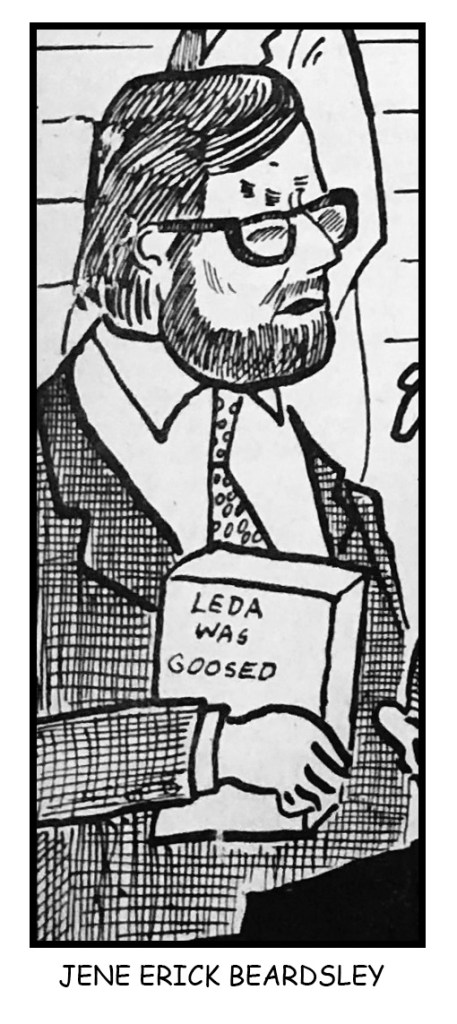
His idol was William Butler Yeats. Anyone who attended Jene Beardsley’s literature classes at Eastern University knows that.
A student once asked him if he had ever written a poem as good as Yeats and he said, “Yes.”
Then he winced at his impertinence.
“I only wrote one poem I thought came close to Yeats,” he explained. I wish I could remember which of Jene’s many poems he thought was truly Yeatsian.
Jene Beardsley was professor of English literature at then Eastern Baptist College when I was a student in the sixties and seventies. He was an eloquent lecturer who meticulously dissected the pathology of poems and expected his students to show they had grasped some of it in their blue book essays. I remember one of my classmates had tears in her eyes when she showed me Jene’s red-ink comment on her test: “Most of the time you are way off.” Jene’s annotations on essays could sting because his handwriting was so graceful and elegant.
Jene was not an extrovert and he spent long hours alone in his tiny office re-reading and underlining the books that engulfed him. “I can’t really get excited about a lecture unless I find something new to say,” he explained.
He was cautious around new students until he got to know them. When I was accepted into his small phalanx of close friends I discovered a deeply complicated and intense man (as befits a poet) who had strong opinions about literary figures and a high pitched giggle when he laughed. He hated Erle Stanley Gardner, writer of the Perry Mason stories, and he dismissed poets Ogden Nash and Rod McKuen as “stupid and trite.” He thought some popular writing was actually terrible and he cited Walter Van Tilburg Clark’s The Ox-Bow Incident as an example. I never understood why.
I was a pale imitation of a campus radical in the seventies (at least by Eastern Baptist College standards) and Jene would view my satirical cartoons of the school’s president and dean with apparent appreciation but no comment.
After my graduation from Eastern in 1971 it was easier to see Jene socially. I remember several evenings with Jene and other friends in my Phoenixville, Pa., apartment, feasting, laughing, and – yes – drinking wine, which was especially taboo in the Eastern Baptist College rule book. He liked most of his faculty colleagues but tended to mimic some of their traits. He did a devastating parody of the high-pitched accent of a foreign language professor.
I kept in touch with Jene during the years I was on the adjunct faculty teaching journalism and mass media in the seventies and eighties. My classes met on Thursday evenings and I made it a point to visit Jene each week in his tiny office. He always seemed glad to see me but it was also obvious he was intensely absorbed in lecture preparation or perhaps in the creation of a new poem. I never overstayed my welcome, but I never missed an opportunity to visit him. As time went by he allowed his hair and beard to grow long and gray and he began to look like Jerry Garcia. Also befitting a poet.
Then, sadly, we began to lose touch after he retired. I sent him birthday greetings every January on FaceBook and he would respond warmly. I didn’t hear from him for several years and one of my former students sent me a FaceBook message to ask if I knew if he was okay. I sent him a note by mail but earlier this year my student reported, “Beardsley is okay, he says his eyesight is bad and prevents him from reading the small print in social media.” I sent him a note to say how good it was to be back in touch. But that was my last message to him.
This morning I signed onto Facebook and saw a report that Jene had died July 24. He was 83.
I wish I had stayed closer to him.
Jene Beardsley leaves a treasure of memories for his students and friends.
He also bequeaths to us the many poems he left behind. Some of them as good as Yeats.
This one in particular is on my mind:
A Sudden Death in the House
How thoughtless of you to get up on that morning – unsteady In bathrobe and slippers, with toothbrush and washcloth ready, Breakfast frying in the kitchen, son leaving for work – merely To die, the day in your absence resuming so queerly. Now, us guessing the reason you rose just to go back to sleep. This brief but formal complaint is but love in disguise: May you who rose to die have died to rise.
I had just settled into my chapel desk at RAF Bentwaters when I realized Air Force life was going to involve more than sipping strong coffee and typing.
It was March 1965. I was 18 and I had been on base for less than two months. I had completed tech school training to be a chaplain services specialist in at Amarillo Air Force Base in Texas. I knew how to set up a Catholic altar for Mass, adjust the bible and candles for Protestant worship and, if need be, arrange the kiddush for Shabbat. I could type 50 words a minute and I could prepare a chapel bulletin or type a chaplain’s sermon with decent speed. I thought the next three years of my tour of duty on the twin bases RAF Bentwaters and Woodbridge in beautiful Suffolk would be pleasant ones. It was every American’s dream to live in swinging England in the sixties.
Soon, however, I learned there would be more to life than assisting chaplains. As a low-ranking GI with a single stripe on my sleeve I would be forced to endure less edifying chores. Once a month I would be assigned KP duty, a grueling 15-hour day of preparing the mess hall for three massive meals, washing enormous pots and pans, and mopping the red tile floors, all under the obscene guidance of sweaty mess sergeants.
And several times a month there would be Augmentee Guard Duty when the Air Force practiced its military readiness by holding surprise alerts to gauge the bases’ response time. The base would be awakened at 3 or 4 in the morning by screeching loudspeakers calling us to war. Pilots would rush to the flightline. Mechanics, under immense time pressure, would upload tactical nuclear weapons to fighter jets. And clerk typists like me would be called to augment the full-time security police whose job it was to protect the bases’ perimeter and aircraft from attack.
We typists were issued fully loaded World War II vintage M1 carbines and we were posted in the cold English fog at wire mesh gates or parked jets. The time we’d spend on guard would be slightly longer than sergeants figured our bladders could hold a full tank and then we would be relieved to refresh ourselves, warm our hands in front of a foul-smelling paraffin heater, and sack-out in the Augmentee Quonset hut until the next posting or until the alert was over.
As time went on and the international situation deteriorated (nearly 2,000 Americans had died in Vietnam by 1965) our base commander decided all of us needed better training in case we ended up in an actual war zone. The colonel, a World War II hero now responsible for the security of the bases, ordered the Security Police squadron to organize training exercises to prepare the most finger-pad calloused of us typists for war.
I’ve written about these exercises before (https://bit.ly/CkeCnDk). Most of the combat training, as a practical matter, consisted of “cover and concealment,” designed to prepare us to stay invisible in any indefensible situation. We were also taught the art of hurling grenades at the enemy, though the sergeants – also as a practical matter – did not allow us to train with actual grenades. Instead, we used full Coke cans and heaved them as far as we could. Strangely the cans, despite the carbonated pressure inside them, rarely exploded on impact.
For the most part combat training in the primeval pines surrounding Bentwaters and Woodbridge made me think of the war games we played as kids in Morrisville, N.Y. Despite the disapproval of my Dad, who had fought in the bloody Buna Chapel campaign in New Guinea and had a horror of playing war, we would gather in the woods with pretend guns and shout out challenges like, “bang, your dead,” followed by defensive ripostes, “No, you are!”
The experience in England was almost as harmless, although we were supervised by a barrel-chested sergeant with a Claude Akins baritone and we were afraid of him. There was a rumor, probably started by the sergeant himself, that he had been a sniper in Korea and never lost the blood lust.
On the second day of training we were sitting in the pines smoking cigarettes when the sergeant’s walkie-talkie crackled.
“Over,” he said in his Claude Akins baritone. We tilted our ears toward the two-way radio to see if we could make out the message.
“Sergeant?”
“Yessir.” It was customary to say, “Yessir,” when we didn’t know who was on the other end.
I thought I heard the distorted voice on the other end say this is lieutenant so-and-so and something about reports of foreign troops walking near the active runway.
“Are you close enough to check it out?”
“Yessir. On our way.
“Russians!” shouted a tall airman from the supply squadron, who had heard almost as much as I did.
“You full of shit, man,” said a typist from the base personnel office, extinguishing his cigarette. “Russians’d send missiles, not people.”
“See?” the tall airman said, “Who’d guess it? It’s a surprise attack.”
“You people shut up and follow me,” rumbled the sergeant in his Claude Akins voice. We stood obediently and followed him into the pines. I noticed his shoulders seemed even wider from the back.
We walked toward the runway, hid in the thicket, and listened. A distant voice was calling a cadence.
“Get down,” said the Claude Akins voice. We dropped to our bellies and covered our heads.
“No, just kneel out of sight and shut up,” he said.
We held our breaths. The sergeant leaned forward and tilted his ear to the sound of the cadence. Gradually we could hear the thick heels of a dozen brogans on the tarmac approaching the runway.
I squinted through my GI-issue spectacles. There was a small group of men marching in the distance, all of them in a brownish green uniform that was distinctly not American.
“Russians!” hissed the tall typist, trying in vain to stifle himself.
“Shut up,” said the Claude Akins voice, strangely calm.
We sat motionless in the pine needles. The sergeant watched the approaching uniforms for several moments and nodded to himself before picking up his walkie-talkie.
“A small British army company on the tarmac near the south gate,” he radioed.
The response was garbled but I’m sure I heard a profane version of “what are they doing there?”
“Well, I don’t actually know,” the sergeant said, using the patient tone non-coms reserve for new lieutenants.
“Check it out please and we’ll be right there.”
The sergeant glanced back at us. “Wait until they get closer,” he said. “Then follow on my order.”
We waited tensely. It did not appear to me that the uniformed group was carrying rifles. That was okay. Neither were we.
I thought the sergeant might have a slight adenoid condition as he breathed steadily, crouched in anticipation. The uniformed group was getting closer. I noticed that one of the men, who seemed to be their leader, was wearing epaulets and a red beret.
As they came close enough for me to see the laces in their boots, the sergeant stood and said, “Now.”
Together, in rout formation, a dozen of us suddenly materialized out of the dense woods and strode aggressively toward the Brits.
“Halt!” the sergeant shouted.
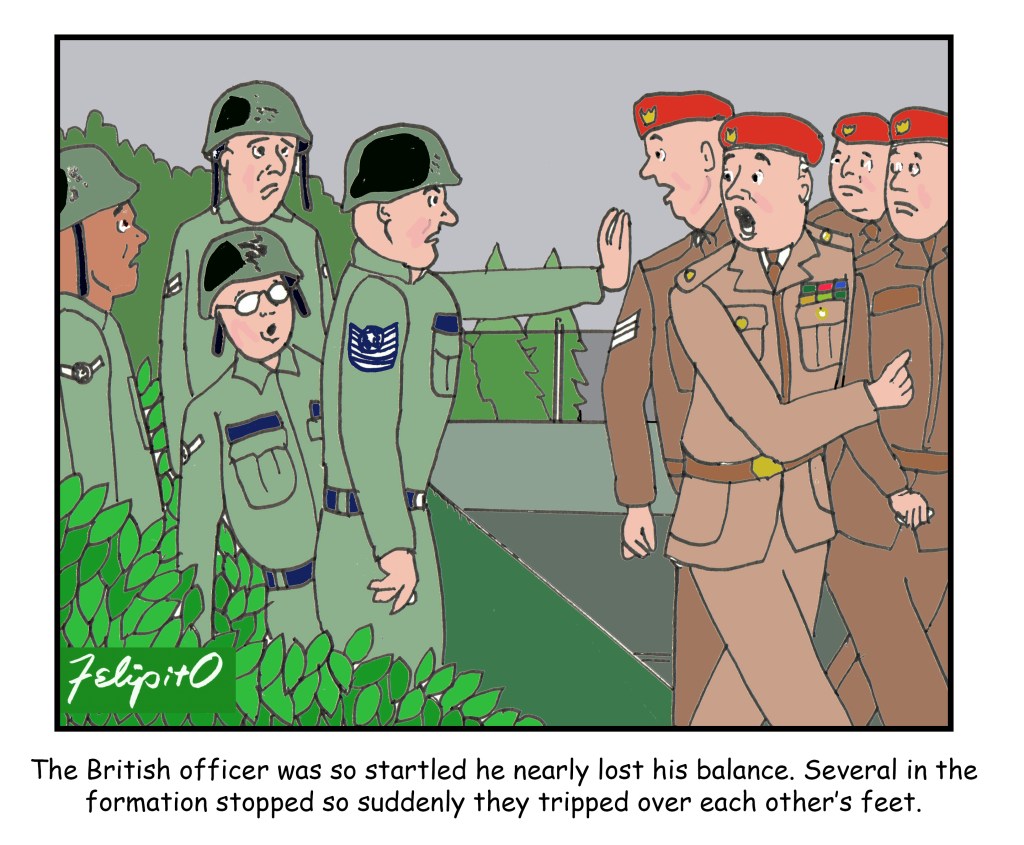
The British officer was so startled he nearly lost his balance. Several in the formation stopped so suddenly they tripped over each other’s feet. The officer stared at our sergeant with his mouth agape as the other marchers regained their balance.
“Erm, halt,” the British officer said finally, but at this point no one was moving. The British officer and the marchers stared dumbfoundedly at the sergeant and the fearsome American warriors behind him.
Our sergeant and the British officer stood silently at first, making wary eye contact. The silence seemed eerie to me. Even the birds were quiet.
Our sergeant spoke first.
“You are trespassing on an American military installation,” said the Claude Akins voice.
The officer’s lips moved silently at first.
“Oh, I do apologize,” he said in what I took to be an aristocratic accent. “Trespassing? Oh, my.”
The officer turned toward a man with three stripes on his sleeve. “How on earth did we get so far afield?” he asked the three-striped man, who flushed an angry red.
“Well, I do beg your pardon,” the officer told the sergeant. “You must excuse us.”
He looked around and shrugged nervously.
“Thank you. We shall be going now.”
But as the officer was speaking an Air Force security police truck with flashing blue lights screeched onto the tarmac, followed by a large blue Air Force bus. A second lieutenant wearing a white covered service cap jumped out of the truck. He was followed by three white-capped security police airmen brandishing M-16 automatic rifles.
The young lieutenant approached the British officer.
“Are you in command?”
The Brit snapped to attention and saluted the callow lieutenant. The lieutenant saluted back.
“You have violated the security of an American Air Force Base and I must ask all of you to come with me.”
“I have already apologized to the sergeant here,” the officer said.
“My commander wants to talk with you,” the lieutenant said. “Please have your men get on the bus and come with me.”
“Oh, I do hope that won’t be necessary…”
“On the bus. Now.” The lieutenant sounded as if his voice had just changed the week before. The other security police airmen raised their M-16’s threateningly.
The British officer turned to his men. “Do as he asks,” he said. The three-striped man looked as if he wanted to throttle the officer, but he led the other Brits onto the bus.
The lieutenant turned to the officer and opened the door of the truck. “In here with me,” he said. The officer shrugged and got in.
The lieutenant walked over to our sergeant, who saluted him sharply. “Well done, Sergeant,” the lieutenant said, returning the salute. Her got into the truck and drove away.
When the truck and bus were out of sight, the sergeant bent at his waste and erupted in laughter.
“That dumb ass must have passed a dozen no trespassing signs to get here,” he said in the voice Claude Akins would use if Claude Akins ever laughed.
Thew sergeant turned to us and assured us we had done a good job using the words he knew we’d appreciate most:
“You people light ‘em up,” he said.
We knew it was okay to laugh, too.
“Don’t worry, Sarge,” said the tall skinny typist. “If they had given us any trouble we’da thrown a Coke can at them.”
It was days before we heard what happened to the Brits after they had been taken away on a bus. There was a rumor they had been involved in some top-secret exercise to test American security. And perhaps that was the case.
But after a while someone said they had overheard the young lieutenant tell the story at the O Club. He said the British officer had gotten drunk in Ipswich the night before the incident and had bet a fellow Sandhurst graduate he could march his company right up to the American tower and the Yanks would never notice.
That seemed to me like strange behavior for Sandhurst graduates.
But if the story was true, I’d say he lost the bet.
And to this day, the only combat training I ever received was cover and concealment, and how to throw a Coke can 50 paces.







 Cakes and Ale