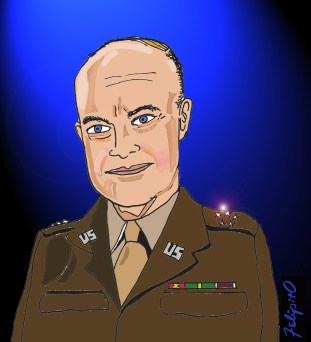
 Friday marks the 75th anniversary of VE Day on May 8, 1945.
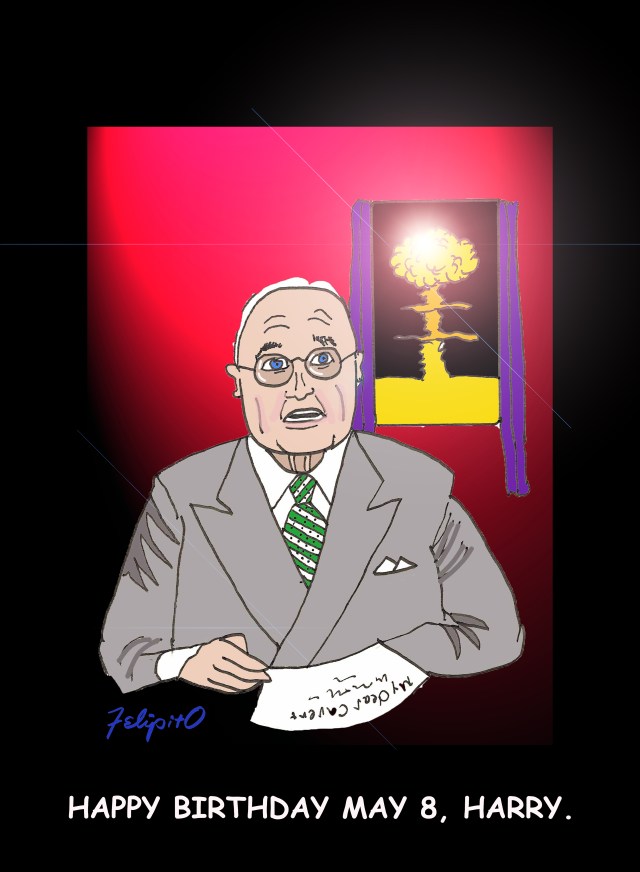
The Second World War was not over then, and thousands of young people on both sides continued to die in vicious battles on the Pacific Rim. It would be three more months before the nuclear bombing of Japan would bring the slaughter to an end.
But Winston Churchill assured his people that they could pause for a few moments of celebration. And in May 2020, it is a good time to pause and think of the millions on both sides who fought and waited and died in this war. Most of them are gone now.
I was born a year after the war ended, a droplet in the tsunami of baby boom births that followed. There will never come a time, in my life, when I will not think of my father, uncles, pastors, teachers, and mentors in the Greatest Generation that endured the Great Depression and the greatest war.
This year also marks the 130th birthday of Dwight D. Eisenhower, one of the iconic figures of my youth.
General Ike was the primary architect of the victory over Nazi Germany that will be celebrated Friday. He was a war hero whose gravitas raised him to political power and he was president of the United States during eight years of my childhood. I have vague memories of his predecessor, Harry Truman (and the affected way television reporter John Cameron Swayze said “PREZ-i-dent TROO-man”) but it’s Ike I most clearly remember.
In November 1952 my family owned a 12-inch Admiral television and my father’s parents were invited to make the 60-mile drive from Oneonta to Morrisville to watch the election returns. Ike was running against the hapless Adlai Stevenson of Illinois and, at 6, I was aware that my parents held Stevenson in quiet contempt. Grandma and Grandpa voted in Oneonta and drove to Morrisville – the last time I remember Grandpa leaving his house – and I remember the excitement of their arrival. I asked whom they had voted for, and I can still hear Grandma’s happy voice: “Eisenhower!”
For the next several years I managed to catch several highlights of Ike’s presidency: his measured comment on the death of Stalin, his refusal to intervene when Britain and Israel attempted unsuccessfully to prevent Egypt from seizing the Suez Canal, his muted comment when the Soviet Union launched the first artificial satellite to orbit the earth, his dramatic decision to sent federal troops to enforce the integration of Little Rock, Ark., public schools. And, of course, his heart attack and stroke, from which he had recovered slowly while the nation held its collective breath.
Everyone liked Ike, at least so far as I knew. I remember being shocked in the sixth grade when one of my classmates raised his hand to complain to the teacher as we read the latest edition of My Weekly Reader, “Gary has drawn a mustache and beard on President Eisenhower.” Miss Johnson gasped and sent Gary to the principal’s office, which I thought was a just punishment.
Gary, as it turned out, was the scion of one of the few Democrat families in Morrisville. His father, a prosperous farmer, later became postmaster in the village when the Democrats returned to office.
I remember December 1960 when Ike pushed the button to light the national Christmas Tree in Washington. That wasn’t particularly impressive on our black and white Admiral (which survived all eight years of Ike’s two terms) but by then I was imagining how great it would be next year when President-elect John F. Kennedy lit the lights.
I was not the only Boomer to succumb to the charisma of JFK and by 1960 I was a confirmed Democrat, albeit too young to register to vote. I believed the rhetoric of the Kennedy campaign that the United States was moribund under Eisenhower, that the country needed to get moving again, that it was time for vigorous, youthful leadership.
But that didn’t stop me from sitting in front of the old Admiral to watch Ike’s farewell address, the one in which he warned against the growing influence of the military industrial complex. I may not have realized, at 16, how discerning he had been.
My man crush on JFK did not dim while he was alive, but now a comparison of the two presidents – the oldest and youngest presidents ever elected at the time – has caused me to change my mind about Ike’s place in the political firmament.
One of the many biographies of Eisenhower, Ike’s Bluff, President Eisenhower’s Secret Battle to Save the World, (Little Brown and Company, 2012) makes a concise case for a reevaluation of Ike.
According to a Good Reads review:
While Eisenhower was quickly viewed by many as a doddering lightweight, behind the bland smile and simple speech was a master tactician. To end the hostilities, Eisenhower would take a colossal risk by bluffing that he might use nuclear weapons against the Communist Chinese, while at the same time restraining his generals and advisors who favored the strikes. Ike’s gamble was of such magnitude that there could be but two outcomes: thousands of lives saved, or millions of lives lost.
As the 75th anniversary of VE Day approaches, it’s appropriate to remember that General Ike was not only the tactician who helped win the war in Europe, he was also the political virtuoso who kept Roosevelt, Churchill, Stalin, Montgomery, and Patton working together to make it happen. Ike’s ability to herd these political cats may be the most remarkable achievement of the war.
Ike’s true stature as a strategist was obvious within weeks after he left office. Looking back on the turbulence of the early 1960s, it seems unlikely he would have approved a CIA scheme to invade Cuba at the Bay of Pigs because his experience would have led him to see it was politically unfeasible and militarily unachievable. Too, although he approved initial U.S. involvement in Vietnam, the erstwhile supreme allied commander was always convinced that a land war in Asia would be a disaster. He wouldn’t have hesitated to pull the plug on sending more troops to Vietnam. Had he been in office from 1961-1965, history would have been radically different. And the military industrial complex wouldn’t have won.
Ike died in Walter Reed Hospital on March 28, 1969, after suffering a series of heart attacks. Despite chronic pain he was kept alive for weeks by medical machinery that was state of the art in 1969. Finally, he begged his doctors to let him go.
Eisenhower was buried in his army uniform bearing the five stars of a general of the army. Toward the end he had lost so much weight that the uniform seemed immense on him.
I think he never doubted that his place in history was secure.
And I came to realize decades ago that his greatness as a president far surpassed the callow judgments of many of his contemporaries, including mine.




 Cakes and Ale